
Cloud Service Providers (CSPs) must keep up with FedRAMP ConMon deliverables to keep their federal authorization active. The Federal Risk and Authorization Management Program created this ongoing assessment framework to help CSPs maintain their security authorization. You need to implement continuous monitoring as it’s a crucial FedRAMP requirement to get and keep your authorization.
The continuous monitoring process, known as ConMon, plays a key role in FedRAMP compliance. The National Institute of Standards and Technology (NIST) special publication 800-137 serves as its foundation. FedRAMP puts CSPs into three security levels—Low, Moderate, and High. Most applications, about 80%, get authorized at the moderate level. Your Annual Assessment costs will be about 80% of your original Assessment. The way you plan and execute your ConMon strategy can substantially affect your compliance costs.
This piece breaks down the six key criteria of the ConMon process. You’ll learn about the required deliverables and get applicable information to stay compliant. The content helps both new applicants and those who want to improve their existing monitoring program. You’ll know what evidence to collect, when to submit it, and how to keep your cloud service FedRAMP-compliant.
Setting Up a FedRAMP-Compliant Continuous Monitoring Program
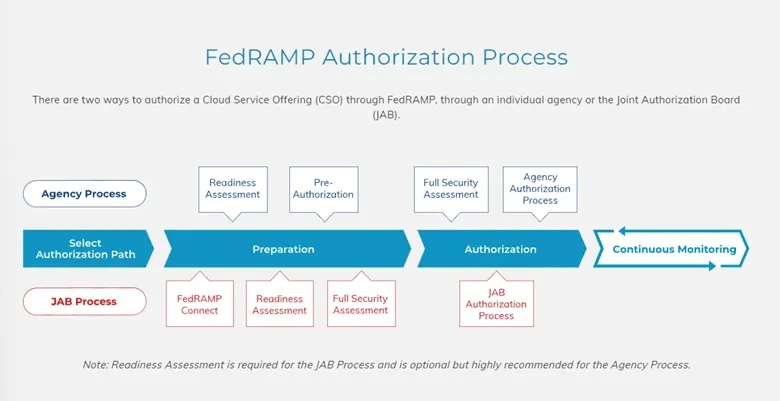
Image Source: AuditBoard
“FedRAMP continuous monitoring (ConMon) is extremely prescriptive as to what is required for the ongoing assessment of security controls.” — FedRAMP Program Management Office, Federal Risk and Authorization Management Program – U.S. Government cloud security authorization program
A well-designed continuous monitoring program is the foundation of long-term FedRAMP compliance. This approach will give a secure cloud service throughout its operational lifecycle.
Defining your ConMon strategy and scope
The first step to build a FedRAMP-compliant continuous monitoring program needs a clear strategy. Information Security Continuous Monitoring (ISCM) helps maintain awareness of security posture, vulnerabilities, and threats that support organizational risk management decisions. Your ISCM strategy should adapt based on risk-based decision making and requirements from any tier in your organization.
The planning phase should identify all deliverables needed for monthly submissions and annual assessments. This becomes crucial as FedRAMP requirements keep evolving. Your strategy should include both the core FedRAMP monthly and annual deliverables along with agency-specific requirements.
Your ConMon program’s scope must cover all assessment boundaries. FedRAMP has predefined Core Controls that need annual assessment as part of the continuous monitoring process. You must also pick additional controls—typically all but one of these controls from your baseline—to make sure everything gets reviewed within the three-year authorization cycle.
Aligning with NIST SP 800-137 and FedRAMP guidelines
FedRAMP ConMon builds on the continuous monitoring process from NIST SP 800-137. NIST implementation follows six key steps: Define the ISCM strategy; Establish an ISCM program; Implement the ISCM program; Analyze and Report findings; Respond to findings; and Review and Update ISCM strategy and program.
This alignment’s main goal provides: (i) operational visibility; (ii) managed change control; and (iii) attendance to incident response duties. Regular reporting and remediation create operational visibility to keep risk levels below what was reported in the original Authorization to Operate (ATO).
Cloud services with multiple agency customers must implement a Collaborative ConMon approach under security control CA-7. This collaborative model helps both agencies and CSPs by creating a central forum to address questions and reach consensus on deviation requests, significant change requests, and annual assessments.
Establishing monitoring frequencies and thresholds
A resilient ConMon program needs clear monitoring frequencies and thresholds. FedRAMP lists specific control frequencies in Column J of the FedRAMP Security Controls Baseline workbook. The standard monitoring schedule includes:
- Monthly activities: Complete vulnerability scans of operating systems, web applications, and databases, with 100% of inventory components scanned. This includes submitting updated POA&Ms, inventory reports, vulnerability scan results, and patch reports.
- Annual activities: Third-party assessment organization (3PAO) testing of the predefined Core Controls plus your selected subset of controls.
- Remediation timeframes: FedRAMP has strict remediation requirements—30 days for high findings, 90 days for moderate findings, and 180 days for low findings. Missing these thresholds might lead to escalation up to ATO revocation.
The ConMon lifecycle requires documentation, verification, and impact confirmation of all changes through your change control process. This ongoing assessment keeps your cloud service’s security posture at FedRAMP standards even after getting an ATO.
Monthly and Annual ConMon Deliverables Explained
“During the review, the CSP must submit monthly ConMon deliverables (scan files, POA&M, and up-to-date inventory) which adhere to FedRAMP requirements for Continuous Monitoring and vulnerability scanning.” — FedRAMP Program Management Office, Federal Risk and Authorization Management Program – U.S. Government cloud security authorization program
The life-blood of FedRAMP compliance depends on submitting evidence that your cloud service meets federal security standards. CSPs must stick to structured reporting schedules after authorization to keep their ATO.
Monthly vulnerability scans and patch reports
Security monitoring is the life-blood of effective continuous monitoring. CSPs must run detailed monthly scans of their entire system inventory for all FedRAMP-authorized cloud services. These scans must cover operating systems, web applications, and databases within the authorization boundary.
CSPs must perform authenticated scans with full system authorization wherever possible for Moderate and High impact systems. All vulnerability scanners must check their vulnerability database for automatic signature updates at least monthly to detect the latest threats.
Monthly scan reports show ongoing compliance and have:
- Summaries of newly identified system vulnerabilities
- Documentation of applied patches and remediation efforts
- Evidence of scanner signature updates
- Configuration management reports documenting system changes
CSPs should check internet-reachable resources more often – at least every three days for both authenticated and unauthenticated assessments. Non-internet-reachable resources need weekly checks at minimum.
Annual 3PAO control subset testing
FedRAMP requires annual assessments by an accredited 3PAO beyond monthly activities. These assessments review a predefined set of core controls (129 controls) plus additional controls. This approach will give a full review of all controls at least once every three years.
The annual assessment process has several key parts:
- Assessment planning and scope definition using the FedRAMP Annual Assessment Control Selection Worksheet
- Security testing performed by the 3PAO following FedRAMP test cases
- Validation of POA&M items closed since the previous assessment
- Confirmation of any deviation requests (False Positives, Risk Adjustments, Operational Requirements)
- Security Assessment Report (SAR) documenting all findings
CSPs must provide fresh evidence each year since reusing evidence from previous assessments isn’t allowed.
POA&M lifecycle and update cadence
The Plan of Action and Milestones (POA&M) helps track remediation activities. CSPs must track each unique vulnerability as an individual POA&M item based on the scanning tool’s reference identifier. FedRAMP updated the POA&M template in 2022 to add two columns that track CISA Binding Operational Directive 22-01 findings and associated CVEs.
FedRAMP sets strict remediation timeframes based on risk severity:
- Critical/High: 30 days
- Moderate: 90 days
- Low: 180 days
CSPs can submit deviation requests for vulnerabilities that can’t be fixed within standard timeframes. These include Risk Adjustments (RA) when mitigating factors reduce exploitation likelihood or impact, False Positives (FP) when vulnerabilities don’t exist, and Operational Requirements (OR) when fixes would affect system functionality.
Vendor Dependencies (VD) happen when CSPs depend on downstream vendors to fix vulnerabilities. High-risk VDs need to be reduced to Moderate within 30 days, and CSPs must verify vendor status monthly. Any vulnerability not fixed within 192 days becomes an “accepted vulnerability”.
Security Tools and Technologies Supporting ConMon
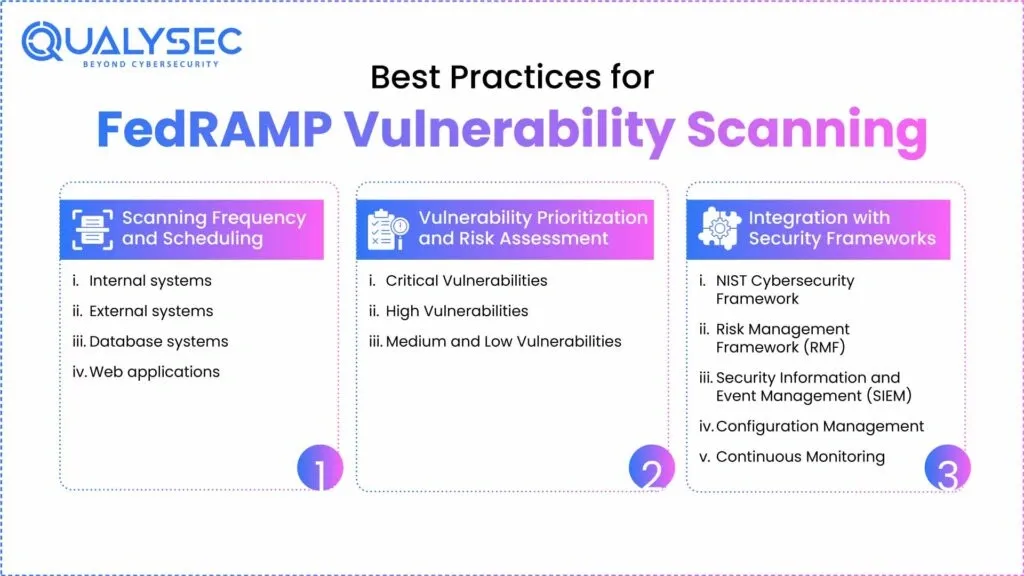
Image Source: Qualysec
Tools and technologies are the life-blood of any successful FedRAMP continuous monitoring program. Documentation and processes matter, but security technologies must be configured properly to collect evidence consistently and identify security issues quickly.
SIEM integration for up-to-the-minute data analysis
Security Information and Event Management (SIEM) systems are vital to FedRAMP compliance. They provide centralized, tamper-resistant logging of events, activities, and changes. Security teams can detect and respond to threats early because these systems automate log analysis, flag anomalies, and connect events across systems. SIEM solutions must continuously review and audit logs in FedRAMP-authorized environments. Standard retention practices include 30-day hot storage and 12-month cold storage.
Automated configuration management tools
Automated configuration management tools help maintain security baselines in your cloud environment. Cloud systems change constantly, so configuration management and change control processes protect security integrity. Cloud Service Providers (CSPs) must assess security impacts to verify potential vulnerabilities before making changes. These tools save time, improve visibility, and reduce the impact of new requirements on existing processes. The best tools enforce secure configurations that match NIST 800-53 standards and fix deviations automatically.
Vulnerability scanning platforms and update policies
Vulnerability scanning is the foundation of continuous monitoring. FedRAMP compliance requires scanners with specific capabilities. Moderate and High impact systems need authenticated scanning with full system authorization. Scanners must produce machine-readable output (XML, CSV, or JSON) and check signature updates monthly. Security measures protect scanners from unauthorized use or modification. They must maintain assessor-validated configuration settings. Risk scoring uses CVSSv3 base scores from the National Vulnerability Database when available. CSPs must scan operating systems, web applications, and databases monthly. This scanning covers all inventory components.
These integrated tools create the technical foundation to generate required ConMon deliverables. Your cloud service stays secure throughout its authorization lifecycle.
Handling Incidents and Change Requests in ConMon
Quick incident response and change management play vital roles in FedRAMP continuous monitoring requirements. Cloud Service Providers must show they know how to handle security incidents and make changes while staying compliant.
Incident response plan requirements (IR-8c)
The FedRAMP security control baseline requires CSPs to develop and maintain a complete Incident Response Plan (IRP) throughout their authorization lifecycle. In fact, IR-8 specifies that CSPs must create and maintain a plan that has:
- A roadmap to implement incident response capabilities
- Clear structure and organization of incident response teams
- Definition of reportable incidents
- Metrics to measure incident response effectiveness
- Resource requirements and management support
- Information sharing protocols
CSPs must update their IRP when system and organizational changes occur or when they face problems during implementation, execution, or testing. This living document needs protection from unauthorized disclosure and modification while remaining available to designated response personnel.
Reporting zero-day vulnerabilities and critical risks
CSPs must report all incidents—suspected or confirmed—that could lead to or have caused loss of confidentiality, integrity, or availability of cloud services. Notwithstanding that, strict reporting timelines apply: CSPs must alert stakeholders within one hour after the CSIRT, SOC, or IT department identifies an incident. They must notify:
- Impacted customers
- Cybersecurity and Infrastructure Security Agency (CISA)
- FedRAMP at [email protected]
- Agency POCs including AOs and Agency Incident Response Teams
CSPs must provide daily updates until recovery finishes, then submit a final report that details the occurrence, root cause, response actions, and lessons learned. Federal regulators might reduce remediation timelines for critical vulnerabilities from 30 days to just three days.
Submitting and tracking SCRs with FedRAMP PMO
The FedRAMP PMO sets specific procedures to handle change requests and incident information. Escalation paths exist for unresolved vulnerabilities, and the FedRAMP Marketplace may flag concerns not addressed quickly enough to potential agency customers. These actions may trigger when requirements aren’t met:
- A Corrective Action Plan (CAP) results from late incident notifications that don’t follow FedRAMP procedures
- Late responses to CISA Emergency Directives within required timeframes lead to a CAP
- A Detailed Finding Review (DFR) triggers after four or more incidents within six months
CSPs should see these requirements as helpful rather than burdensome. Strong incident response and change management processes help protect federal data and maintain authorization status.
Documentation, Reporting, and FedRAMP Compliance Checklist
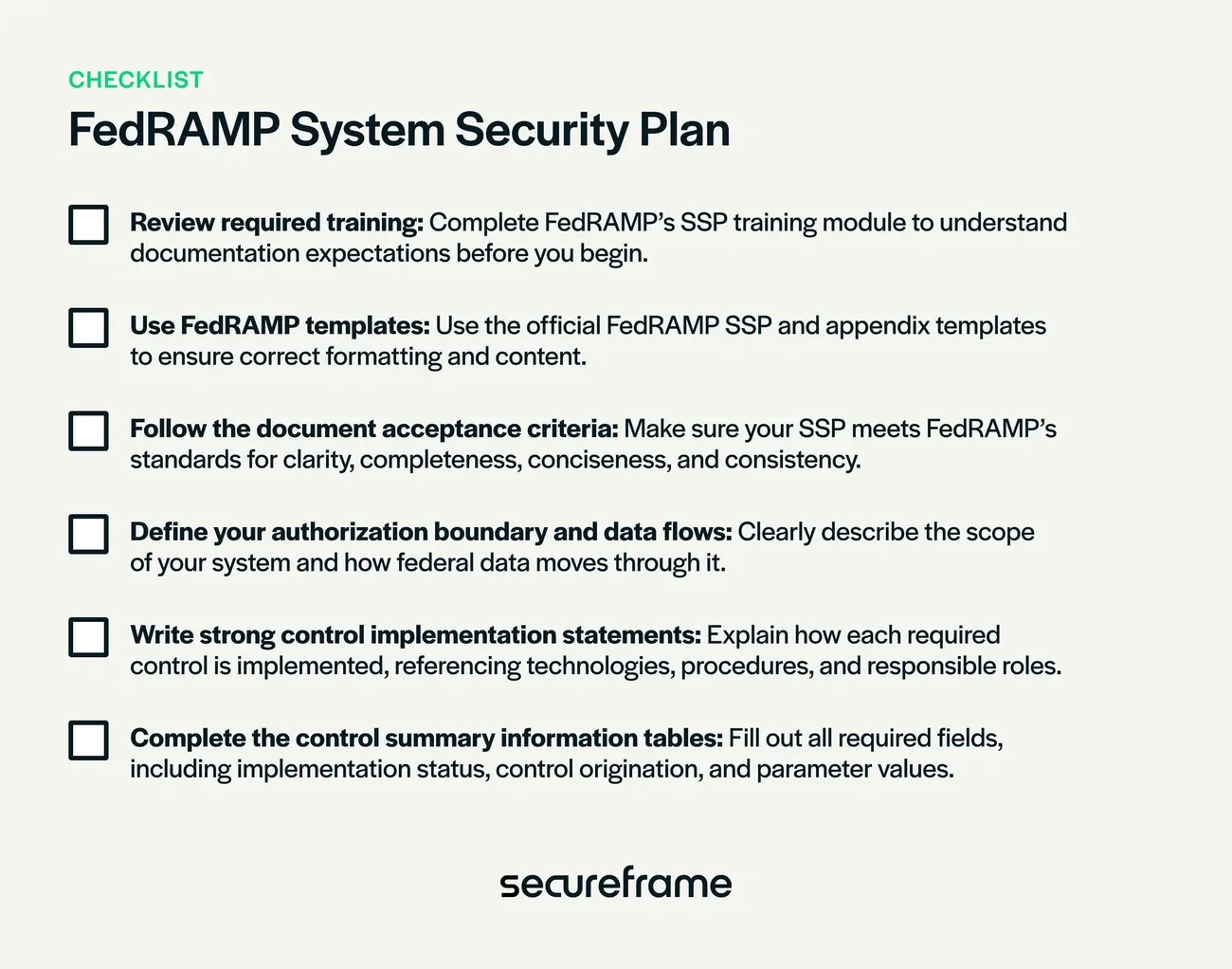
Image Source: Secureframe
Success in FedRAMP continuous monitoring depends on proper documentation. Your cloud service’s lifecycle needs smooth authorization maintenance, which comes from well-organized evidence.
Maintaining audit-ready documentation
Being “audit-ready” means keeping controls, logs, and compliance evidence accurate and organized. Controls without proper documentation do not exist from FedRAMP’s point of view. CSPs must keep detailed documentation that shows they follow continuous monitoring requirements. All FedRAMP-related materials need version control and document history tracking. Security controls must have immutable audit logs available at the time they’re needed to prove they work as intended.
Using the FedRAMP ConMon deliverables template
FedRAMP offers official templates that standardize its coverage:
- Continuous Monitoring Monthly Executive Summary Template – Provides an overview of monthly submissions
- FedRAMP Continuous Monitoring Deliverables Template – Identifies schedules and locations for monthly/annual deliverables
- Plan of Action and Milestones (POA&M) Template – Tracks vulnerabilities and remediation plans
Checklist for monthly and annual evidence submission
Regular submissions must include:
- Monthly: Upload vulnerability scans, updated POA&M, inventory, and deviation requests on the same day each month
- Check POA&M records for accuracy before submission
- Keep deliverables in a secure repository on USDA Connect.gov or your secure system
- Update documentation yearly or after most important changes
Conclusion
FedRAMP Continuous Monitoring gives Cloud Service Providers Cloud Service Providers both a vital responsibility and a chance to be strategic. We got into the detailed requirements that are the foundations of an effective ConMon program. Your security posture grows stronger and authorization status stays intact when you maintain proper documentation, conduct regular vulnerability scanning, and follow strict remediation timelines.
A clear roadmap for compliance emerges from the structured approach above—from monthly vulnerability assessments to annual 3PAO testing. CSPs with reliable monitoring processes face fewer unexpected issues during annual assessments and reduce compliance costs over time. Note that ConMon expenses make up about 80% of your total FedRAMP compliance budget, which makes proper execution crucial.
Companies starting their FedRAMP experience need expert help to direct them through these complex requirements. We suggest you Book a Readiness Call with our experienced compliance specialists who can assess your current posture and create a tailored ConMon strategy.
This systematic security monitoring approach offers real business advantages beyond compliance. Federal customers trust your security practices more, while your security team’s threat detection and response capabilities improve. FedRAMP’s required documentation practices create operational clarity that helps your entire organization.
ConMon success needs attention to detail, consistent execution, and dedication to improvement. CSPs that become skilled at these elements keep their FedRAMP authorization and establish themselves as trusted partners for federal agencies looking for secure cloud solutions.
Key Takeaways
Understanding FedRAMP ConMon requirements is crucial for maintaining federal cloud authorization and avoiding costly compliance failures.
• Monthly deliverables are non-negotiable: Submit vulnerability scans, POA&M updates, and inventory reports monthly with 100% system coverage to maintain authorization.
• Remediation timelines are strict: Address critical/high vulnerabilities within 30 days, moderate within 90 days, or risk escalation up to ATO revocation.
• Annual assessments require fresh evidence: 3PAO testing covers core controls plus additional subsets—reusing previous evidence isn’t permitted.
• Incident reporting must be immediate: Notify all stakeholders within one hour of security incident identification, with daily updates until resolution.
• Documentation equals compliance: Controls without proper documentation are considered non-existent by FedRAMP—maintain audit-ready evidence consistently.
The ConMon process typically costs 80% of your initial assessment budget, making proper execution essential for long-term compliance success. CSPs that implement robust monitoring processes experience fewer surprises during annual assessments and build stronger relationships with federal customers through demonstrated security commitment.
FAQs
Q1. What are the key components of a FedRAMP Continuous Monitoring (ConMon) program? A FedRAMP ConMon program includes monthly vulnerability scans, patch reports, and POA&M updates, as well as annual third-party assessments of security controls. It also involves maintaining audit-ready documentation and adhering to strict incident reporting and remediation timelines.
Q2. How often should vulnerability scans be conducted for FedRAMP compliance? For FedRAMP compliance, CSPs must conduct comprehensive monthly scans across their entire system inventory, including operating systems, web applications, and databases. Additionally, internet-reachable resources should be scanned at least every three days.
Q3. What are the remediation timeframes for vulnerabilities in FedRAMP? FedRAMP establishes specific remediation timeframes based on risk severity: 30 days for critical/high vulnerabilities, 90 days for moderate vulnerabilities, and 180 days for low vulnerabilities.
Q4. How should incidents be reported in a FedRAMP-compliant environment? Incidents must be reported to all stakeholders, including impacted customers, CISA, FedRAMP, and relevant agency POCs, within one hour of identification. Daily updates are required until recovery is complete, followed by a final report detailing the incident, response actions, and lessons learned.
Q5. What documentation is essential for FedRAMP Continuous Monitoring? Essential documentation includes the Continuous Monitoring Monthly Executive Summary, FedRAMP Continuous Monitoring Deliverables Template, and the Plan of Action and Milestones (POA&M) Template. All documentation should be version-controlled, regularly updated, and maintained in a secure repository.