
Getting ready for an ISO 27001 audit might feel daunting at first. The good news is that thousands of organizations complete this process successfully each year. The ISO certification market shows promising growth with an expected CAGR of 8.3%, reaching $34.5 billion by 2028. This globally recognized security standard has become crucial in today’s business landscape.
Major tech players like Apple, Google, Amazon, and Intel have all earned their ISO 27001 certification. These companies clearly see its value in today’s security-focused marketplace. Organizations need a clear audit readiness checklist to speed up their certification process, especially since ISO 27001:2022 is now active with a transition deadline of October 31, 2025. A well-laid-out security audit plays a vital role in cutting risks and staying accountable to regulators, partners, and clients.
This piece lays out ISO 27001 audit preparation steps to get your organization ready in just 60 days. You’ll be all set for both Stage 1 documentation reviews and Stage 2 effectiveness evaluations after implementing this blueprint. The certification stays valid for three years, and you’ll learn how to maintain it through required annual surveillance audits.
Day 1–5: Define Scope and Assign Ownership
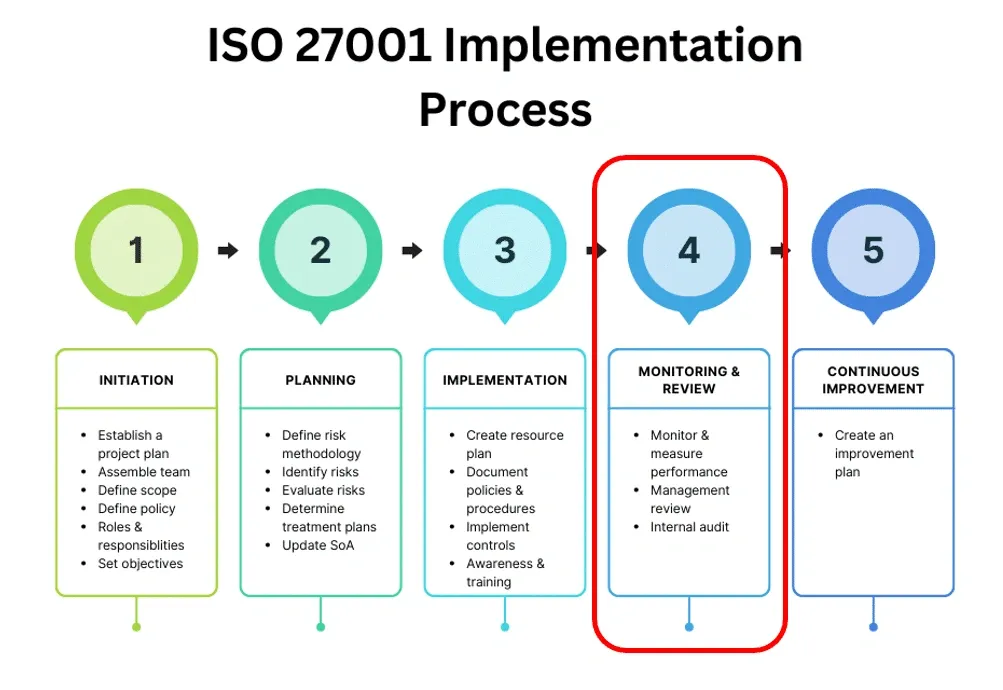
Image Source: Iseo Blue
A successful ISO 27001 audit starts with a clear definition of your organizational boundaries and leadership roles. You should spend the first five days of your 60-day preparation timeline to set these building blocks and put your implementation on the right track.
Appointing an ISO 27001 Project Lead
Your first step is to choose a dedicated project manager who will serve as your ISO 27001 Lead Implementor. This person needs specialized knowledge and skills to manage information security management systems (ISMS). Their expertise will help you navigate through the complexities of the iso 27001 audit process.
The project lead makes sure everyone follows ISO 27001 standards closely. This reduces the risk of non-compliance that could happen from oversight or split focus. The approach matches perfectly with Clause 5.3’s emphasis on clear organizational roles and responsibilities. The lead should:
- Take charge of developing, implementing, and maintaining the ISMS
- Build strong relationships with stakeholders to get resources
- Put standards into practical, enforceable security controls
- Build a clear audit readiness checklist for implementation
Defining ISMS Scope and Boundaries
The ISMS scope stands as one of your most important decisions during iso 27001 audit preparation. Your scope tells everyone which information you plan to protect, no matter where it sits or how people access it.
Your scope document should look at:
- How internal and external processes depend on each other
- Where everything is located and how teams are organized
- What information assets need protection
- How third-party relationships affect information security
ISO 27001 needs a documented ISMS scope statement. This short, simple document shows your ISMS boundaries clearly. Auditors will only look at what’s inside your defined scope during certification. A software company might write something like: “The ISMS covers all business processes related to software development and customer support activities performed at our headquarters”.
Identifying Stakeholders and Business Context
Your organization’s context serves as the foundation of your ISMS, as ISO 27001 clause 4.1 points out. You need to spot both internal and external issues that matter to information security.
Internal issues include how your organization is structured, what drives it (values, mission, vision), its processes, available resources, and contracts. External issues cover market trends, what others think of you, laws you must follow, political situations, and new technology.
You also need to identify stakeholders who can affect your ISMS or be affected by it. These usually include:
- Top management and employees
- Customers and suppliers
- Regulators and government entities
Good stakeholder engagement helps build trust, meet regulations, and find potential problems early. Regular talks with these groups during your iso 27001 audit process will help make sure your security policies and controls match real-life expectations and needs.
Day 6–10: Conduct a Gap Analysis and Readiness Assessment
Your next significant phase in the iso 27001 audit trip starts after setting up your ISMS scope and leadership structure. You need a full picture of your current security posture. The focus during days 6-10 should be on finding gaps between your existing practices and ISO 27001 requirements to build your implementation plan.
Using an ISO 27001 Self-Assessment Checklist
A well-laid-out self-assessment shows how ready your organization is for certification. A complete checklist helps pinpoint where your information security management system stands compared to the standard, eliminating random guesswork.
The best ISO 27001 self-assessment tools look at five key areas:
- Context of the organization
- Leadership and commitment
- Planning for risks and opportunities
- Support resources and documentation
- Operational controls and processes
Self-assessment questionnaires usually have 19-20 questions that take about 20 minutes to complete. These questions get into areas such as:
“Have you determined the external and internal issues that are relevant to your organization’s purpose that affects your knowing how to achieve the intended results of your Information Security Management System?”
“Has the information security risk assessment process been defined and developed to be repeatable and ensure consistent, valid and comparable results?”
The readiness score you receive helps determine how much support you’ll need to achieve certification. You should Book a Readiness Call with a certification body if your score shows major gaps that need expert guidance.
Mapping Current Controls to Annex A
Your gap analysis centers on comparing your existing security practices with ISO 27001’s Annex A controls. The control mapping process remains vital even though the 2022 version removed the “A.” prefix.
Start by gathering evidence of your current security controls—audit logs, incident management tickets, training records, and vendor contracts. Then review each control’s implementation status:
- Fully implemented
- Partially implemented
- Not implemented
- Not applicable
The updated ISO 27001:2022 standard groups controls into four themes: Organizational, People, Physical, and Technological. Your analysis should line up with this structure as you review each control’s effectiveness.
Identifying Documentation and Process Gaps
Review your documentation against ISO 27001 requirements after mapping controls. This policy review confirms whether you have all required compliance documents.
Key documentation to review includes:
- Information security policy
- Risk assessment methodology
- Risk treatment plan
- Incident response procedures
- Access control policies
Check if each document is current, version-controlled, and has management approval. Look for inconsistent or outdated policies that need updates.
Your final gap analysis report should show:
- Your ISMS scope and how it connects to business objectives
- Your current information security state
- Specific gaps between your practices and ISO 27001 requirements
- A priority-based implementation plan with effort estimates
This assessment creates a clear roadmap for the next phase of your iso 27001 audit process. You can focus your resources on fixing the biggest security gaps first.
Day 11–20: Build Core ISMS Documentation
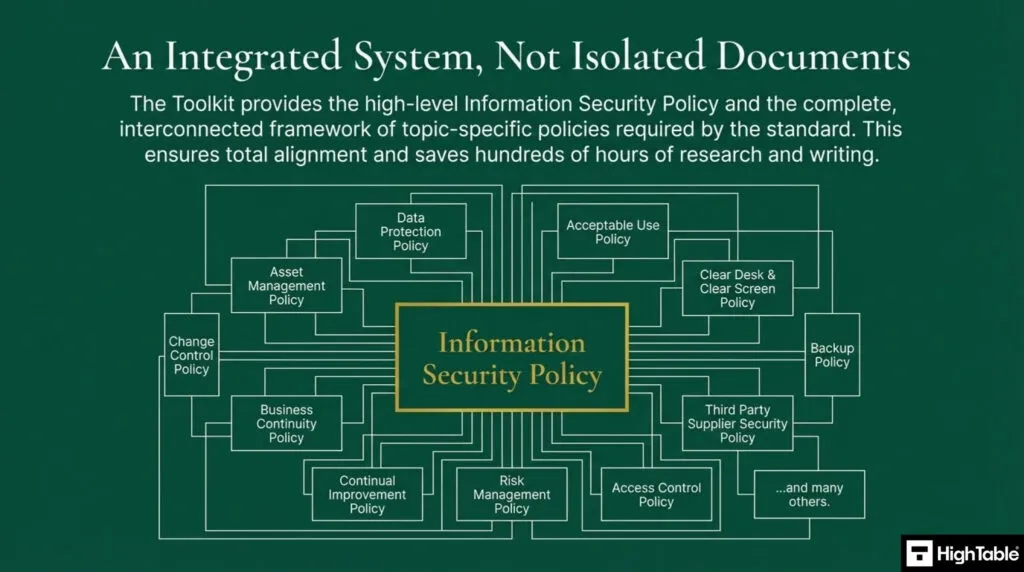
Image Source: High Table ISO 27001 Toolkit
“The risk assessment and Statement of Applicability (SoA) are the most critical deliverables.” — Glocert International, ISO 27001 Implementation Roadmap Provider
Building reliable documentation is the life-blood of your iso 27001 audit preparation. Your scope definition and gap identification should lead to creating core documentation that auditors will inspect first during days 11-20.
Creating the Information Security Policy
The Information Security Policy is the life-blood of your ISMS and provides a complete overview of your organization’s approach to information security. This high-level document needs three significant elements:
- Confidentiality: Methods to protect sensitive information through access controls
- Integrity: Procedures that keep information accurate and unaltered
- Availability: Measures that keep systems operational when needed
This policy shows management’s steadfast dedication to information security. ISO 27001 Clause 5.2 requires top management to establish policies that fit your organization’s needs, reach employees and stakeholders effectively, and get regular reviews.
Start by drafting a document that has purpose, scope, information security principles, objectives, roles and responsibilities, legal requirements, and review procedures. The policy should be non-technical so employees can understand it, whatever their technical expertise.
Drafting the Risk Management Procedure
The 2022 revision of ISO 27001 does not require a specific methodology for risk identification. Organizations therefore have flexibility in their approach. Your risk management procedure must show the entire risk assessment process that clause 6.1.2 requires.
The procedure needs to outline:
- Risk identification methods (assets-threats-vulnerabilities method is accessible to more people)
- Risk assessment criteria (likelihood and effect)
- Risk ownership assignment
- Treatment options (accept, avoid, transfer, alleviate)
The people responsible for activities should make risk decisions. They know the assets, processes, and environment better than a central coordinator.
Developing the Statement of Applicability (SoA)
Auditors will inspect the SoA closely during your iso 27001 audit process. This mandatory document, outlined in clause 6.1.3, shows which Annex A controls you’ve implemented and why.
Your SoA must have:
- All 93 controls (in ISO 27001:2022) listed systematically
- Clear indication of applicable or non-applicable controls
- Justification for including or excluding each control
- Implementation status of each control
The SoA ended up revealing your organization’s security profile and guides the certification auditor. Senior management must approve this document to show leadership commitment.
Version Control and Review Cycles
Document control is vital to your audit readiness checklist. ISO 27001 clause 7.5.3 requires controlling documented information through:
- Unique identification (document ID and version numbers)
- Appropriate formatting (headers, footers, revision tables)
- Access control based on roles
- Regular reviews (at least annual)
- Clear approval workflows
Each document should have a version control table that shows date, author, changes made, and version number. This creates a clear audit trail that shows how documents evolve.
Electronic document management systems work better than manual methods. They track versions automatically and ensure everyone sees the current version. This stops outdated documents from circulating – a common audit finding.
Core documentation needs formal review yearly or when major organizational changes happen. This helps maintain ISO 27001 certification through ongoing surveillance audits.
Day 21–30: Perform Risk Assessment and Treatment Planning
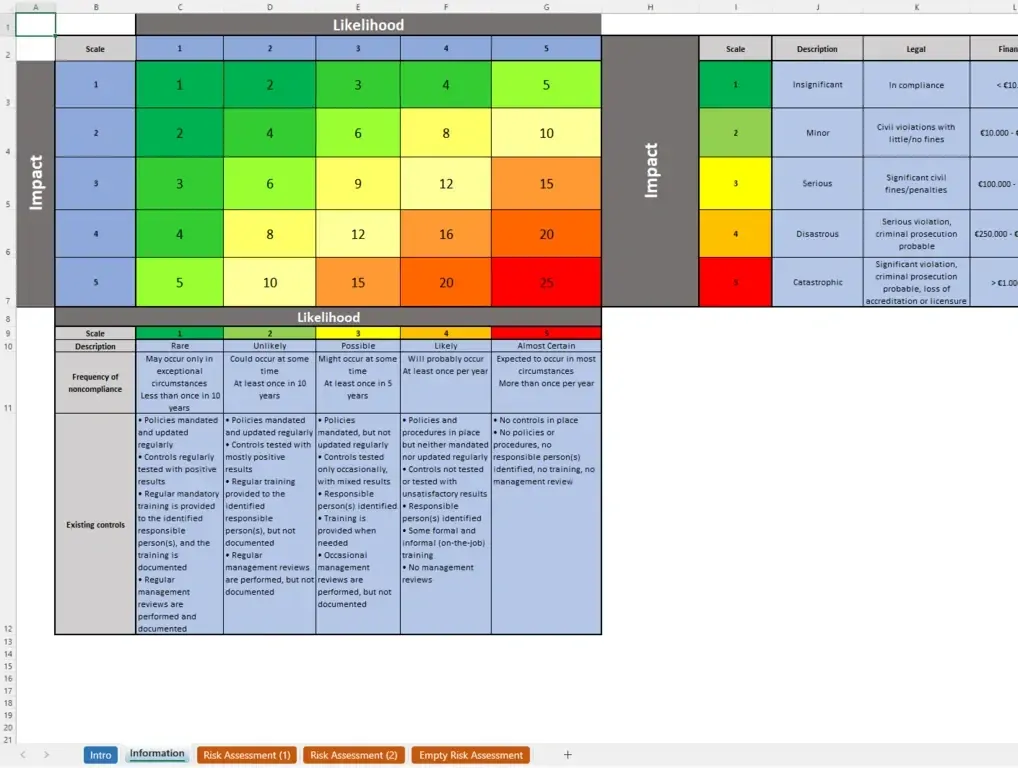
Image Source: Cyberzoni.com
Risk assessment serves as the foundation of your iso 27001 audit preparation. You should be ready to shift from theoretical documentation to practical risk identification and treatment planning during days 21-30. Auditors examine these elements most carefully.
Asset Identification and Classification
A solid risk assessment starts when you identify what needs protection. The ISO 27001 context defines assets as anything valuable to your organization. Your first step is to create complete inventories of:
- Information assets (databases, intellectual property)
- Tangible assets (hardware, infrastructure)
- Intangible assets (brand reputation, employee knowledge)
- People assets (employees, contractors, freelancers)
After identification, you need to classify these assets based on security needs that factor in confidentiality, integrity, availability, and stakeholder requirements. The most successful implementations use a simple three-tier classification: Public, Internal, and Confidential. This approach will give a balanced protection level based on risk and help focus your security budget where it matters.
Threat and Vulnerability Analysis
Once you have your asset inventory, you need to spot potential threats and vulnerabilities for each asset. Take into account both internal threats like employee errors and system failures, as well as external ones such as cyberattacks and natural disasters. You should document your chosen methodology to make it repeatable and get consistent results.
The main goal here is to uncover all possible scenarios where security might be at risk. This methodical approach helps you avoid the common mistake of fixing only obvious risks while missing subtle vulnerabilities.
Risk Scoring and Prioritization
The next step involves reviewing each identified risk through a structured scoring system. ISO 27001 lets you choose between qualitative or quantitative evaluation methods.
Most organizations use risk matrices with scales for qualitative approaches. These typically range from Low-Medium-High or 1-5 to score both likelihood and impact. Quantitative methods focus on calculating potential financial losses and probability distributions.
Your risk assessment documentation should clearly explain your chosen method. This helps ensure you get comparable results across departments. The end result should be a prioritized risk register that directs resources to the most important threats.
Defining Risk Treatment Options
The final phase involves creating your risk treatment plan that outlines how you’ll handle each identified risk. ISO 27001 gives you four treatment options:
Mitigation: Implement controls to reduce risk likelihood or impact Acceptance: Acknowledge and monitor risks deemed acceptable Avoidance: Eliminate the risk source entirely Transfer: Share risk through insurance or outsourcing
Your risk treatment plan needs a clear owner for each risk, specific actions, target completion dates, and selected controls from ISO 27001 Annex A. This document becomes your roadmap for control implementation in the next phase of your iso 27001 audit process.
Note that risk assessment isn’t a one-time task—you need to review it at least yearly to keep your certification. A well-laid-out, repeatable process now will make future audit readiness much easier.
Day 31–45: Implement Controls and Train Teams
Your iso 27001 audit implementation phase starts after completing planning and documentation. Days 31-45 mark a significant milestone. Your team will now turn theoretical controls into actual security measures.
Rolling Out Annex A Controls by Domain
The latest ISO 27001:2022 standard groups controls into four key domains that need systematic implementation:
- Organizational controls (37 measures): These are the foundations of company-wide processes covering policies, asset management, access control, and supplier relationships
- People controls (8 measures): These include human-focused protections like screening, training, and remote work policies
- Physical controls (14 measures): These establish safeguards for facilities, equipment, and storage media
- Technological controls (34 measures): These cover technical measures across network security, encryption, and monitoring systems
Your risk treatment plan should guide control prioritization. Organizations don’t need to implement all 93 controls. Start with controls that address your highest-priority risks.
Conducting Security Awareness Training
Security awareness training goes beyond mere compliance. It serves as your primary defense against threats. ISO 27001 clause 7.2.2 requires appropriate awareness education for all employees and relevant contractors.
A successful awareness program needs to be:
- Well-planned based on employee roles
- Delivered monthly at minimum
- Current with evolving threats
The training process should build a genuine security culture. Your employees become active defenders instead of potential vulnerabilities. This fundamental change turns your workforce into a valuable security asset.
Documenting Control Implementation Evidence
Evidence collection must happen alongside implementation. This step is vital to pass your iso 27001 audit. Each implemented control needs documentation that proves its existence and effectiveness.
Technical controls require screenshots, configuration files, or system logs. Process-based controls need training records, meeting minutes, or approval workflows. These documents are the foundations of your audit readiness checklist.
Auditors look at both documentation and real-life effectiveness. Keep your Statement of Applicability updated to show each control’s current status.
Day 46–55: Run Internal Audit and Management Review
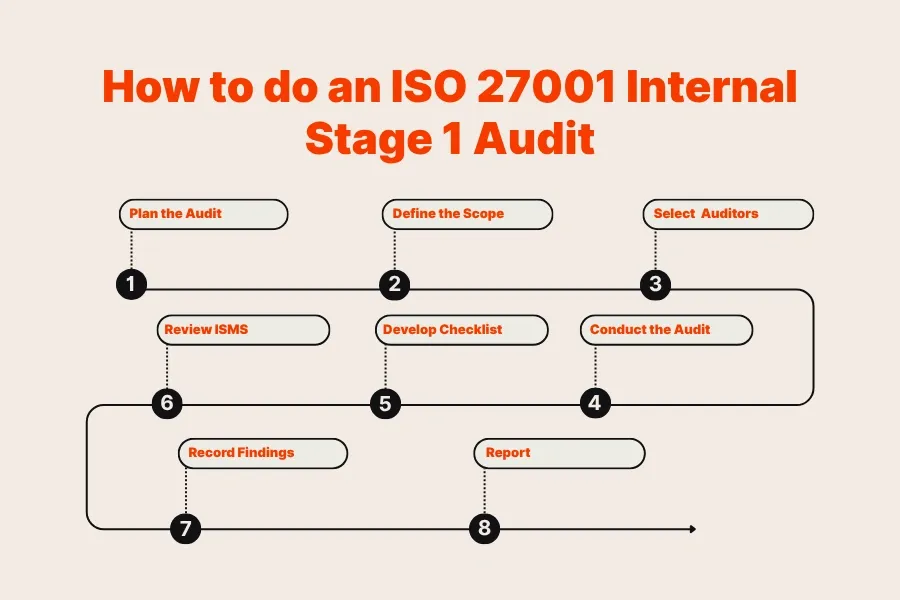
Image Source: YOUR ISO
“Internal audit and management review must be completed before the certification audit.” — Glocert International, ISO 27001 Implementation Roadmap Provider
Your ISMS implementation needs a full check to make sure you’re ready for your external iso 27001 audit. Days 46-55 will help you focus on two key ways to assess: internal audits and management reviews.
Conducting an ISO 19011-Compliant Internal Audit
Internal audits work like a health check for your ISMS. They give you an objective look at how well you meet both your organization’s needs and ISO 27001 standards. Your team needs independent auditors who know your organization and industry well.
Your internal audit should get into:
- Compliance with clauses 4-10 of ISO 27001
- Implementation status of security controls
- How well risk treatment measures work
- Whether documentation matches actual practices
The audit program needs clear structure, responsibilities, and methods with proper scope and timing. Certification bodies usually want at least one complete internal audit each year before certification. You should create a detailed audit plan that looks at previous findings and high-risk areas.
Preparing the Management Review Report
Management reviews show leadership’s dedication and confirm your ISMS stays suitable and effective. ISO 27001 clause 9.3 requires this review to include:
- Actions taken from previous reviews
- Changes to external/internal issues affecting the ISMS
- Information security performance feedback (nonconformities, audit results)
- Monitoring and measurement outcomes
- Risk assessment results and treatment plan status
- Ways to improve
Companies seeking certification should run weekly management reviews before Stage 1 audit. This builds proof of regular oversight. The CISO, Senior Information Risk Owner, CTO and sometimes CEO participate since they have authority over information security.
Corrective Actions and Nonconformity Logs
Each internal audit finding needs proper documentation and fixes. Your action plan for nonconformities should list:
- Description of the finding
- Why it happens
- Quick fixes and long-term solutions
- When you’ll implement changes
- Who’s responsible
Clause 10.2 says organizations must fix nonconformities by controlling and correcting them. Then they need to figure out if more action can prevent future problems. You must document everything in nonconformity logs to show both problems and solutions.
Note that auditors get suspicious when nonconformity logs are empty. No system works perfectly. Finding issues internally before external auditors do shows your iso 27001 audit process works well.
Day 56–60: Prepare for Stage 1 and Stage 2 Audits
Your ISO 27001 audit is just five days away. You need to move quickly to prepare for the two-stage certification process ahead.
Stage 1: Documentation and SoA Review
The Stage 1 audit, also known as the “documentation review,” checks if you’re ready for deeper evaluation. Auditors will review your ISMS documentation to verify that your policies and procedures line up with ISO 27001 requirements. They focus on:
- Looking at your Statement of Applicability
- Confirming mandatory documents exist
- Verifying ISMS scope is clearly defined
- Identifying nonconformities that need correction
Note that Stage 1 determines if your management system is reliable enough to move to Stage 2. Documentation that’s outdated or incomplete often creates compliance gaps during this review.
Stage 2: Control Effectiveness and Staff Interviews
Stage 2 audit really looks at how you operate, unlike Stage 1. Auditors verify that your organization doesn’t just look good on paper but actually puts security controls to work. This complete assessment has:
- Testing implemented controls in live scenarios
- Interviewing employees from all departments
- Reviewing evidence of security practices
- Looking at risk management processes
Auditors use the “3 P’s” methodology: reviewing policies (what you say you do), procedures (how you say you do it), and proof (evidence you’re actually doing it).
Handling Nonconformities and Final Certification
Auditors group their findings into three categories:
- Major nonconformities: Serious issues that affect ISMS capability and must be fixed before certification
- Minor nonconformities: Lapses that don’t substantially impact system effectiveness
- Opportunities for Improvement (OFIs): Recommendations you don’t have to act on
You must submit a corrective action plan within 14 days that addresses the mechanisms behind both major and minor findings. Your next step is to Book a Readiness Call with your certification body to review remediation timelines.
A successful completion earns you an ISO 27001 certificate. This certificate remains valid for three years, but you’ll need surveillance audits.
Key Takeaways
Achieving ISO 27001 certification in 60 days is possible with a structured approach that breaks down complex requirements into manageable phases.
• Define scope and leadership first: Appoint a dedicated project lead and clearly document your ISMS boundaries within the first 5 days to establish a solid foundation.
• Conduct thorough gap analysis: Use self-assessment checklists to map current controls against Annex A requirements and identify specific documentation gaps.
• Build core documentation systematically: Create your Information Security Policy, Risk Management Procedure, and Statement of Applicability as the backbone of your ISMS.
• Implement risk-based controls: Focus on controls that address your highest-priority risks rather than trying to implement all 93 Annex A controls.
• Complete internal audits before certification: Run ISO 19011-compliant internal audits and management reviews to identify and resolve nonconformities early.
• Prepare for two-stage certification process: Stage 1 reviews documentation while Stage 2 tests actual control effectiveness through staff interviews and evidence examination.
Remember that ISO 27001 certification is not a one-time achievement but requires ongoing maintenance through annual surveillance audits and continuous improvement of your information security management system.
Conclusion
Getting ISO 27001 certification needs proper planning, but our 60-day roadmap simplifies this complex process into manageable phases. We’ve covered each critical step in this piece—from defining your ISMS scope and assigning leadership roles to conducting final audit preparations. A systematic approach turns what seems like an overwhelming task into a clear trip with defined milestones.
Companies following this blueprint get more than just certification. They build resilient information security practices that protect critical assets, build stakeholder trust, and create competitive advantages. This framework creates the foundations for continuous security improvement rather than just meeting compliance requirements.
Leadership commitment, proper documentation, and employee participation drive successful implementation. On top of that, it uses a risk-based approach that will give a targeted security control system addressing real threats to your organization instead of generic concerns. This focused protection helps maximize security investment value while reducing unnecessary overhead.
Certification marks just the beginning. Your ISMS needs constant maintenance through regular internal audits, risk assessments, and management reviews. These activities help your security posture work against evolving threats. We suggest you Book a Readiness Call with certified experts who can evaluate your current state and provide customized guidance for your certification trip.
ISO 27001 certification shows your steadfast dedication to information security excellence. This structured 60-day approach lets organizations of all sizes achieve this prestigious standard quickly. You now have a clear path with this blueprint to deepen your security posture and join thousands of organizations worldwide that benefit from ISO 27001 certification.
FAQs
Q1. How long does it typically take to prepare for an ISO 27001 audit? It’s recommended to begin preparation 6-12 months in advance of the audit. This allows time for conducting a gap analysis, performing risk assessments, updating documentation, and running internal audits to identify and address non-conformities.
Q2. What are the main stages of an ISO 27001 certification audit? The certification audit process usually takes 2-3 months and consists of two main stages. Stage 1 involves reviewing ISMS documentation to ensure policies and procedures are properly designed. Stage 2 is a more comprehensive assessment of the operational implementation of controls.
Q3. How can organizations effectively manage the documentation required for ISO 27001? Implement a robust document control system with version tracking, regular reviews, and clear approval workflows. Use electronic document management systems to ensure everyone accesses the most current versions. Keep core documentation up-to-date with annual reviews or updates following significant organizational changes.
Q4. What role does employee training play in ISO 27001 compliance? Employee training is crucial for ISO 27001 compliance. Conduct regular security awareness training (at least monthly) that’s tailored to different employee roles. Focus on creating a security culture where employees actively participate in defending against threats rather than being potential vulnerabilities.
Q5. How should an organization handle non-conformities identified during an audit? For both major and minor non-conformities, submit a corrective action plan within 14 days that addresses the root causes. Major non-conformities must be resolved before certification can be granted. Maintain a non-conformity log documenting issues and their resolutions to demonstrate the effectiveness of your ISMS process.