The adoption of ISO 27001 controls has jumped by 24.7% since 2020. This global standard offers a detailed framework that builds effective information security management systems (ISMS). Organizations can establish strong security practices through this framework as the digital world grows more complex.
ISO 27001’s 2022 update reduced the controls list from 114 to 93. The changes made it more suitable for modern cybersecurity challenges. These ISO 27001 Annex A controls now fall into four main categories: Organizational Controls (37), People Controls (8), Physical Controls (14), and Technological Controls (34). The update added 11 new controls that cover threat intelligence, cloud services security, and ICT readiness for business continuity.
Organizations worldwide clearly value this framework, with 44,499 ISO 27001 certifications issued in 2020 – a 22% increase from the previous year. This piece decodes the ISO 27001 controls list and explains Annex A requirements. You’ll understand the key components of ISO 27001 compliance without technical jargon, whether you seek certification or want to improve your security posture.
Understanding ISO 27001 Annex A: A Strategic Overview
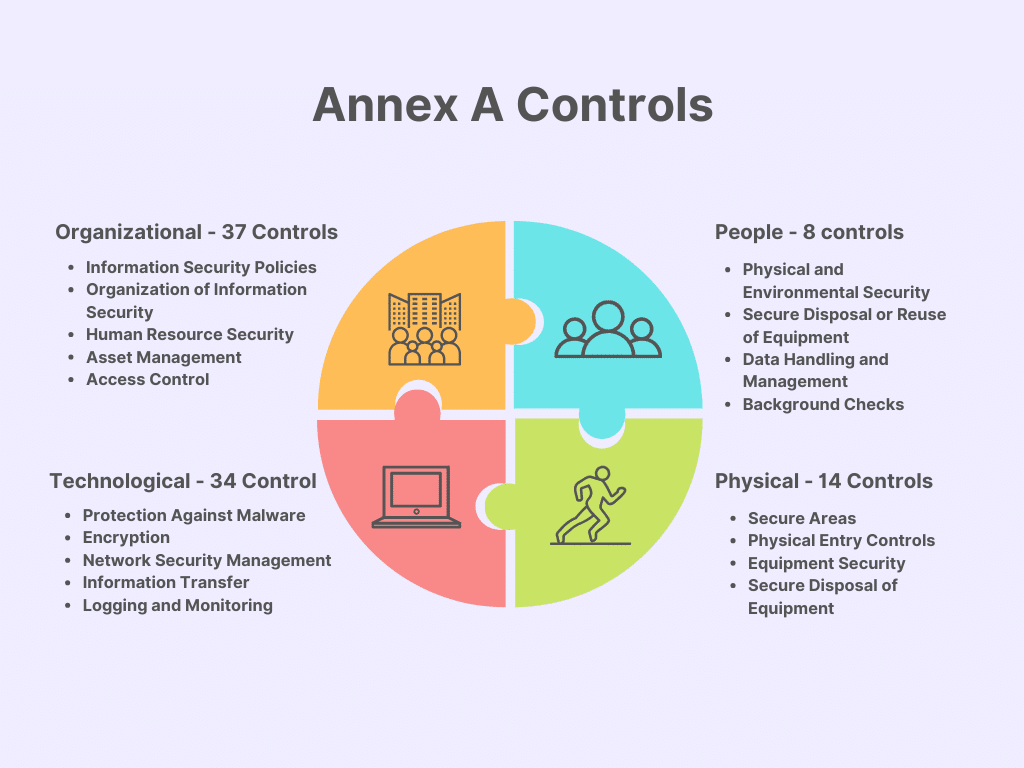
Image Source: Spectral
Annex A is the foundation of ISO 27001 implementation and gives organizations a well-laid-out approach to information security management. Executives who want to strengthen their organization’s security and meet compliance requirements should pay close attention to this strategic component.
What is Annex A in ISO 27001?
Annex A is a detailed catalog of security controls that organizations can pick from to build their information security management system (ISMS). The catalog has 93 controls split into four distinct categories that cover everything in information security. Organizations use these controls as practical safeguards to protect their information assets and show they comply with ISO 27001.
The 2022 ISO 27001 revision changed Annex A by a lot, bringing down the number of controls from 114 to 93. This wasn’t just about cutting numbers – it combined 24 controls from before and added 11 new ones to tackle new security challenges. The revision also updated 58 controls from ISO 27002:2013 to match today’s cybersecurity and information security needs.
The four categories of Annex A controls include:
- Organizational controls (A.5) – 37 controls we focused on information security governance
- People controls (A.6) – 8 controls related to secure management of human resources
- Physical controls (A.7) – 14 controls addressing protection of the physical environment
- Technological controls (A.8) – 34 controls mainly related to IT security
Annex A’s flexibility makes it valuable. ISO 27001 knows that security needs are different for each organization. Companies can customize their implementation based on their specific needs and choose controls that work for them after identifying stakeholder requirements and checking security risks.
Why Executives Should Care About Annex A
Annex A isn’t just another technical checklist – it’s a strategic asset that brings real business value. You can use this framework to develop a solid information security plan that fits your organization’s business and operational needs. This saves time and resources since you don’t have to start from zero.
The framework also works as an internal governance document that puts your security approach in writing. This becomes more important as organizations face increased regulatory scrutiny and cybersecurity threats.
Here’s what proper implementation of Annex A controls can do for your business:
- Improved competitiveness – ISO 27001 certification shows your steadfast dedication to security best practices
- Reduced financial and legal risk – Good implementation helps you avoid fines and data breach losses
- Enhanced brand perception – Security certification builds trust and makes your reputation better
- Regulatory compliance – You can meet business, legal, economic, and statutory requirements easily
- Operational improvements – Your security efforts get better structure and focus
- Audit efficiency – You need fewer audits because of detailed coverage
The controls help executives spread security best practices to employees and external partners, keeping operations strong throughout the organization’s ecosystem. Security threats keep changing, and the framework matches this by focusing on constant monitoring and improvement.
ISO 27001 certifications keep growing – 44,499 were issued in 2020, showing a 22% jump from the year before. This shows how much organizations value Annex A for building strong security frameworks. More businesses see ISO 27001 compliance as crucial for success, especially in B2B relationships where security assurance often determines partnerships.
The ISO 27001 Controls List Explained Simply
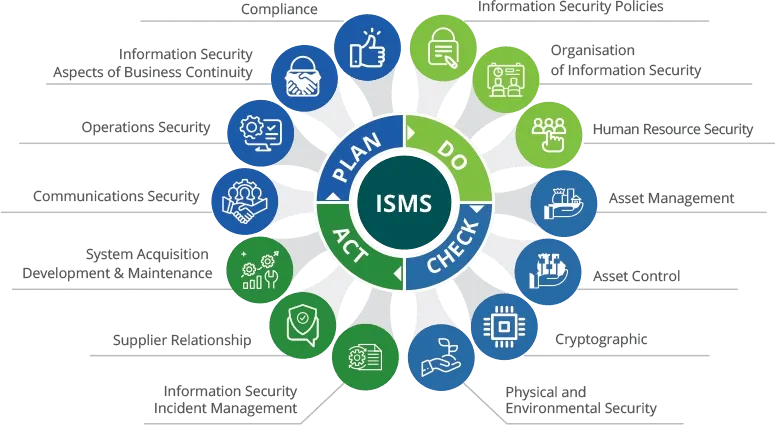
Image Source: Omnex
“Since industry compliance requirements, technology needs, and scope of operations are unique for each organization, the ISO 27001 Annex A control list serves as a framework, rather than a checklist of requirements.” — StrongDM, Cybersecurity and privileged access management solutions provider
The 93 controls in ISO 27001 are the foundations of information security principles. Executives must learn about these controls and how they line up before they tackle specific requirements.
Overview of the 93 Controls
ISO 27001:2022 brought a major restructuring of its security controls. The previous 114 controls were streamlined into 93. This wasn’t just about trimming – 24 controls from the 2013 version were combined. The framework added 11 new controls to tackle emerging security challenges:
- Threat intelligence (A.5.7)
- Information security for cloud services (A.5.23)
- ICT readiness for business continuity (A.5.30)
- Physical security monitoring (A.7.4)
- Configuration management (A.8.9)
- Information deletion (A.8.10)
- Data masking (A.8.11)
- Data leakage prevention (A.8.12)
- Monitoring activities (A.8.16)
- Web filtering (A.8.23)
- Secure coding (A.8.28)
Each control now comes with an attribution taxonomy. This table with suggested attributes helps companies line up their control selection with common industry language and international standards. Companies can use this approach with their risk assessment and Statement of Applicability (SoA) compliance work.
Companies start by identifying requirements from interested parties and assessing security risks. They then document which controls fit their specific situation in their Statement of Applicability.
How Controls Are Grouped by Category
The new ISO 27001:2022 has simplified its structure. Instead of 14 categories, the 93 controls now fit into four main themes. This makes them easier to direct:
- Organizational Controls (A.5) – These 37 controls focus on information security governance. They cover everything outside people, technology, and physical security. The controls address policies, roles, threat intelligence, and supplier relationships.
- People Controls (A.6) – This smallest group of 8 controls focuses on employee’s handling of sensitive information. They cover screening, employment terms, awareness training, discipline, confidentiality, remote work, and security reporting.
- Physical Controls (A.7) – These 14 controls protect tangible assets and secure facilities. The category includes entry systems, guest protocols, security monitoring, and protection from threats like theft, natural disasters, and intentional damage.
- Technological Controls (A.8) – These 34 controls handle the tech side of information security. They protect systems through authentication, encryption, network security, data leak prevention, and monitoring.
This new structure beats the old versions. Executives can now focus on four clear domains that match typical organizational structures, rather than dealing with 14 different categories.
The controls create an all-encompassing approach to information security. Organizational controls build the foundation through policies. People controls make sure staff know what to do. Physical controls protect the actual environment. Technological controls safeguard digital assets. Together, they keep your organization’s information confidential, intact, and available.
Organizational Controls: Governance and Risk Management
Image Source: ResearchGate
The organizational controls section stands as the largest category in the ISO 27001 framework. It contains 37 distinct controls that are the foundations of effective information security governance. Organizations build their entire information security management system on these controls.
A.5.1 to A.5.37 Overview
Organizational controls include everything that doesn’t fit under people, technology, or physical security domains. These controls address fundamental aspects like identity management, documentation practices, and evidence collection processes. This category plays a significant role in establishing a security culture throughout the organization.
The 2022 version of ISO 27001 introduced several new controls among the 37 organizational controls:
- Control 5.7: Threat intelligence
- Control 5.23: Information security for use of cloud services
- Control 5.30: ICT readiness for business continuity
These additions reflect the progress of information security challenges that respond to changing technological landscapes. The organizational controls span security management areas from establishing information security policies (A.5.1) to documenting operating procedures (A.5.37).
Organizational controls promote an all-encompassing approach to information security. Organizations use these controls to categorize information assets by context, determine security risks, define responsibilities, combine security smoothly into project processes, and establish supplier relationship guidelines. These controls go beyond technical configurations and shape how organizations approach security governance.
Key Controls for Policy, Roles, and Supplier Management
Policies, roles, and supplier management represent some of the most significant organizational controls. Control A.5.1 (Policies for Information Security) requires organizations to have formal information security policies. Management must approve these policies, which should be published, communicated to, and acknowledged by appropriate personnel. Business strategy, regulatory requirements, and the current threat environment shape these policies.
Control A.5.2 (Information Security Roles and Responsibilities) establishes clear accountability by defining specific security roles throughout the organization. Security isn’t just IT department’s responsibility but requires participation across all organizational levels.
Supplier management forms another vital subset of organizational controls. Controls A.5.19 through A.5.23 address various aspects of managing security in supplier relationships. Third-party relationships often present substantial security risks. To name just one example, A.5.19 requires organizations to maintain accurate records of supplier types that could affect information security integrity and understand how to vet suppliers based on risk levels.
A.5.20 addresses information security within supplier agreements. Written agreements must outline security requirements that suppliers need to follow. Organizations must monitor and review supplier services (A.5.22) and specifically address cloud service security (A.5.23) due to their unique challenges.
Recent events highlight these controls’ importance. Reddit faced a cyber-attack in February 2023 when an attacker accessed internal code and documents after getting an employee’s credentials. Strong organizational controls help prevent such incidents by establishing clear policies, defining responsibilities, and managing third-party risks.
A.5.37 (Documented Operating Procedures) requires organizations to document all information security processes. This documentation ensures consistency, clarity, and accountability. This control supports the entire ISMS by formalizing security tasks, which creates repeatable processes with consistent results.
People Controls: Managing Human Risk in Information Security
“People are often the weakest link in cybersecurity. Even with the most advanced firewalls and encryption, a single human error—such as falling for a phishing scam or misconfiguring access permissions—can lead to a serious security breach.” — Copla Consulting, Cybersecurity and compliance consulting firm specializing in ISO 27001 implementation
Human factors are the biggest security risk in information security today. Statistics show that 82% of data breaches happen due to human error or social engineering. The ISO 27001 framework tackles this challenge with specific people controls. These controls help turn employees from potential security risks into valuable assets for your security program.
A.6.1 to A.6.8 Breakdown
The people controls section has only eight controls, making it the smallest category. Yet it has a major effect by managing how staff handle data and interact with each other. These controls set up basic security practices throughout an employee’s time with the company:
A.6.1 Screening makes background checks mandatory for all job candidates. This preventive measure will give access to sensitive systems only to trustworthy individuals. Background checks usually look at references, CV details, qualifications, identity, and sometimes criminal records or financial history.
A.6.2 Terms and Conditions of Employment requires security responsibilities to be clearly written in job contracts. Your organization’s security standards become binding from day one.
A.6.3 Information Security Awareness, Education, and Training requires regular security training programs tailored to different roles. This control shows that security awareness is more than just checking a compliance box.
A.6.4 Disciplinary Process spells out what happens when someone breaks security policies.
A.6.5 Responsibilities After Termination or Change of Employment has procedures to handle security risks during job changes, including quick access removal.
A.6.6 Confidentiality or Non-Disclosure Agreements uses legal contracts to protect sensitive information.
A.6.7 Remote Working deals with keeping information secure when staff work outside the office.
A.6.8 Information Security Event Reporting builds a culture where staff quickly report anything suspicious.
Training, Screening, and Remote Work Security
You need to focus on three key areas to implement people controls well. A detailed screening process creates the foundation of your human security strategy. ISO 27001 recommends matching verification checks to each role’s risk level. Jobs that handle sensitive information need extra thorough vetting.
Security awareness training has grown from a simple compliance task into a vital defense tool. ISO 27001 clause 7.2.2 states that “all employees of the organization and, where relevant, contractors should receive appropriate awareness education and training and regular updates in organizational policies and procedures, as relevant for their job function”. Good training programs should:
- Plan for different employee roles
- Run regularly, at least monthly
- Stay current with new threats and security incidents
Remote work security has become more important as hybrid work becomes normal. Control A.6.7 asks organizations to create a specific remote working policy that defines data security rules. This includes giving secure equipment, banning personal devices, and teaching safe remote work practices.
Organizations must add technical protection, set clear responsibilities, and offer proper IT support to secure remote work. This often means using privacy screens, secure communication tools, and teaching staff about specific remote work risks.
People controls need both technical and cultural approaches. Adding these controls to your security program turns your workforce into your first defense line against threats.
Physical Controls: Securing Facilities and Equipment
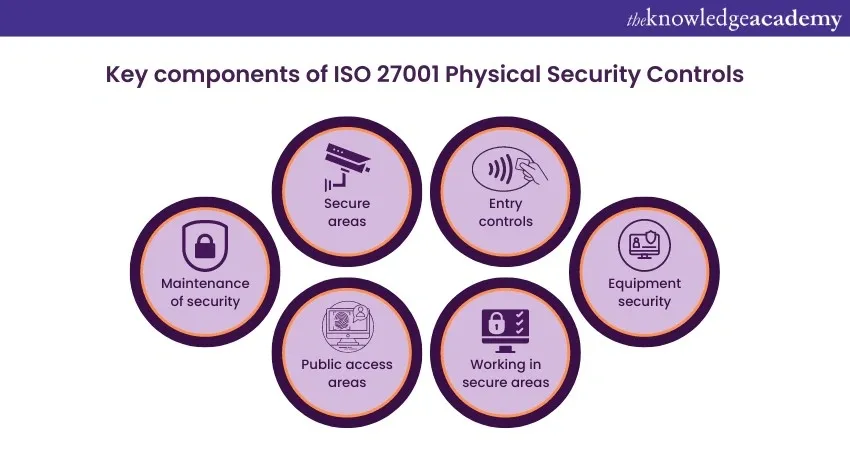
Image Source: The Knowledge Academy
Physical security plays a vital yet often overlooked role in information security management. The ISO 27001 framework tackles this through 14 specific controls. These controls protect tangible assets, equipment, and facilities from unauthorized access and environmental threats.
A.7.1 to A.7.14 Summary
ISO 27001 Annex A‘s physical controls section has safeguards that protect the physical environment where information assets exist. These controls fit into several key categories:
Perimeter and Entry Security has physical security perimeters (A.7.1) and physical entry controls (A.7.2). They create boundaries between areas with different security needs and put in place entry mechanisms like keycards, biometrics, or security personnel.
Workspace Protection covers securing offices, rooms, and facilities (A.7.3), work in secure areas (A.7.6), and clear desk and screen policies (A.7.7). These controls make sure sensitive information stays hidden from unauthorized people.
Environmental Protection looks at physical security monitoring (A.7.4) and protection against physical and environmental threats (A.7.5). This part deals with safeguards against natural disasters, civil unrest, and intentional destruction.
Equipment Security looks after equipment location and protection (A.7.8), off-premises asset security (A.7.9), storage media (A.7.10), supporting utilities (A.7.11), cabling security (A.7.12), equipment maintenance (A.7.13), and secure disposal or re-use of equipment (A.7.14).
The 2022 version of the standard added physical security monitoring (A.7.4). This addition shows how surveillance systems and continuous monitoring have become vital in modern security strategies.
Access Control, Equipment Disposal, and Environmental Safety
Physical Access Control serves as the foundation to secure facilities. You need to define security perimeters, set up proper entry points, and install entry controls based on risk assessment. Your organization should manage access, review access rights regularly, and keep visitor logs. The most effective setup should have:
- Monitored reception areas
- Staff identification systems
- Visitor badges and escort requirements
- Secure emergency access points
- Biometric access where appropriate
Equipment Disposal and Reuse (A.7.14) tackles one of the biggest security risks many organizations face. You must verify that all sensitive data and licensed software gets removed or securely overwritten before disposal or reuse. A good implementation needs:
- Organization-wide disposal and reuse procedures
- Secure wiping software that overwrites data or physical destruction of storage media
- Removal of all identifying labels and markings
- Documentation of the disposal process for audit purposes
- Employee training on proper disposal procedures
Risk evaluations become essential for repair scenarios. You should weigh data sensitivity and decide if destruction makes more sense than repair.
Environmental Safety controls guard against natural disasters and intentional physical threats. You’ll need expert advice about specific threats like fire, flood, or earthquakes. Your organization must:
- Get a full picture of physical location risks
- Set up detection systems for fire, flood, and electrical surges
- Put in place physical security controls based on risk profiles
- Create incident response procedures for physical security events
- Test and maintain protective systems regularly
Regular testing and updates through internal audits help verify that physical controls work effectively. Any gaps found should lead to improvements right away.
These physical controls create a vital defense layer that works alongside organizational, people, and technological controls in your ISO 27001 framework.
Technological Controls: Cybersecurity and Data Protection
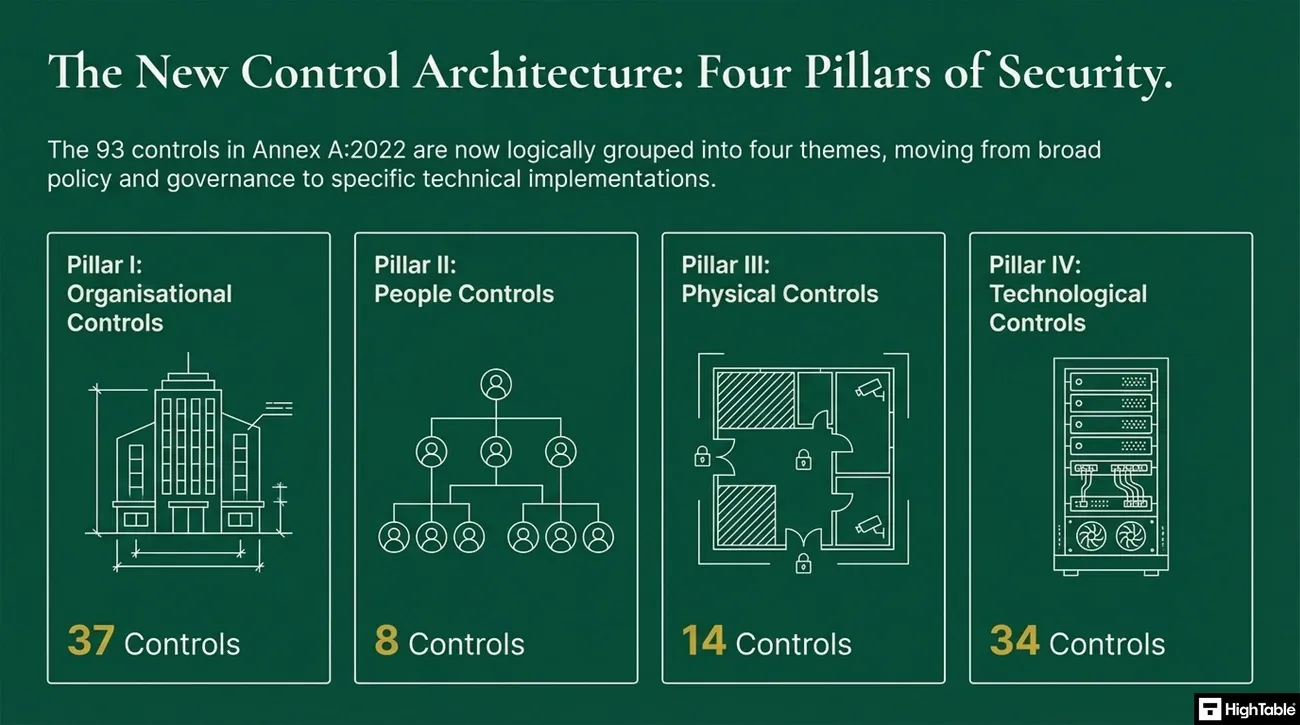
Image Source: High Table
ISO 27001’s technological controls serve as the digital defense layer of any information security management system. These controls protect your digital assets against emerging cyber threats through 34 distinct measures that cover everything from access management to secure coding practices.
A.8.1 to A.8.34 Overview
Technological controls make up the largest technical component of ISO 27001. They address user endpoint devices and system testing. We divided these controls into several key categories:
- Access Management (A.8.1-A.8.5) – Controls focusing on user access, privileged rights, and authentication mechanisms
- System Operations (A.8.6-A.8.14) – Covering capacity management, malware protection, vulnerability management, and data backups
- Monitoring and Logging (A.8.15-A.8.18) – Ensuring security events are properly recorded and analyzed
- Network Security (A.8.20-A.8.24) – Protecting network infrastructure through segmentation, filtering, and encryption
- Secure Development (A.8.25-A.8.34) – Governing application security throughout the development lifecycle
The 2022 update brought several new technological controls that tackle emerging challenges. These include configuration management (A.8.9), data masking (A.8.11), data leakage prevention (A.8.12), monitoring activities (A.8.16), web filtering (A.8.23), and secure coding (A.8.28).
Encryption, Logging, and Secure Development Practices
Encryption (A.8.24) stands out as one of the most critical technological controls. Organizations need clear cryptographic policies based on business requirements. ISO 27001 doesn’t specify encryption algorithms but requires appropriate key management processes. These processes should cover how you generate, store, recover, and destroy cryptographic keys.
Logging (A.8.15) serves as the life-blood of effective security monitoring. Your organization must create, store, and analyze logs of system activities. These logs should include user IDs, timestamps, system identifiers, and network addresses. You need to protect these logs from unauthorized changes to maintain their value as evidence during security investigations.
Secure development practices (A.8.25-A.8.31) blend security throughout the software development lifecycle. Your team needs to establish security requirements (A.8.26), follow secure architecture principles (A.8.27), and implement secure coding guidelines (A.8.28). These controls require separate development, testing, and production environments (A.8.31) along with secure testing procedures (A.8.29).
Technological controls need constant maintenance and monitoring to work against evolving threats. They remain a vital part of any complete ISO 27001 implementation.
How to Implement ISO 27001 Controls Without Overwhelm
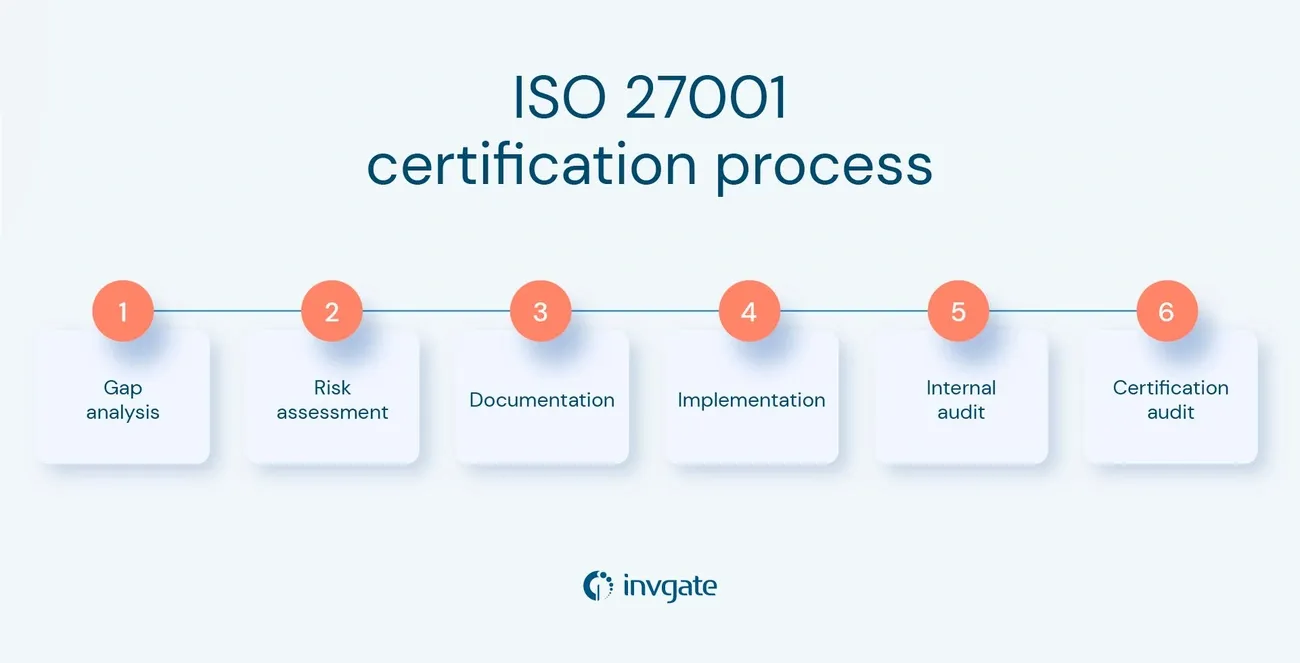
Image Source: InvGate’s Blog
The implementation of 93 ISO 27001 controls might seem overwhelming at first. A methodical approach can turn this complex task into a manageable process that brings security benefits without burdening your team.
Start with Risk Assessment and SoA
Risk assessment is the life-blood of successful ISO 27001 implementation. Your team should establish a clear methodology that defines rules to identify risks, assess impacts and likelihood, and determine acceptable risk levels. A detailed evaluation of internal and external threats to your organization’s information assets should follow once you have the methodology ready.
The Statement of Applicability (SoA) links your risk assessment work to control implementation. This vital document must:
- List all Annex A controls
- Specify which controls are applicable versus not applicable
- Provide justification for inclusion or exclusion
- Document implementation status and methods
Auditors use this implementation roadmap to see exactly “where” and “how” you’ve chosen to implement security measures.
Use Automation Tools for Monitoring and Reporting
Technology simplifies ISO 27001 compliance significantly. Organizations can reduce audit completion times by up to 50% with automation tools. Most companies earn certification in 12-24 weeks instead of the standard timeline.
Automation offers these benefits:
- Continuous compliance monitoring through automated tests
- Simplified evidence collection from integrated systems
- Automatic generation and updating of your SoA
Your existing security infrastructure can blend with these tools to pull evidence automatically, identify requirement gaps, and give immediate insights into compliance status.
Want to simplify your ISO 27001 experience? Book a Readiness Call to learn how automation speeds up your certification path while reducing implementation complexity.
Benefits of ISO 27001 Compliance for Business Leaders
ISO 27001 certification does more than just strengthen security. Your organization’s bottom line, relationships, and market position will see real business benefits.
Improved Stakeholder Trust
ISO 27001 certification changes how stakeholders view your organization. Studies show that 70% of customers think businesses don’t protect personal information well enough. Getting certified shows your steadfast dedication to data protection and builds deeper trust with investors, partners, and customers. The certification proves you handle data securely. It also helps maintain client confidence when you regularly share updates about security practices and improvements throughout your relationship.
Reduced Legal and Financial Risk
Security breaches come with huge costs. IBM reports that a data breach in 2023 cost USD 4.45 million on average. A strong ISO 27001 system substantially cuts these financial risks. The standard lines up with global rules like GDPR to help you avoid fines and legal troubles. You can minimize breach risks by fixing security flaws – often the weakest points in information security systems.
Competitive Advantage in B2B Deals
ISO 27001 certification gives you a clear advantage in today’s market. Many big organizations only work with ISO 27001-certified vendors. This makes certification necessary to access certain business opportunities. Your clients find it easier to evaluate you as a vendor, which speeds up business deals. Certified organizations can often charge more for their services because clients value the extra security.
Want to get these benefits? Book a Readiness Call to learn how ISO 27001 controls can build trust, reduce risks, and discover new business opportunities for your organization.
Conclusion
ISO 27001 is a resilient framework that helps organizations build strong information security practices. This piece explores four control categories that are the foundations of the standard’s optimized approach: Organizational (37), People (8), Physical (14), and Technological (34). These controls create a complete security posture to protect your organization from evolving threats.
Business leaders often see ISO 27001 compliance as a technical challenge at first. The strategic benefits are way beyond the reach and influence of security improvements. Your organization gets most important competitive advantages through increased stakeholder trust, lower legal exposure, and a stronger position in B2B relationships. The framework gives you a structured method that turns security from a vague concept into practical, measurable processes.
A methodical approach leads to ISO 27001 success. You need a full picture of risks and a detailed Statement of Applicability. Teams of all sizes can definitely achieve continuous compliance more easily with automation tools that reduce monitoring complexity.
Your organization might want formal certification or just stronger security practices. These 93 controls give you a clear direction forward. We suggest you Book a Readiness Call to evaluate your current security posture. This will help find the quickest way to ISO 27001 compliance for your business needs.
Rising ISO 27001 certification rates worldwide show that organizations understand its value. These controls need investment, but they demonstrate improved resilience, better reputation, and ended up stimulating business growth. Your experience toward information security excellence begins with understanding these controls and continues through regular monitoring, evaluation, and improvement.
Key Takeaways
ISO 27001’s 93 controls provide executives with a strategic framework for building robust information security while delivering measurable business value beyond mere compliance.
• Start with risk assessment and Statement of Applicability – These foundational documents guide which of the 93 controls apply to your organization’s specific security needs and business context.
• Focus on the four control categories systematically – Organizational (37), People (8), Physical (14), and Technological (34) controls work together to create comprehensive security coverage.
• Leverage automation tools to reduce implementation complexity – Modern compliance platforms can cut audit times by 50% and streamline evidence collection from existing systems.
• Capitalize on competitive advantages in B2B relationships – ISO 27001 certification often becomes a prerequisite for vendor partnerships and can command premium pricing for services.
• Transform security from cost center to business enabler – Proper implementation reduces breach risks (average cost: $4.45M), builds stakeholder trust, and opens new market opportunities.
The 2022 update streamlined controls from 114 to 93 while adding 11 new controls for emerging threats like cloud security and threat intelligence. This evolution makes the standard more relevant for today’s digital landscape while maintaining its comprehensive approach to information security management.
FAQs
Q1. What are the main categories of controls in ISO 27001:2022? ISO 27001:2022 organizes its 93 controls into four main categories: Organizational Controls (37), People Controls (8), Physical Controls (14), and Technological Controls (34). This structure provides a comprehensive framework for implementing information security measures across different aspects of an organization.
Q2. How can executives implement ISO 27001 controls without becoming overwhelmed? Executives can implement ISO 27001 controls effectively by starting with a thorough risk assessment and creating a Statement of Applicability (SoA). Additionally, using automation tools for monitoring and reporting can significantly simplify the process, reducing audit completion times and streamlining evidence collection.
Q3. What are some key benefits of ISO 27001 compliance for businesses? ISO 27001 compliance offers several benefits including improved stakeholder trust, reduced legal and financial risks associated with data breaches, and a competitive advantage in B2B deals. Many organizations now require ISO 27001 certification from their vendors, making it a valuable credential in the marketplace.
Q4. How does ISO 27001 address human factors in information security? ISO 27001 addresses human factors through its People Controls section, which includes 8 specific controls. These cover areas such as employee screening, security awareness training, confidentiality agreements, and procedures for remote working. The standard recognizes that employees can be both a potential vulnerability and a valuable asset in maintaining information security.
Q5. What new controls were introduced in the 2022 version of ISO 27001? The 2022 update of ISO 27001 introduced 11 new controls to address emerging security challenges. These include threat intelligence, information security for cloud services, ICT readiness for business continuity, physical security monitoring, configuration management, data masking, data leakage prevention, and secure coding practices.