
CMMC controls determine your organization’s eligibility to compete for defense contracts. Organizations without proper certification cannot participate in defense contract opportunities. The Cybersecurity Maturity Model Certification uses a tiered system that impacts every member of the defense supply chain. Organizations must meet 15 simple safeguarding requirements for Federal Contract Information (FCI) at Level 1. Level 2 expands to include all 110 requirements from NIST SP 800-171 for Controlled Unclassified Information (CUI).
Prime contractors bear responsibilities beyond their own organizations. They must ensure their subcontractors maintain the required CMMC level throughout the contract’s duration. Companies that fail to verify supply chain compliance risk contract penalties, security breaches, and lost DoD business opportunities. The assessment preparation could take up to a year, based on the CMMC controls your organization needs to implement. Many organizations find it challenging to navigate these NIST CMMC controls requirements, particularly when managing multiple subcontractors who handle different types of information. In this piece, we’ll examine how CMMC controls affect subcontractors, explain certification requirements at each level, and share strategies that work for managing supply chain risk.
CMMC Flowdown: How Subcontractors Inherit Controls
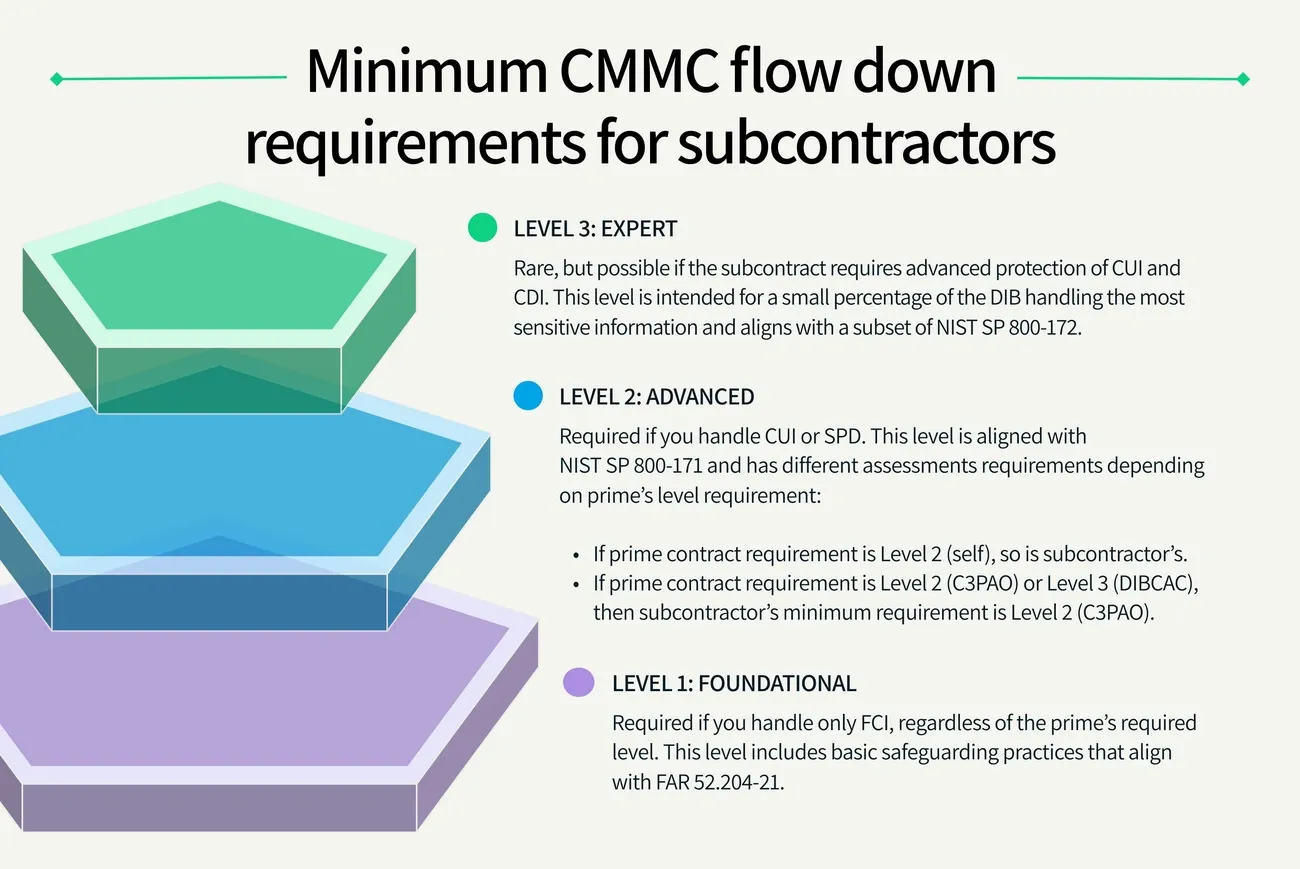
Image Source: Secureframe
The defense supply chain creates vital compliance obligations through subcontractor relationships. DFARS requirements create a contract structure that pushes cybersecurity standards from prime contractors down to every subcontractor tier that handles sensitive information.
DFARS 252.204-7012 and 7021 Flowdown Clauses
Defense contracts push requirements beyond prime contractors through specific DFARS clauses that enforce supply chain security. Prime contractors must add DFARS 252.204-7012, 252.204-7019, 252.204-7020, and 252.204-7021 to their subcontracts. These clauses are the foundations of CMMC compliance throughout the supply chain. DFARS 252.204-7021 states that contractors must “flow down the correct CMMC level to subcontracts and other contractual instruments”. On top of that, it prevents prime contractors from sharing FCI or CUI with subcontractors who haven’t met CMMC requirements.
Prime Contractor Obligations to Enforce CMMC
Prime contractors hold major responsibility for their subcontractors’ compliance. Primes must check if subcontractors have current CMMC certification at the right level before awarding contracts. This creates real challenges since primes can’t directly check subcontractor status in the Supplier Performance Risk System (SPRS). They must rely on what subcontractors provide, like SPRS screenshots or certificate copies. This exposes prime contractors to legal risks if subcontractors misstate their compliance status, which could lead to contract defaults and possible suspension or debarment.
CMMC Controls by Level: FCI vs CUI Handling
The requirements that flow down change based on what information subcontractors handle:
- Level 1 (Self): The minimum needed for subcontractors who only handle Federal Contract Information (FCI), with yearly self-assessment against 15 simple safeguarding controls
- Level 2: Needed for any subcontractor handling Controlled Unclassified Information (CUI) or Security Protection Data (SPD), requiring all 110 NIST SP 800-171 controls
- Level 3: The DoD rarely requires this level for subcontractors unless specifically stated in guidance
A subcontractor’s requirements depend only on the sensitivity of information they handle, whatever the prime contractor’s CMMC level might be. To cite an instance, subcontractors who only handle FCI need Level 1 certification, even if their prime needs Level 3.
Subcontractor Certification Requirements and Assessment Types
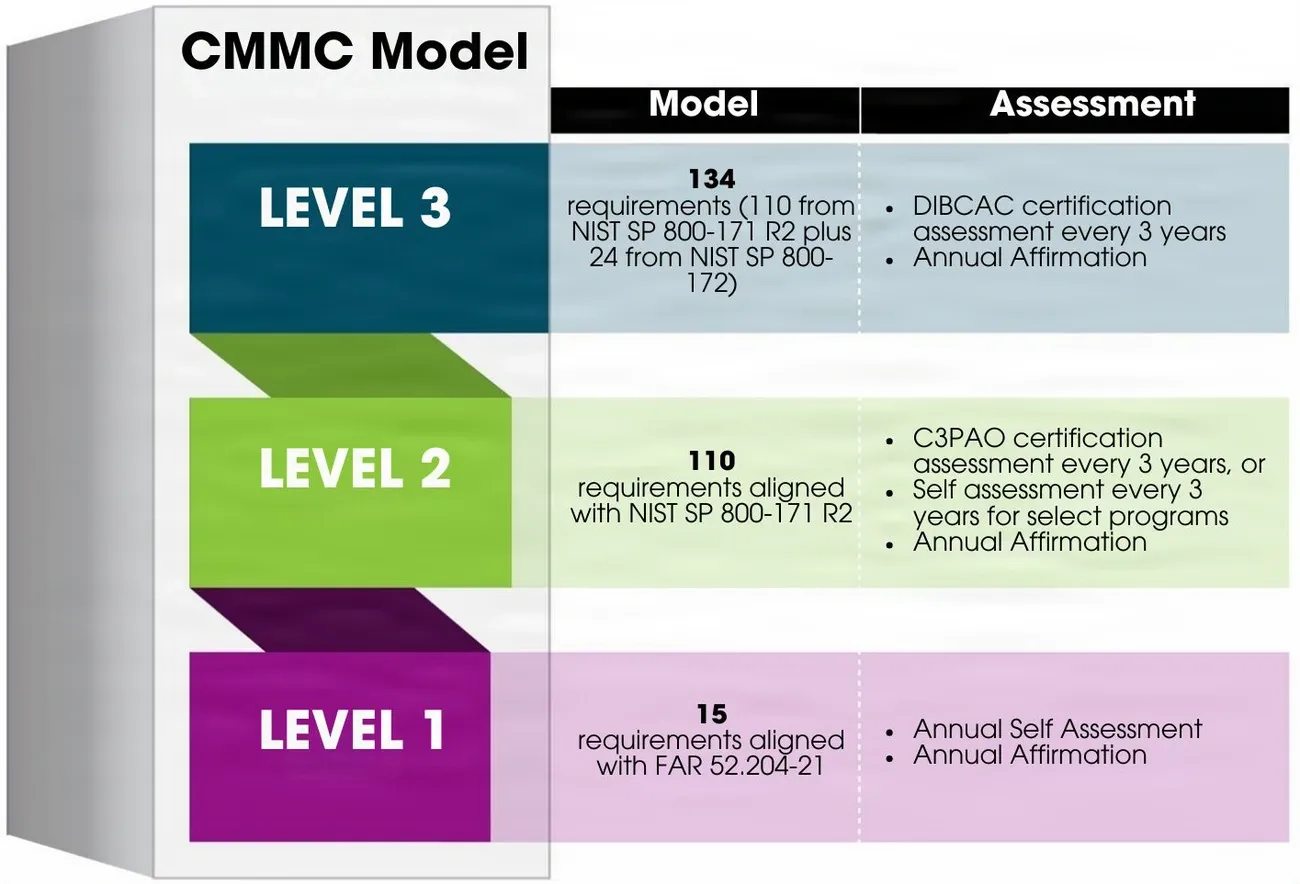
Image Source: DoD CIO – Department of War
Subcontractors must follow different certification paths based on how sensitive their information is. The CMMC program requires specific assessments and verification processes that protect government data effectively.
Level 1 Self-Assessment and SPRS Attestation
Subcontractors who handle Federal Contract Information need to complete a yearly self-assessment. This assessment covers 15 security requirements outlined in FAR 52.204-21. A senior company official must confirm compliance through the Supplier Performance Risk System (SPRS). Level 1 stands out as the only CMMC tier that doesn’t allow Plans of Action and Milestones (POA&Ms). Companies must implement all controls before they can attest, and their results stay valid for one year.
Level 2 C3PAO Certification for CUI
Level 2 certification takes two different paths depending on CUI sensitivity. Companies that process non-critical CUI can do a self-assessment every three years. Those that handle defense-sensitive CUI need formal certification from a Certified Third-Party Assessment Organization (C3PAO). C3PAOs review how well companies implement all 110 NIST SP 800-171 controls using methods from NIST SP 800-171A. Companies must reach either Final Level 2 status by meeting all requirements or Conditional Level 2 status with an 80% minimum score and approved POA&M.
Level 3 DIBCAC Assessment for High-Risk Programs
The Defense Contract Management Agency’s DIBCAC exclusively handles Level 3 certification, which has the strictest verification process. Companies need Final Level 2 (C3PAO) status first with a similar assessment scope. They also need to implement 24 extra security controls from NIST SP 800-172 that protect against Advanced Persistent Threats. Results stay valid for three years, and companies must confirm both Level 2 and Level 3 compliance yearly.
POA&M Restrictions and Conditional Status Rules
CMMC’s program sets strict limits on Plans of Action and Milestones. Levels 2 and 3 allow POA&Ms only under specific conditions: assessment scores must reach 80% minimum, critical controls must be in place, and companies must fix all issues within 180 days. Companies lose their Conditional Status if they don’t complete fixes within this timeframe. Level 2 doesn’t allow POA&Ms for six specific controls that protect CUI data.
Managing Supply Chain Risk Through CMMC Controls
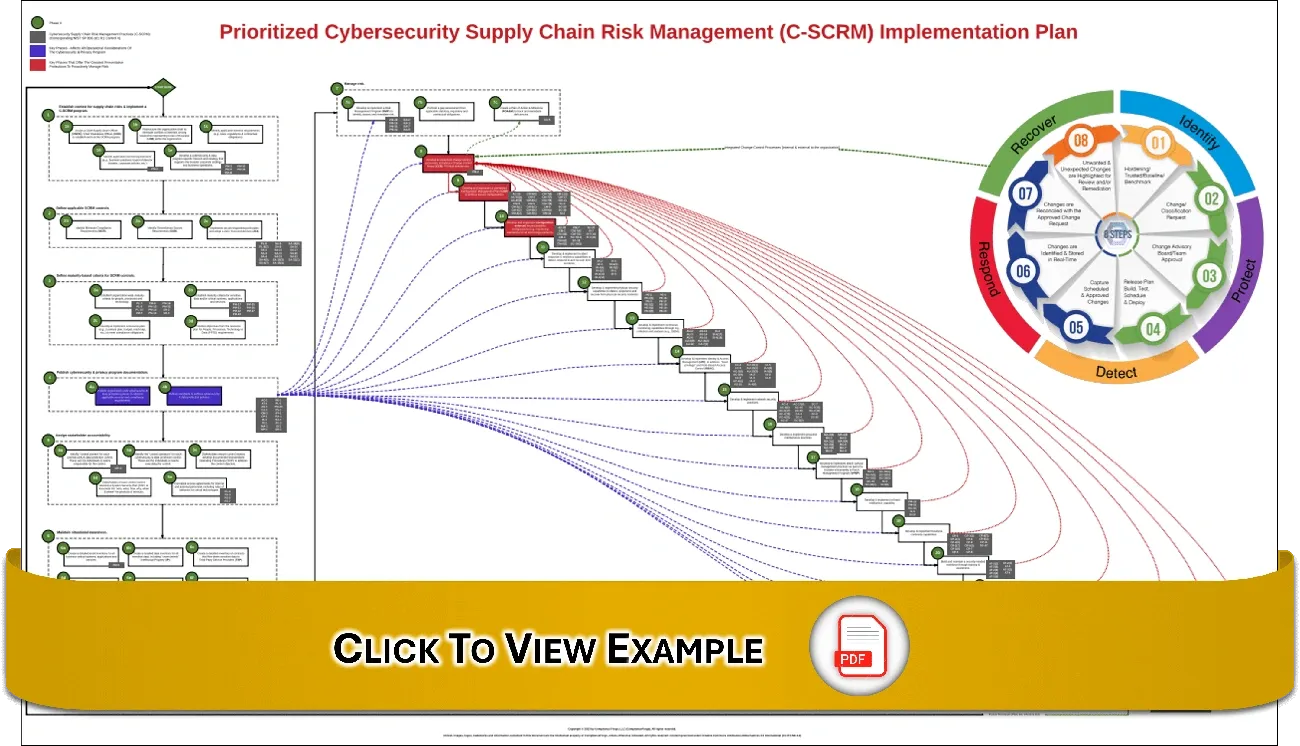
Image Source: ComplianceForge
Supply chain risk management goes beyond simple CMMC certification verification. The DoD has found that the defense industrial base faces major threats. Malicious cyber activity cost the U.S. economy between $57-$109 billion in 2016 alone.
Mapping Subcontractor Data Flows to CMMC Levels
The first step should be creating complete data flow maps that show exactly where FCI and CUI enter, move through, and exit your supply chain. This vital step determines each subcontractor’s CMMC level based on data sensitivity—not company size. Level 1 is enough for vendors who handle only FCI, while those working with CUI need Level 2 certification.
Ongoing Monitoring and Certification Expiry Tracking
Verification is just the start – you need to set up monitoring systems that work. These systems should track certification expiration dates, schedule quarterly reviews, and ask for updates on subcontractors’ Plans of Action and Milestones. Regular monitoring provides data you need to handle security incidents effectively. Waiting for annual deadlines often leads to rushed work and mistakes.
CMMC Controls Mapping Solutions for Tiered Vendors
Your next step should be developing centralized documentation systems that map supplier relationships in your multi-tier supply chain. Many companies benefit from dashboards that track supplier compliance status, certification expirations, and CMMC readiness. These tools help visualize supply chain risk in five key areas: planning, due diligence, contracting, ongoing monitoring, and termination.
Integrating CMMC into Procurement and Onboarding
The process ended up embedding CMMC requirements directly into procurement workflows. Your contracts should include specific clauses that require appropriate certification levels, maintenance throughout performance, and immediate notification of status changes. Pre-screening questionnaires can verify CMMC compliance before vendors enter your selection process.
Best Practices for Subcontractors to Meet Flowdown Obligations
Defense subcontractors need a systematic approach to prepare for CMMC compliance through assessment, documentation, and collaboration. The flowdown obligations require more than just checking boxes – you need careful preparation and continuous maintenance.
Performing a Gap Assessment Against NIST CMMC Controls
A full gap assessment helps you identify areas of non-compliance, avoid certification delays, and set priorities for fixes. This three-part evaluation shows vulnerabilities and creates a clear certification path. Your assessment should:
- Bring together key people from IT, operations, leadership, and end users who work with systems and data
- Keep detailed records to prevent confusion about responsibilities or missed deadlines
- Begin fixing issues right after assessment and tackle high-risk gaps first
Developing a System Security Plan (SSP)
Your CMMC compliance depends on a solid SSP, which assessors review first. This formal document must:
- Show how you meet all 110 NIST SP 800-171 requirements (for Level 2)
- List all systems that store, process, or send CUI
- Explain security control implementation with specific details—not vague descriptions
- Cover system boundaries, roles, responsibilities, and technologies
Book a Readiness Call with a certified consultant to check your SSP before submission.
Maintaining Evidence for SPRS and Prime Review
Prime contractors can’t see your SPRS status directly, so proper documentation becomes crucial. You should:
- Take screenshots of SPRS submissions
- Keep assessment evidence for six years from your CMMC Status Date
- Update SPRS scores at least every three years
- Submit yearly confirmations of continued compliance for Level 2
Collaborating with MSSPs for Control Implementation
Small businesses benefit from working with Managed Security Service Providers. A successful MSSP partnership requires you to:
- Include their role in your asset inventory, SSP, and network diagrams
- Create a matrix that shows shared control responsibilities
- Make sure they provide control-to-service mappings and architectural diagrams
- Check their knowledge of CMMC requirements and support during assessment
Conclusion
CMMC compliance across your supply chain needs detailed understanding, careful planning, and ongoing oversight. The tiered system affects organizations based on how sensitive their information is, not their size. So prime contractors must check proper certification levels for all subcontractors. Subcontractors must match their controls to their data handling duties.
CMMC compliance might be tough, but it offers important benefits beyond qualifying for contracts. Improved security controls protect your company and make the entire defense industrial base stronger against ongoing threats. It also streamlines operations when compliance processes are well-documented. This helps clarify everyone’s roles and makes information flow better.
The path to certification needs solid preparation whatever your required level. A detailed gap assessment gives most organizations the clearest way forward. You should Book a Readiness Call with qualified consultants before any formal evaluation. They can spot potential issues and suggest the quickest ways to fix them. Set up ongoing monitoring systems instead of rushing when certification renewals come due.
CMMC isn’t just about checking boxes—it’s a core security framework that protects our nation’s sensitive information. Defense contract requirements keep changing. Companies that make CMMC controls part of their daily operations will get ahead while supporting national security. Your organization should treat subcontractor compliance as a shared duty. This builds stronger supply chain relationships that help everyone involved.
Key Takeaways
Understanding CMMC flowdown requirements is critical for defense contractors managing supply chain compliance and avoiding contract exclusion.
• Prime contractors must verify all subcontractors have appropriate CMMC certification levels before contract award and throughout performance • Subcontractor CMMC requirements depend on data sensitivity (FCI vs CUI), not the prime contractor’s certification level • Level 1 requires annual self-assessment for FCI handling, while Level 2 needs C3PAO certification for CUI processing • Effective supply chain risk management requires mapping data flows, tracking certification expiries, and integrating CMMC into procurement workflows • Subcontractors should start with comprehensive gap assessments and develop detailed System Security Plans before pursuing certification
CMMC compliance extends far beyond individual organizations—it creates a security framework protecting the entire defense industrial base. Prime contractors face legal exposure for subcontractor non-compliance, while subcontractors risk losing all defense contract opportunities without proper certification. Success requires treating CMMC as an ongoing operational requirement rather than a one-time compliance exercise.
FAQs
Q1. Are subcontractors required to comply with CMMC? Yes, subcontractors must comply with CMMC requirements. The level of compliance depends on the type of information they handle. Subcontractors dealing with Federal Contract Information (FCI) need Level 1 certification, while those handling Controlled Unclassified Information (CUI) require Level 2 certification.
Q2. How do prime contractors verify subcontractor CMMC compliance? Prime contractors must verify subcontractor CMMC compliance before awarding contracts and throughout the contract lifecycle. This is typically done by requesting documentation such as SPRS screenshots or certification copies from subcontractors, as primes cannot directly access subcontractor status in the Supplier Performance Risk System (SPRS).
Q3. What are the key steps for subcontractors to achieve CMMC compliance? Key steps for subcontractors include performing a gap assessment against NIST CMMC controls, developing a comprehensive System Security Plan (SSP), maintaining evidence for SPRS and prime contractor review, and potentially collaborating with Managed Security Service Providers (MSSPs) for control implementation.
Q4. How often do subcontractors need to renew their CMMC certification? The renewal frequency depends on the CMMC level. Level 1 requires annual self-assessment and attestation. Level 2 certification, conducted by a C3PAO, is valid for three years but requires annual affirmation of continued compliance. Level 3 assessments, performed by DIBCAC, are also valid for three years with annual affirmations required.
Q5. What are the consequences of non-compliance for subcontractors? Non-compliance with CMMC requirements can result in subcontractors losing eligibility for defense contracts. Prime contractors cannot share FCI or CUI with non-compliant subcontractors, effectively excluding them from the defense supply chain. This can lead to significant business losses and potential legal issues for both the subcontractor and the prime contractor.