
ISO 27001 plays a vital role in protecting sensitive information in today’s digital world. Recent studies show that 43% of businesses faced a breach or attack last year. Organizations need strong information security practices now more than ever.
ISO/IEC 27001 sets the standards for managing security controls within an Information Security Management System (ISMS). This system helps companies protect various types of data – from financial records and intellectual property to employee information and third-party data. The standard’s importance shows in the numbers: ISO Survey 2023 reported 48,671 valid certificates worldwide.
Manufacturing leads the list of cyberattack targets in 2024, making up 26% of all incidents. A modern ISMS has become crucial for business survival. Companies with ISO 27001 certification gain a competitive edge. This certification proves they can manage information assets well and build stronger security practices.
Let’s get into what ISO 27001 certification means in this piece. We’ll look at the ISMS framework and explain its value to CTOs. On top of that, you’ll find a practical roadmap that helps avoid common mistakes and get the most from your security investments.
What is ISO 27001 and Why CTOs Should Care
ISO 27001 stands as the leading global standard for information security management, developed jointly by the International Organization for Standardization (ISO) and International Electrotechnical Commission (IEC). This standard goes beyond a simple security checklist. It represents an all-encompassing approach to protect an organization’s most valuable asset – information.
Definition of ISO/IEC 27001 and ISMS
ISO 27001’s core purpose lies in setting up requirements to implement, maintain, and improve an Information Security Management System (ISMS). This framework forms the foundations of managing sensitive company information through systematic policies and procedures. Picture an ISMS as a vault that protects your organization’s crown jewels. It safeguards not just hardware and software, but the entire ecosystem of people, processes, technology, and governance principles.
The standard belongs to a broader ISO/IEC 27000 series that focuses on information security management. Its complete title – “ISO/IEC 27001 – Information security, cybersecurity and privacy protection — Information security management systems — Requirements” – shows its expanded reach in the current version.
Random security measures often create disconnected controls that work as point solutions. An ISO 27001-compliant ISMS brings structure and coherence to your security strategy. This systematic approach makes sure nothing gets overlooked when protecting vital information assets.
What is ISO 27001 intended to ensure?
The standard’s primary goal focuses on protecting three basic aspects of information: confidentiality, integrity, and availability. It uses a risk-based method to spot potential threats and put appropriate controls in place.
The ISO 27001 framework requires organizations to:
- Get into information security risks by looking at threats, vulnerabilities, and what it all means
- Create and implement security controls that work together to handle unacceptable risks
- Set up a management process that ensures these controls meet security needs as time goes on
The latest version (ISO 27001:2022) has 93 security controls spread across four main sections:
- Organizational controls (policies, governance)
- People controls (training, awareness)
- Physical controls (facility security)
- Technological controls (software, hardware protections)
This well-laid-out approach creates a proactive security stance instead of just reacting to problems after they happen.
Why ISO 27001 matters in modern cybersecurity
ISO 27001’s importance has reached new heights in today’s threat landscape. CTOs and their organizations get several key benefits:
Risk management framework: The standard gives you a systematic way to identify, analyze, and address vulnerabilities. You can spot and fix risks early, before they become bigger problems.
Legal and regulatory alignment: Organizations can meet various laws, regulations, and contractual requirements related to information security. This lines up with frameworks like GDPR, which reduces legal exposure by a lot.
Competitive differentiation: Getting ISO 27001 certification shows your steadfast dedication to protecting information, verified by independent experts. This certification works like a “badge of trust” and gives businesses an edge in markets where privacy matters.
Cost reduction: Organizations save money by preventing security incidents instead of dealing with aftermath. The certification investment is nowhere near the savings you get through better security.
Operational improvements: ISO 27001 helps companies define clear processes and procedures, which proves invaluable for growing organizations. Everyone knows their roles and responsibilities, and critical knowledge stays within the organization.
CTOs get a structured framework that makes security part of business operations rather than a separate function. This integration becomes crucial as organizations depend more on digital systems and face sophisticated cyber threats.
Understanding the ISO 27001 Framework Structure
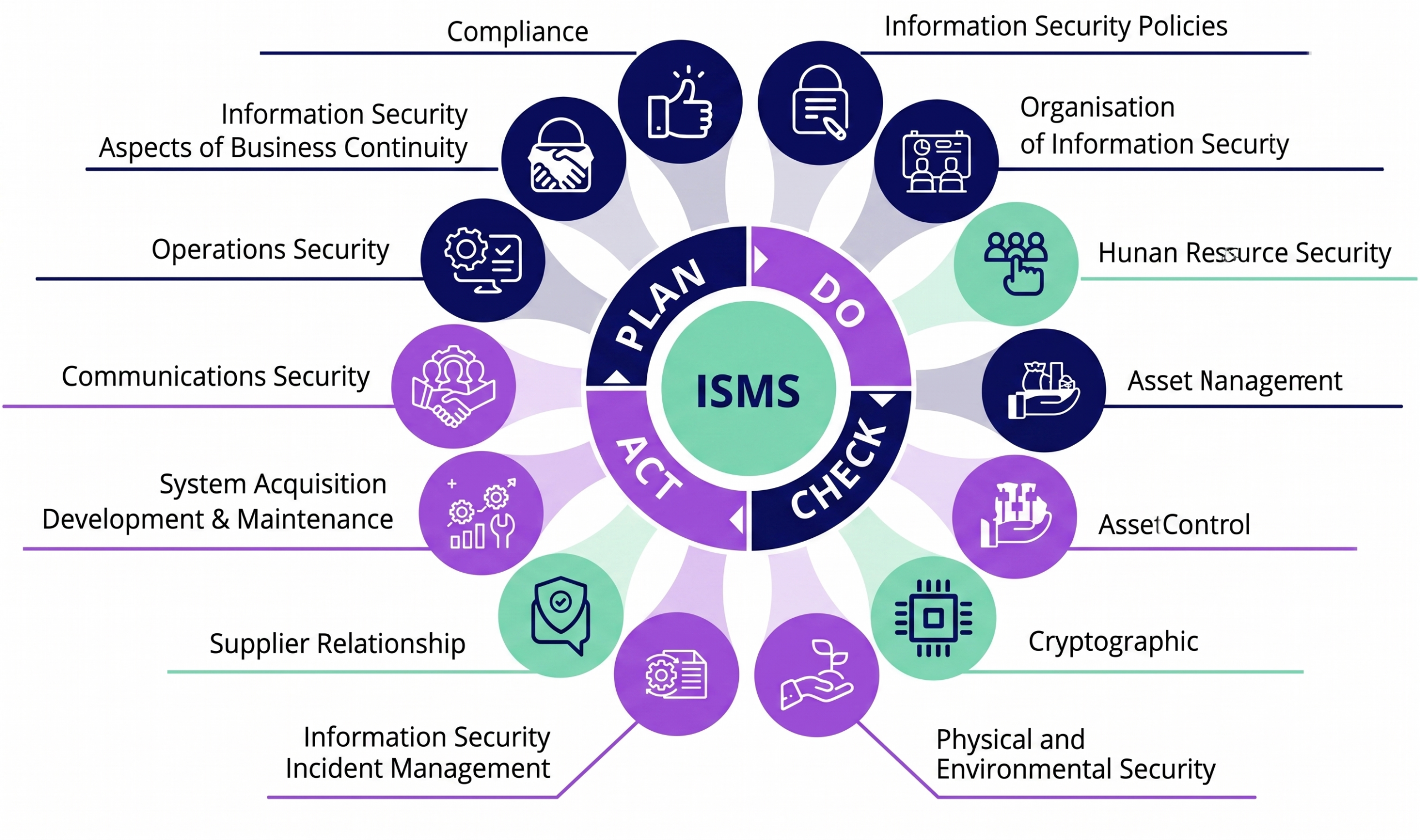
Image Source: Omnex
ISO 27001 has two main parts that create a complete information security management system. Organizations need to understand this structure to set up and run an effective ISMS.
Clauses 4–10: Core ISMS Requirements
The backbone of ISO 27001 lies in Clauses 4-10. These clauses outline what certified ISMS must do. They provide a structured way to manage information security:
Clause 4: Context of the Organization needs you to identify internal and external factors that affect information security and what stakeholders expect. This helps customize your ISMS to fit your organization’s environment and risks. You must document your ISMS scope and purpose clearly, showing which information assets it protects.
Clause 5: Leadership puts the spotlight on management commitment and responsibility. Top executives must take an active role and follow ISMS policies just like everyone else. They need to create security policies and define who does what.
Clause 6: Planning focuses on handling risks. Your organization must write down how it finds, analyzes, and deals with security risks. You also need measurable ISMS goals and plans to reach them.
Clause 7: Support looks at what you need to run your ISMS – people skills, training, and awareness. Communication methods and document management also fall under this clause.
Clause 8: Operation deals with putting security measures in place and keeping records of what you do. This clause shows you how to use your ISMS “playbook” in real life.
Clause 9: Performance Evaluation requires you to watch, measure, and check how well your ISMS works through internal audits and management reviews.
Clause 10: Improvement tells organizations to make their ISMS better by fixing problems and taking corrective steps.
Annex A: Overview of 93 Controls in 4 Themes
Annex A works with Clauses 4-10 by giving you specific security controls to use. Clauses 4-10 tell you “what” to do, while Annex A shows you “how”.
The 2022 version has 93 controls in four main groups:
- Organizational controls (37 controls) handle governance, policies, roles, assets, incidents, and supplier relationships. These controls set rules for users, equipment, and systems.
- People controls (8 controls) manage human resources securely through screening, training, remote work, and incident reporting. These give staff the knowledge they need to work safely.
- Physical controls (14 controls) protect your physical space with security boundaries, entry checks, and equipment safeguards. People and objects interact directly with these controls.
- Technological controls (34 controls) cover IT security with access management, malware protection, backup, and monitoring. Software, hardware, and firmware make these controls work.
The Statement of Applicability (SoA) shows which controls your organization uses and how you use them.
What is the latest version of ISO 27001?
ISO/IEC 27001:2022 came out in October 2022. This third version updates the 2013 standard with several big changes:
The new version groups Annex A controls into 4 themes instead of 14 domains. It now has 93 controls instead of 114 by combining similar ones. All the same, no old controls disappeared—24 controls now unite what used to be 57 separate ones.
The 2022 version also adds 11 new controls for modern security challenges:
- Threat intelligence
- Cloud services security
- ICT readiness for business continuity
- Data masking and deletion
- Web filtering
- Secure coding
If you’re certified under ISO 27001:2013, you must switch to the 2022 version by October 31, 2025. After this date, the old certification won’t work anymore. You’ll need to update your Statement of Applicability and put the new controls in place.
The Role of ISMS in Enterprise Cybersecurity
The digital world faces complex cyberthreats. A well-laid-out approach to information security has become crucial to business success. An Information Security Management System (ISMS) acts as the foundation of an organization’s security posture and creates a systematic framework to protect valuable information assets.
What is ISO 27001 ISMS and how it works
An Information Security Management System (ISMS) offers a systematic approach that includes policies, procedures, and controls to protect an organization’s sensitive information. Traditional security measures often lack structure, but an ISMS brings order through the Plan-Do-Check-Act (PDCA) cycle. This living process identifies and fixes security gaps before they become audit failures or public incidents.
ISMS goes beyond security tools. It takes an all-encompassing approach to security by blending people, processes, and technology. The framework creates a proactive, risk-based method to protect information rather than just responding to incidents.
Organizations start with risk assessment to implement ISMS effectively. They map assets and data streams, establish ownership, and link them to specific actions and reviews. The next step creates a Statement of Applicability (SoA) that turns technical decisions into clear rationales stakeholders can understand and support.
ISMS cybersecurity integration with business systems
ISMS must blend with existing business processes to work well. This approach will give a complete set of security measures that apply consistently at all organizational levels.
The core team needs to focus on:
- Process Mapping: Business processes need documentation with clear ISMS requirements, integration points, and process owners
- Policy Alignment: Information security policies should connect with HR and procurement policies
- Performance Measurement: Teams should track metrics and key indicators to check how well ISMS works
Security becomes part of daily operations through this integration. A ISO 27001-conformant ISMS works well with other ISO-based systems like ISO 22301 for business continuity. Many process requirements are similar, which makes integration easier.
How ISMS supports confidentiality, integrity, and availability
The CIA triad—confidentiality, integrity, and availability—are the foundations of information security principles. ISMS addresses each component specifically:
Confidentiality protects information from unauthorized access by users or systems. ISMS uses access controls, encryption, and security measures that limit information to authorized people.
Integrity keeps information accurate and complete. ISMS uses data validation, change management, and digital signatures to prevent unauthorized changes that might affect data reliability.
Availability makes sure authorized users can access information when needed. ISMS includes business continuity plans, redundancy measures, and disaster recovery processes to keep systems running during disruptions.
ISMS creates a structured way to manage these three vital aspects of information security. Regular reviews and proper controls help organizations protect their information assets as threats evolve.
ISO 27001 Certification Process Explained
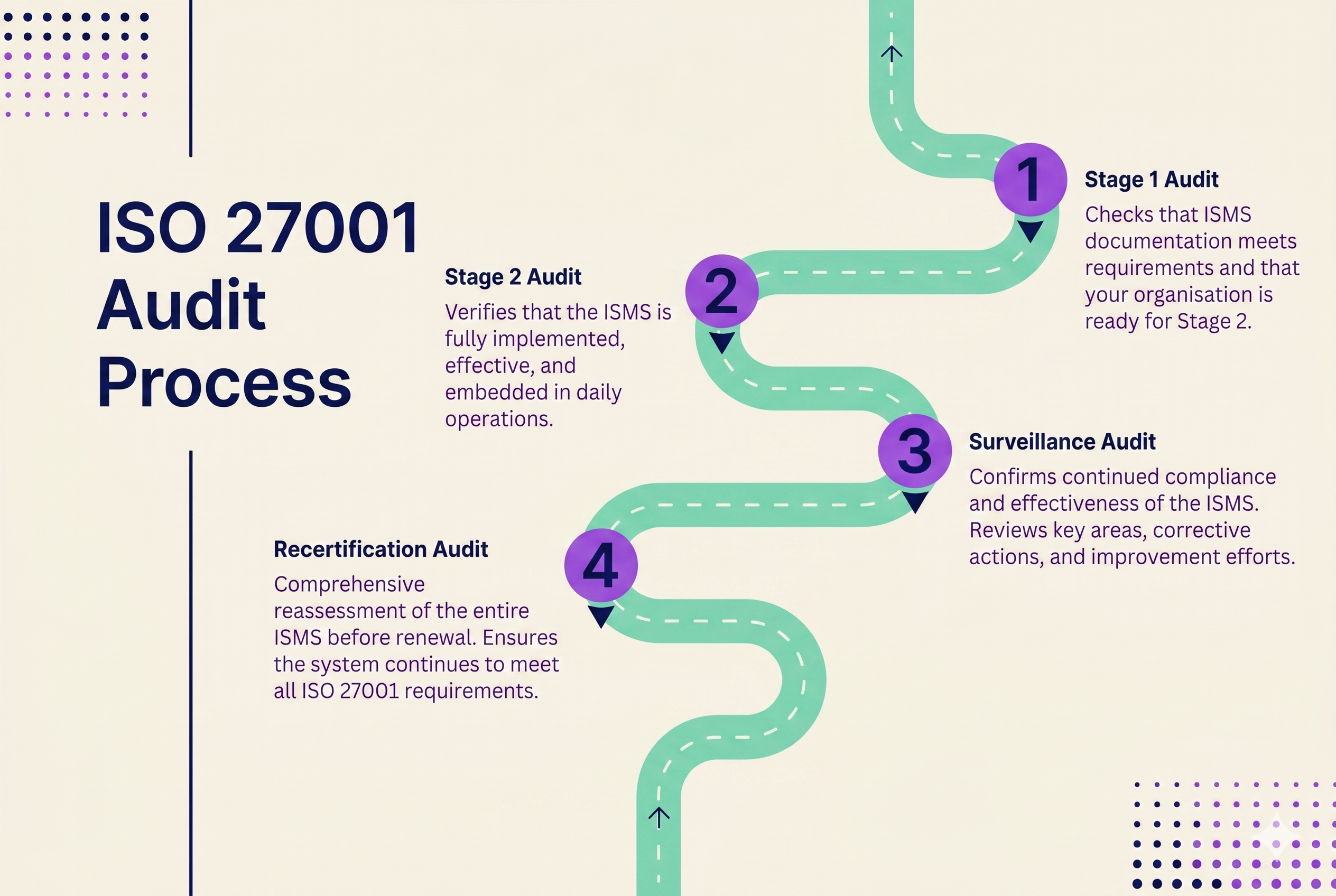
Image Source: YOUR ISO
The experience of implementing an ISMS to getting your ISO 27001 certification follows a well-laid-out process that confirms your security practices. Companies that become skilled at this process earn more than just a certificate. They gain a competitive edge in markets where security awareness keeps growing.
What is ISO 27001 certification?
ISO 27001 certification is an official confirmation from an accredited certification body that shows your organization’s ISMS meets all ISO 27001 standard requirements. This credential shows your steadfast dedication to protecting sensitive information through systematic processes that manage risks and implement security controls.
You’ll need to pass a multi-stage audit by an independent, accredited certification body. Auditors make sure your organization hasn’t just written down security policies – they check if you’ve put them into practice and managed to keep them working as part of an effective ISMS.
The certification takes three to twelve months based on your organization’s size, complexity, and current security setup. Once you pass, you receive a certificate good for three years. You’ll need yearly surveillance audits to show you’re still following the rules.
Stage 1 vs Stage 2 Audit Requirements
The ISO 27001 certification audit has two different phases. Each phase has its own goals and requirements:
Stage 1: Documentation Review The original assessment checks if you’re ready for certification by exploring your ISMS documentation. Auditors focus on:
- Making sure required documentation exists and matches ISO 27001 requirements
- Looking over your Statement of Applicability (SoA)
- Checking your risk assessment methods and reports
- Finding potential issues that could cause problems in Stage 2
Stage 1 looks at design rather than implementation. It answers a simple question: “Does your ISMS look right on paper?”. This phase usually takes about a month.
Stage 2: Certification Audit After you pass Stage 1, auditors move to Stage 2. Here they check if your ISMS works well and runs as documented. This deeper phase looks at:
- How you’ve implemented security controls from your SoA
- Proof that security processes work in real life
- How well staff knows and follows security policies
- Whether your risk controls work
Auditors collect evidence by reviewing documents, watching activities, and talking to your team. Stage 2 takes one to three months and ends with the certification decision.
Auditors might find problems, which they label as:
- Major nonconformities: You can’t get certified until you fix these and prove it
- Minor nonconformities: You can still get certified if you have a good plan to fix them
What is ISO 27001 certified vs compliant?
People often mix these up, but certification and compliance mean different things in ISO 27001:
Being ISO 27001 compliant means you follow the standard’s requirements and have the right controls in place. You decide this yourself – no outside verification needed. Compliance shows you’re following the standard’s best practices.
Being ISO 27001 certified means an accredited external group has checked and verified your ISMS meets all requirements. You get objective proof through a structured, independent review process.
This difference matters because:
- Certification gives you more credibility through third-party validation
- Certified organizations get regular checkups to ensure they keep improving
- Certification offers better proof for customers, partners, and regulators who need security assurance
After certification, you’ll need yearly checkups and full recertification every three years to keep your certified status.
Ready to start your certification experience? Book a Readiness Call to learn about your current security setup and create a path to ISO 27001 certification success.
Mapping ISO 27001 Domains to Real-World Controls
Organizations need a practical way to turn ISO 27001’s framework into real-life security measures. This requires a clear understanding of how each domain connects to actual controls. The standard takes a methodical approach by grouping controls into four themes that address different parts of information security.
Organizational Controls: Roles, Policies, and Governance
These 37 controls are the foundations of an effective ISMS. They create clear governance structures and frameworks for making decisions. The controls establish rules about how users, equipment and systems should behave.
Security policies serve as a prime example. Control 5.1 shows management’s commitment and direction. Control 5.2 removes any confusion about roles by clearly defining who does what in information security.
Third-party risk management plays a vital role through controls for supplier relationships (Control 5.19) and ICT supply chain security (Control 5.21). Supply chain weaknesses often become attack points, so these controls help organizations stay secure while working with partners.
Access control policies (Control 5.15) follow a simple rule – employees should only see what they need for their jobs. Most organizations use “need-to-know” and “need-to-use” principles to limit access based on job roles and business needs.
People Controls: Training, Awareness, and HR Security
Human behavior remains the most unpredictable part of information security. These eight controls guide organizations in managing security throughout an employee’s time with the company.
Background checks and competence verification happen before hiring (Control 6.1). The level of screening matches how sensitive the information access will be. Employment contracts spell out security responsibilities (Control 6.2), making security obligations legally binding.
Security awareness programs and training (Control 6.3) help prevent incidents by building a strong security culture. Organizations must run formal training on security policies, personal responsibility, and incident reporting.
Remote work security (Control 6.7) has become crucial as more teams work in hybrid models. This pairs with incident reporting procedures (Control 6.8) so employees know exactly what to do when they spot potential security issues.
Technological Controls: Encryption, Access, and Monitoring
Technical safeguards protect systems and data through 34 distinct controls. These measures secure networks, applications, and information assets.
Cryptography (Control 8.24) serves multiple security goals. It keeps data private through encryption, maintains integrity with digital signatures, prevents denial through cryptographic methods, and verifies system access. A solid cryptography policy must cover algorithm strength, key management, and regulatory needs.
Access management goes beyond policies. It combines privileged access rights (Control 8.2), information restrictions (Control 8.3), secure authentication (Control 8.5), and source code protection (Control 8.4). Together, these ensure only authorized people can reach sensitive data and systems.
System monitoring (Control 8.16) and logging (Control 8.15) track events to catch suspicious activity. Clock synchronization (Control 8.17) might seem minor, but accurate timestamps help connect events across different systems.
Smart implementation of these domain controls turns ISO 27001 from theory into practical security measures. This protects information assets from today’s threats.
Implementing ISO 27001: A CTO’s Roadmap
A methodical approach addressing both organizational and technical aspects of information security helps implement ISO 27001 successfully. CTOs who lead ISMS implementation can substantially increase their certification success rates by following a structured roadmap.
Defining ISMS Scope and Objectives
Your ISMS implementation starts with a precise definition of its coverage. The scope outlines the business areas, processes, assets, technologies, and locations within your ISMS boundaries. Your scope must include all interfaces and dependencies between components that are in-scope and those that aren’t.
Measurable targets that line up with business goals should drive your objectives. These targets need to address:
- Protection of sensitive information assets
- Compliance with contractual and regulatory requirements
- Improvement of security posture over time
- Reduction of security incidents
The scope definition shapes your entire implementation effort and determines both complexity and resource requirements.
Conducting Risk Assessment and Treatment
An effective ISMS implementation centers around risk assessment. This systematic process identifies information assets, their vulnerabilities, applicable threats, and potential effects if compromised.
Organizations can choose risk assessment methods that best suit their context since ISO 27001 standard doesn’t mandate a specific methodology. Whatever method you choose must:
- Identify information assets and assign ownership
- Determine potential vulnerabilities and threats
- Review likelihood and potential impact
- Calculate risk levels based on established criteria
- Prioritize risks based on established thresholds
Treatment plans for each identified risk need development after assessment. You can select from four options: modify (implement controls), retain (accept), avoid (eliminate), or share (transfer through insurance or third-party arrangements).
Developing the Statement of Applicability (SoA)
The Statement of Applicability is a vital document that connects risk assessment to control implementation. This document shows which of the 93 Annex A controls apply to your organization and justifies both inclusion and exclusion decisions.
Your SoA must document implementation status and selection justification for each applicable control. The completed SoA serves as your security control blueprint. It guides implementation efforts and gives auditors detailed evidence of your security approach during certification.
Business Value of ISO 27001 for CTOs
ISO 27001 brings real business value that affects your organization’s bottom line. CTOs working in competitive markets will find certification offers several strategic advantages that justify the investment.
Competitive Advantage and Market Access
ISO 27001 certification creates new business opportunities by showcasing your organization as a security-conscious provider. Many organizations have “categorically won business on the back of achieving registration to ISO 27001″ with “absolute direct correlation” between certification and contract acquisition. This edge becomes valuable during contract bids, as certified companies often cite ISO 27001 as a “key differentiator” that “adds to status in the marketplace”.
The certification helps eliminate time-consuming security questionnaires during procurement. Companies save resources by reducing audit preparation time and face-to-face auditor meetings while boosting their vendor credibility.
Operational Efficiency and Cost Reduction
Organizations often discover inefficiencies and outdated security measures during ISO 27001 implementation. This discovery lets them transform systems into leaner, more secure setups. Risk assessment guides the selection of specific controls, rather than implementing random or reactive measures.
The standard makes internal processes more efficient through better workflows and data handling. Companies that implement ISO 27001 see improved operations thanks to clear documentation and regular training. These improvements reduce confusion and create consistent operations.
Improved Incident Response and Business Continuity
ISO 27001 boosts business continuity through Annex A.17 controls that protect information security during adverse events. These controls require detailed plans to maintain information security continuity during disruptions. The plans define clear responsibilities, activities, and timeframes.
Research from the Uptime Institute shows that 70% of organizations with formal resilience programs had fewer severe incidents than those without such programs. This resilience keeps operations running smoothly. It reduces risks of missed deadlines, lost revenue, and damaged customer relationships while protecting the CIA (confidentiality, integrity, availability) of critical information assets.
Common Pitfalls and How to Avoid Them
Three major roadblocks can derail even well-planned ISO 27001 implementation projects. Organizations can prepare effectively and guide their certification experience without costly setbacks by understanding these challenges.
Underestimating Documentation Requirements
The sheer volume of documentation required for ISO 27001 catches many organizations off guard. The standard needs extensive documentation of policies, procedures, and controls. Actions don’t exist within the ISO 27001 framework without proper documentation. Organizations don’t deal very well with developing and maintaining complete documentation, especially without an existing framework. A document control system that manages versioning, approval, and distribution of policies and procedures will solve this challenge. This system ensures compliance with requirements while keeping available, regularly reviewed documentation.
Lack of Executive Buy-in and Cross-Team Arrangement
ISO 27001 implementation often stalls without strong leadership commitment. Organizations with strong executive leadership are 53% more likely to have successful ISMS implementations. Management might view ISO 27001 as just another burden rather than a strategic investment. Cross-functional collaboration becomes stymied by communication barriers, conflicting priorities, and cultural differences. Research shows teams participating in cross-functional collaboration finish projects on time 33% more frequently. Visible leadership participation in management reviews and consistent resource allocation will overcome resistance. Book a Readiness Call to assess your leadership engagement strategy.
Overlooking Continuous Improvement Obligations
Certification marks just the beginning of your ISO 27001 experience. Many organizations achieve certification but lose momentum afterward and neglect regular audits, risk assessments, and updates to policies and controls. This oversight undermines the entire system because “it’s possible to get an imperfect ISMS certified, but it’s impossible to keep it certified”. Your original certificate stays valid for three years, while surveillance visits verify operational effectiveness. A clear plan for ongoing monitoring, reviews, and improvement of your ISMS will ensure controls remain effective and arranged with evolving business objectives.
Conclusion
ISO 27001 goes way beyond a simple compliance checkbox. This standard serves as a detailed framework that protects your organization’s most valuable information assets. We have explored how this international standard creates a well-laid-out approach to information security management and delivers real business benefits.
Building an effective ISMS needs most important investments in time, resources, and organizational commitment. All the same, the returns are nowhere near the size of these investments because of a better security posture, competitive edge, and operational gains. Organizations with ISO 27001 certification face fewer security incidents, optimized operations, and better market access.
The four control categories—organizational, people, physical, and technological—create a detailed framework that covers every information security aspect. These controls work together to protect the confidentiality, integrity, and availability of critical information assets as threats evolve.
The certification experience might seem overwhelming at first. A structured roadmap in this piece helps organizations avoid common pitfalls with documentation, leadership commitment, and improvement needs. Success ended up depending on seeing ISO 27001 as a strategic business initiative that arranges with organizational goals, not just a technical standard.
CTOs find ISO 27001 certification offers a systematic way to manage information security risks. It shows stakeholders, customers, and regulators the right level of care. This framework also encourages security awareness culture throughout the organization.
Modern sophisticated cyber threats and regulatory requirements make ad-hoc security approaches risky. ISO 27001 gives organizations the structure, discipline, and improvement tools they need to build resilient security practices that adapt to changing risks.
Starting your ISO 27001 experience or looking to boost an existing ISMS? Note that certification marks the start of your security transformation journey. Your organization will develop mature security practices through ongoing risk assessments, regular audits, and continuous improvements. These practices protect information assets while supporting business growth.
Key Takeaways
ISO 27001 provides CTOs with a strategic framework that transforms information security from reactive measures into proactive business advantage through systematic risk management and comprehensive controls.
• ISO 27001 is a business enabler, not just compliance – Organizations report winning contracts directly due to certification, with 48,671 global certificates demonstrating market recognition and competitive advantage.
• The framework covers four control domains systematically – 93 controls across organizational (37), people (8), physical (14), and technological (34) categories provide comprehensive security coverage.
• Risk-based approach drives implementation success – Start with defining ISMS scope, conduct thorough risk assessments, and develop a Statement of Applicability that connects risks to specific controls.
• Certification requires two-stage audit process – Stage 1 reviews documentation readiness while Stage 2 verifies actual implementation, with certificates valid for three years requiring annual surveillance audits.
• Avoid three critical pitfalls for success – Underestimating documentation requirements, lacking executive buy-in, and overlooking continuous improvement obligations are the most common implementation failures.
The standard’s Plan-Do-Check-Act cycle ensures your ISMS evolves with changing threats while maintaining the confidentiality, integrity, and availability of critical information assets. Success depends on viewing ISO 27001 as a strategic business initiative rather than merely a technical compliance requirement.
FAQs
Q1. What exactly is an ISO 27001 Information Security Management System (ISMS)? An ISMS is a systematic approach to managing sensitive company information, encompassing people, processes, and IT systems. It includes a framework of policies and procedures to identify, manage, and reduce information security risks.
Q2. How does ISO 27001 certification benefit an organization? ISO 27001 certification demonstrates a commitment to information security, enhances customer trust, improves competitive advantage, and often leads to new business opportunities. It also helps streamline operations, reduce security incidents, and ensure compliance with various regulations.
Q3. Can you explain ISO 27001 in simple terms? ISO 27001 is an international standard that provides a framework for organizations to establish, implement, maintain, and continually improve an information security management system. It helps protect sensitive information through a risk-based approach tailored to the organization’s specific needs and size.
Q4. What are the key components of an ISO 27001-compliant ISMS? Key components include defining the ISMS scope, conducting risk assessments, implementing security controls, performing regular internal audits, and maintaining a process for continuous improvement. The system should address organizational, people, physical, and technological aspects of information security.
Q5. How long does the ISO 27001 certification process typically take? The certification process usually takes between three to twelve months, depending on the organization’s size, complexity, and existing security measures. It involves a two-stage audit process, with the certificate valid for three years subject to annual surveillance audits.