The European Union (EU) is moving full steam ahead with the world’s first comprehensive AI regulation, and the stakes couldn’t be higher. With fines reaching up to €35 million or 7% of global annual turnover, organizations worldwide need to understand their obligations under the EU AI Act now.
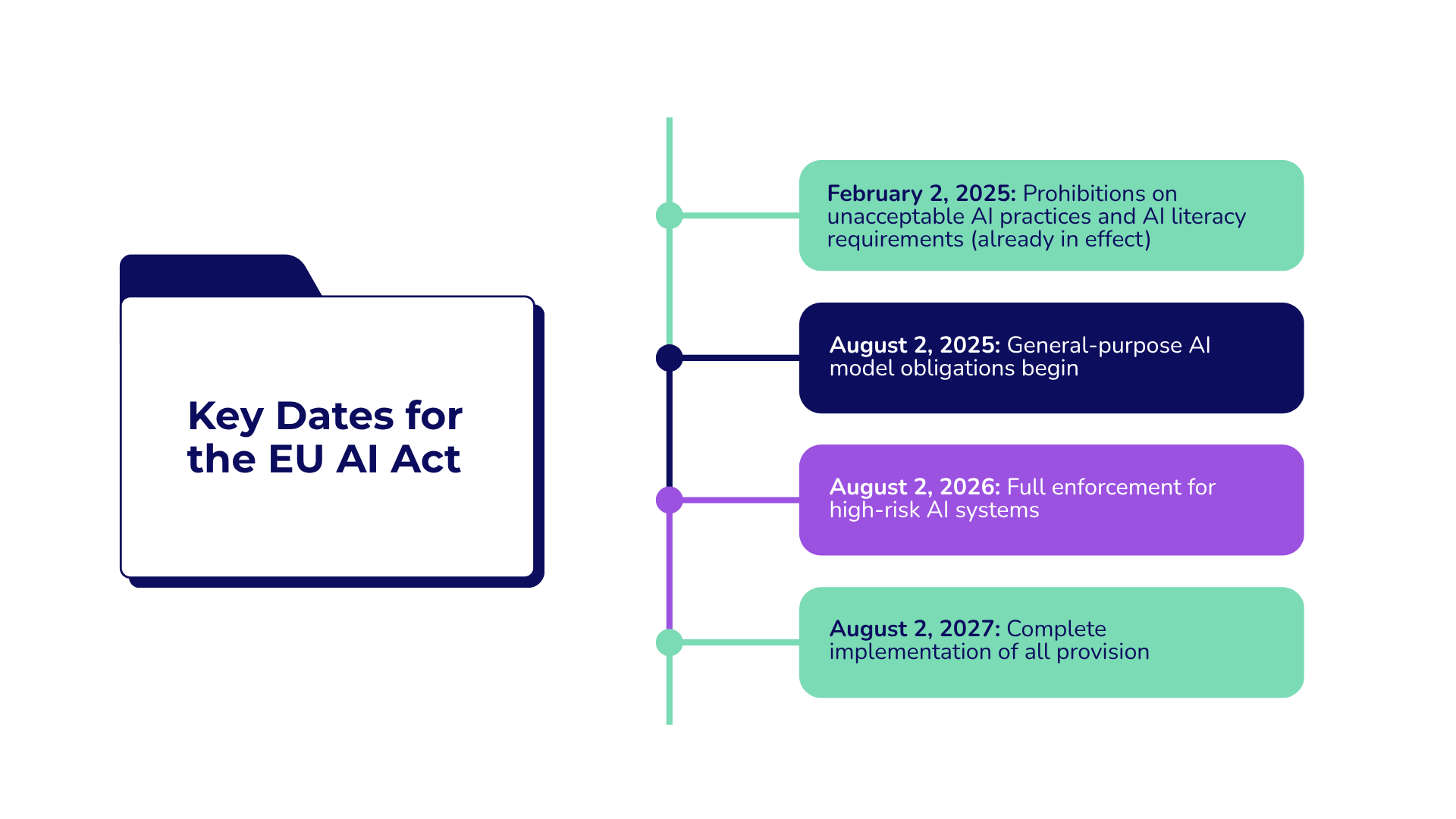
With mid-2026 as the official timeline for full implementation, the clock is ticking for businesses to assess their AI systems, align them with regulatory requirements, and mitigate the risks of non-compliance. But what exactly does this mean for your organization, and how can you ensure you’re on the path to compliance?
The EU Stands Firm on Implementation
The EU AI Act is the first comprehensive set of regulations aimed at governing artificial intelligence usage across different industries. Built on a risk-based approach, the Act categorizes AI applications into three groups based on their potential risks—“unacceptable risk,” “high risk,” and “limited risk.” Examples include banning manipulative AI systems and mandating strict guidelines for biometrics and AI used in sensitive areas like education, healthcare, and employment.
The significance of the EU AI Act cannot be overstated. It’s not just about compliance—it’s about fostering trust, protecting end-users, and ensuring ethical development and deployment of AI technologies. This regulation is poised to become a global standard, influencing how organizations worldwide approach AI solutions.
How the EU AI Act Can Impact Your Organization
The EU AI Act isn’t limited to companies physically located in Europe. The regulation applies to any organization that:
- Places AI systems or services on the EU market (AI Provider)
- Have AI outputs been used by persons in the EU (AI provider, AI deployer)
- Serves EU customers through AI-powered products or services (AI deployer)
This means that businesses, regardless of their location, must comply if their AI systems impact EU users in any way. The Act’s extraterritorial reach follows a similar pattern to GDPR, making it a global standard that affects international business operations.
General Purpose AI
The AI producer category under the EU AI Act is classified as “General Purpose AI,” which includes AI systems that may present systemic risks and are subject to specific transparency requirements. Additionally, AI systems can fall into other risk categories such as unacceptable, high, limited, or minimal risk depending on their application and potential harm.
What is General Purpose AI
General-Purpose AI models are highly versatile AI systems capable of performing a wide range of distinct tasks across various applications without being specifically tailored for one function. According to the EU AI Act (Article 3(63)), these models:
- Display significant generality, meaning they can competently handle many different tasks.
- Are often trained on massive datasets using self-supervised learning at scale.
- Typically have at least a billion parameters, enabling them to generate or analyze text, audio, images, video, and more.
- Can be integrated into diverse downstream systems or applications, powering everything from chatbots to content generation tools.
Large generative AI models like OpenAI’s GPT, Meta’s LLaMA 3, or IBM’s Granite are prime examples of GeneraI Purpose AI.
Why Does GPAI Matter Under the EU AI Act?
The EU AI Act explicitly regulates providers of general-purpose AI models because these systems have broad societal impact and potential systemic risks, including misinformation, bias, privacy violations, and safety concerns.
- Scope: The Act applies to all providers placing GPAI models on the EU market, regardless of their location.
- Risk-Based Approach: GPAI models without systemic risk face transparency and copyright obligations. Models with systemic risk (e.g., extremely large models with far-reaching capabilities) must meet stricter safety, security, and risk management requirements.
- Transparency: Providers must document model capabilities, limitations, and intended uses to ensure downstream users understand the AI’s nature.
- Copyright Compliance: The Act requires policies to respect intellectual property rights related to training data and outputs.
- Systemic Risk Management: For the most advanced GPAI models, providers must implement state-of-the-art safety measures to mitigate risks to public safety and fundamental rights.
Risk-Based Classification System
The EU AI Act categorizes AI systems into four risk levels:
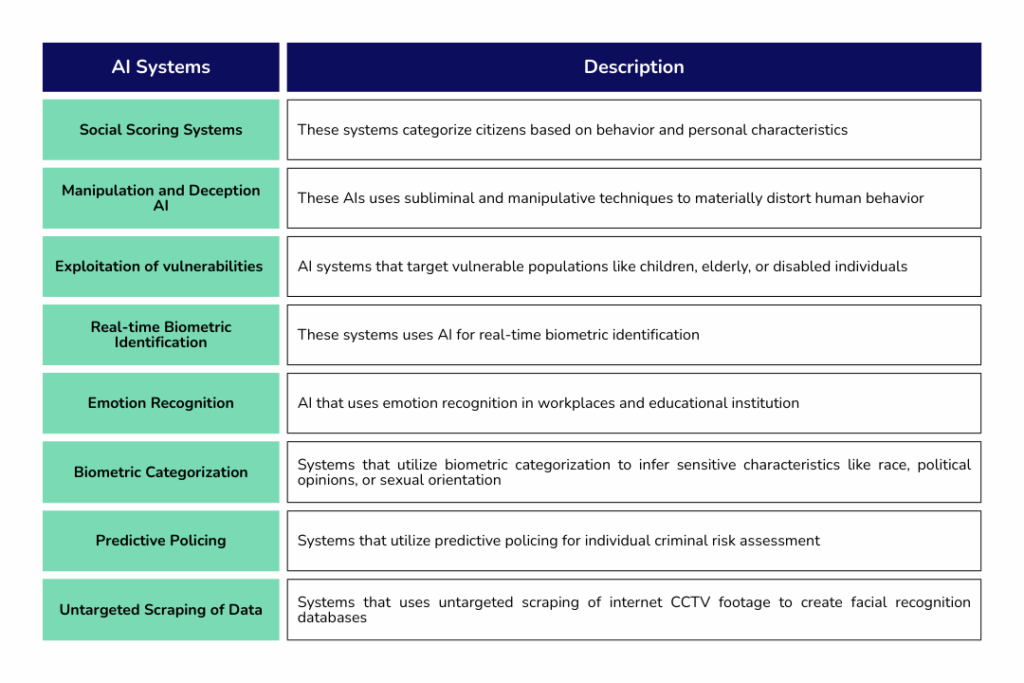
- Unacceptable Risk: AI systems that are completely banned, including social scoring, manipulative techniques, and real-time biometric surveillance in public spaces
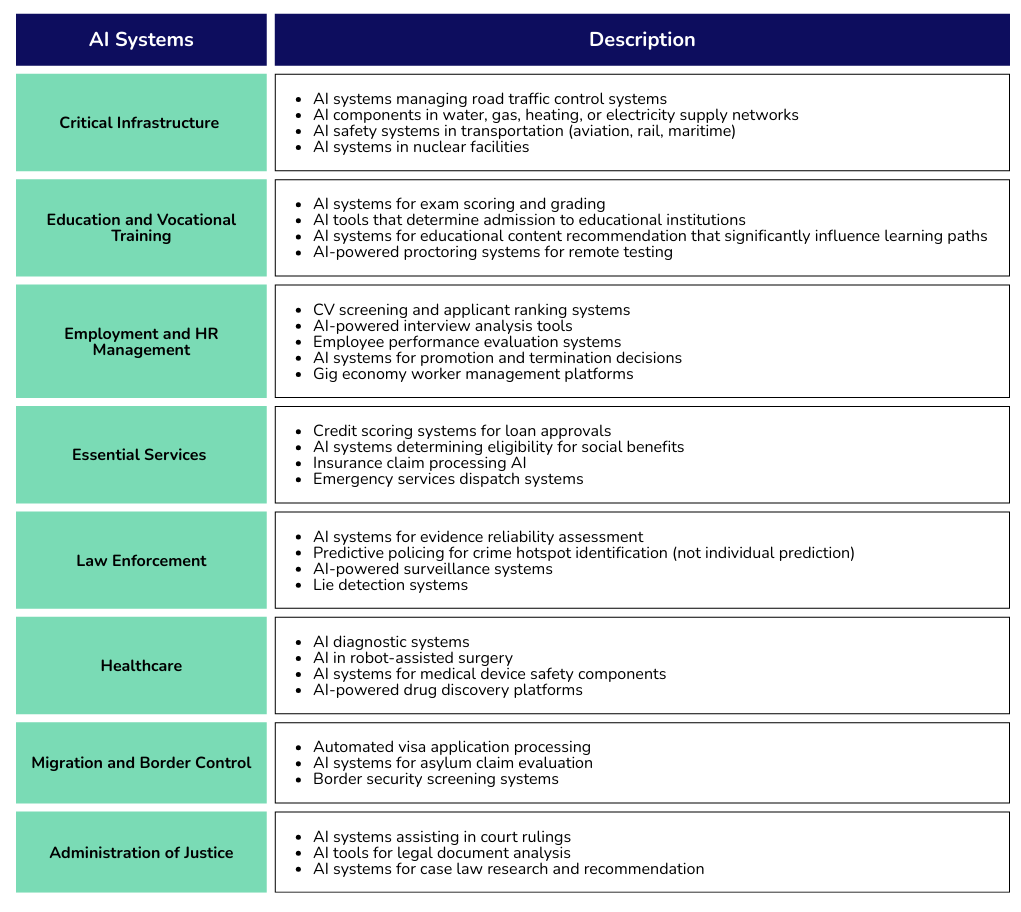
- High-Risk: AI systems used in critical infrastructure, education, employment, essential services, law enforcement, and justice administration – these face the strictest compliance requirements
- Limited Risk: AI systems like chatbots that require transparency obligations but have lighter regulatory burdens
- Minimal Risk: AI systems with minimal compliance requirements
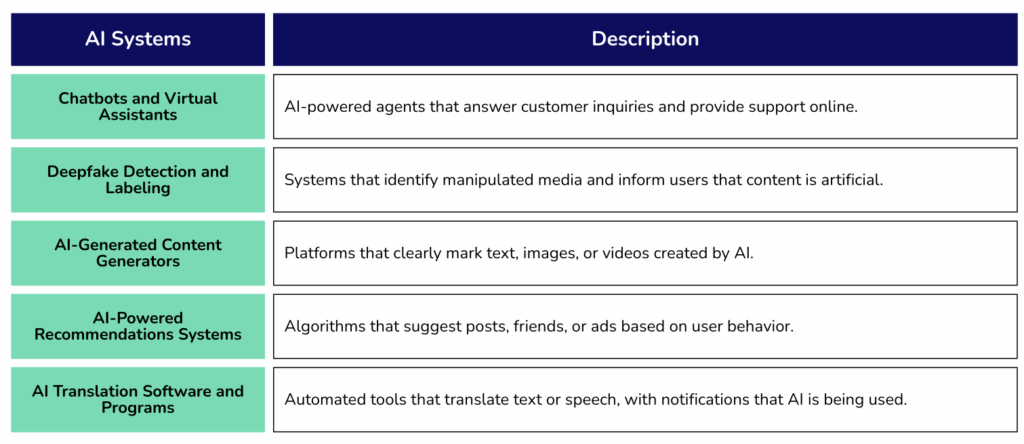
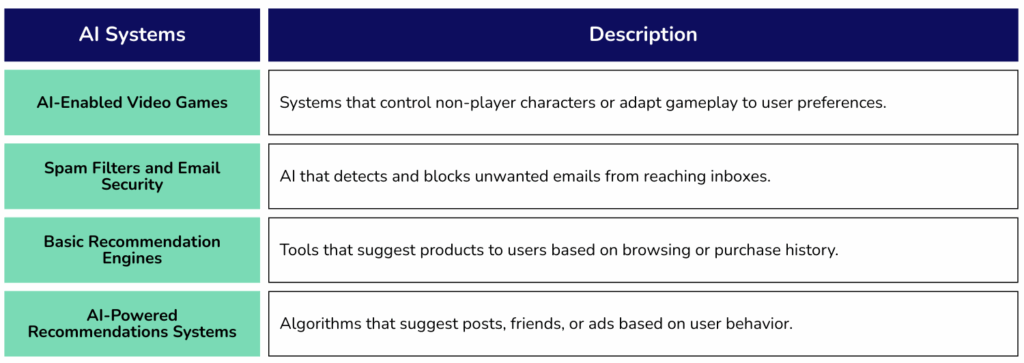
Risk-Based Classification System with Specific Examples
The EU AI Act categorizes AI systems into four risk levels with detailed examples for each category:
Unacceptable Risk – Completely Prohibited
High-Risk – Stringent Compliance Requirements
Limited Risk – Transparency Requirements
Minimal Risk – Light Regulation
What Your Organization Must Do to Comply
- AI System Assessment: Conduct a comprehensive audit of all AI systems your organization uses or provides. This includes identifying which risk category each system falls into and understanding the specific compliance requirements for each.
- Documentation and Governance: Implement robust documentation practices, including technical documentation, risk assessments, and quality management systems. High-risk AI systems require extensive documentation that must be maintained throughout the system’s lifecycle.
- Data Governance: Ensure your AI training data is accurate, representative, and properly managed. The Act requires strict data quality standards and traceability.
- Information Security and Privacy Controls overlap: Ensure additional landscape is reviewed. For instance, are embeddings vector databases reviewed for database inversion attacks, do you have controls in place for adversarial prompting, data leakage of models.
- Human Oversight: Establish clear human oversight mechanisms for AI decision-making processes, particularly for high-risk systems.
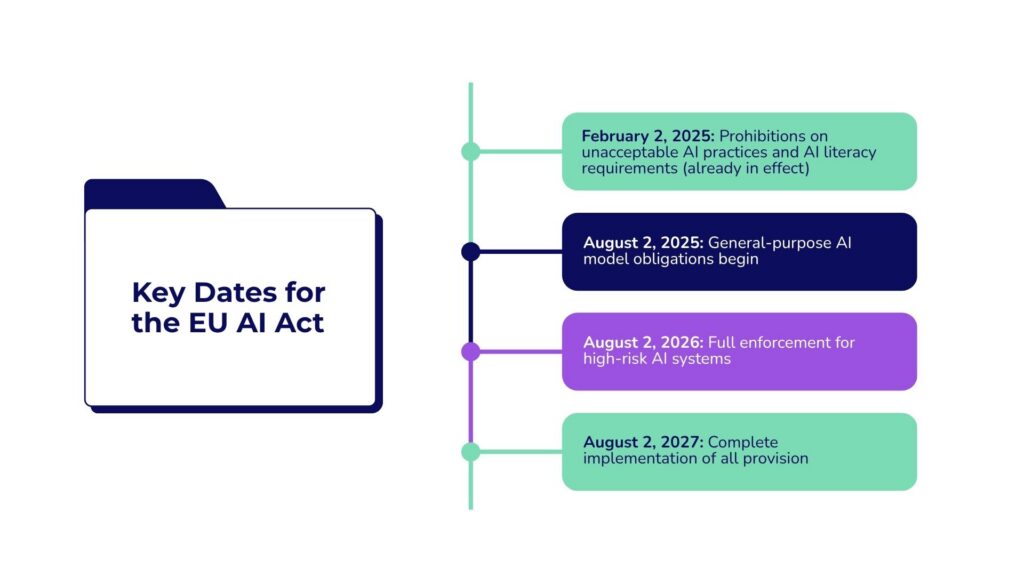
Key Dates on the EU AI Act
The implementation follows a phased approach:
The High Cost of Non-Compliance
The EU AI Act imposes some of the heaviest penalties in European regulation, surpassing even GDPR fines.
- Up to €35 million or 7% of global annual turnover for using prohibited AI systems
- Up to €15 million or 3% of global annual turnover for non-compliance with high-risk AI obligations
- Up to €7.5 million or 1% of global annual turnover for providing incorrect information to authorities
These penalties apply to organizations of all sizes, making compliance essential for business continuity and market access.
Industry Requirements by Sector
| Industry | Examples |
| Aerospace and Defense | The aerospace and defense sector relies heavily on AI for safety-critical systems, autonomous operations, and mission-critical decision-making. AI applications here are often classified as high-risk due to their direct impact on human safety, national security, and critical infrastructure. –Safety-Critical AI Systems: AI governs flight control, navigation, predictive maintenance, and autonomous drones, where failures can lead to catastrophic consequences. -Regulatory Alignment: Aerospace AI must comply with both the EU AI Act and existing aviation safety regulations (e.g., EASA’s Part-AI framework), ensuring seamless certification and conformity assessment. -Security and Trustworthiness: Defense AI systems require robust cybersecurity, transparency, and human oversight to prevent misuse or unintended harm. -Market Access: Compliance is essential for companies to participate in EU aerospace and defense contracts, which increasingly mandate adherence to the AI Act. |
| Manufacturing | Manufacturing increasingly integrates AI for automation, quality control, supply chain optimization, and predictive maintenance, making many AI systems high-risk due to their impact on safety, product integrity, and critical infrastructure. -Industrial Automation: AI controls robotic assembly lines and machinery, where malfunctions can cause workplace accidents or defective products. -Supply Chain AI: Algorithms managing inventory and supplier selection affect operational continuity and economic stability. -Critical Infrastructure: Manufacturing plants often form part of essential services, requiring compliance to prevent disruptions. -Data Governance and Traceability: The Act mandates strict documentation and risk management to ensure AI reliability and safety throughout the production lifecycle. |
| Information Technology | IT companies develop, deploy, and integrate AI systems across sectors, including cloud services, cybersecurity, software development, and AI platforms. Many of these AI applications fall under high-risk or limited-risk categories, triggering compliance obligations. -Cloud and SaaS Providers: AI embedded in cloud platforms serving EU customers must meet transparency and security requirements. -Cybersecurity AI: Systems detecting threats and automating responses are critical to protecting data and infrastructure, thus classified as high-risk. -General-Purpose AI Models: Providers of large language models or AI frameworks must comply with transparency and risk management rules. -Ethical AI Deployment: IT firms must ensure AI systems avoid bias, respect privacy, and provide human oversight, aligning with EU standards. |
| Professional Services | Professional services—including consulting, legal, financial, and engineering firms—use AI to support decision-making, automate processes, and deliver client services. AI applications here often involve sensitive data and high-stakes decisions, placing them in high-risk or limited-risk categories. -Decision Support Systems: AI tools that assist in legal analysis, financial advising, or engineering design impact client outcomes and require transparency. -Data Sensitivity: Handling confidential client data mandates strict data governance and compliance with AI Act data quality and privacy standards. -Human Oversight: Professionals must retain control over AI-assisted decisions to ensure accountability and ethical compliance. -Transparency and Disclosure: Clients must be informed when AI is used in service delivery, meeting the Act’s transparency obligations. |
| Critical Infrastructure | Critical infrastructure sectors—such as energy, water, transportation, and telecommunications—depend on AI for operational management, safety monitoring, and service delivery. AI systems here are predominantly high-risk due to their essential role in public safety and economic stability. -Operational Safety: AI manages grids, pipelines, traffic systems, and communication networks where failures can have widespread societal impact. -Risk Management: The AI Act requires comprehensive risk assessments, continuous monitoring, and resilience measures to prevent service disruptions. -Cybersecurity: Critical infrastructure AI must meet stringent cybersecurity standards to defend against attacks that could cripple essential services. -Regulatory Synergy: Compliance aligns AI governance with other sector-specific regulations, ensuring integrated safety and security frameworks. |
| Healthcare | Healthcare is one of the most heavily impacted sectors under the EU AI Act because virtually all AI applications in this field are classified as high-risk due to their direct influence on patient safety, health outcomes, and fundamental rights such as privacy. -High-Risk Classification: AI systems used in diagnosis, therapy planning, clinical decision support, remote patient monitoring, and medical imaging fall under the high-risk category. These systems require rigorous compliance with risk management, data governance, transparency, and human oversight obligations. -Dual Regulatory Framework: Healthcare AI must comply not only with the EU AI Act but also with existing medical device regulations (MDR/IVDR). This means manufacturers must ensure conformity assessments cover both traditional medical device safety and new AI-specific requirements like explainability and bias mitigation. -Data Governance and Bias Mitigation: Given the sensitivity of health data, the Act extends GDPR requirements by mandating comprehensive assessments of training data quality, representativeness, and bias to safeguard patient safety and prevent discriminatory outcomes. -Post-Market Surveillance: Providers must implement continuous monitoring and incident reporting systems to detect and mitigate risks arising from AI system use in healthcare. |
How Elevate can Help
Navigating the complex requirements of the EU AI Act requires specialized expertise that combines technical understanding with regulatory knowledge. Elevate brings together cybersecurity professionals, AI governance experts, and compliance specialists to provide comprehensive support for your AI Act journey.
As a free gift, for those who click and sign up for our newsletter, we complied an AI Regulations Tracker to help your organization understand AI regulations around the globe. Donwload here.