
The Department of Defense’s Cybersecurity Maturity Model Certification (CMMC) framework represents a critical shift in how defense contractors must approach cybersecurity compliance. For companies operating within the Defense Industrial Base (DIB), understanding the intricate relationship between CMMC requirements and Commercial and Government Entity (CAGE) codes is essential for successful compliance and continued access to government contracts. This comprehensive guide examines the intricacies of CAGE codes within the CMMC framework and offers practical guidance for organizations navigating these regulatory requirements.
Why CAGE Code Matters and How it Can Affect CMMC Compliance
CAGE codes matter because they uniquely identify each business entity within the Department of Defense’s contracting ecosystem, serving as the foundational link for tracking compliance, security requirements, and contract eligibility. Since CMMC compliance is assessed and enforced at the individual CAGE code level, each code represents a discrete entity that must independently meet cybersecurity standards based on the type of information it handles, such as Federal Contract Information (FCI) or Controlled Unclassified Information (CUI). This means organizations with multiple CAGE codes face multiplied compliance obligations, requiring careful management of System Security Plans, controls, and assessments to avoid redundant efforts and ensure all entities maintain certification.
Proper CAGE code management directly impacts the scope, cost, and success of CMMC compliance initiatives, making it a critical factor for contractors aiming to secure and sustain government contracts.
Understanding CAGE Codes: The Foundation of Government Contracting
What are CAGE Codes?
A Commercial and Government Entity (CAGE) code is a unique five-character alphanumeric identifier assigned by the Defense Logistics Agency (DLA) to suppliers conducting business with various government or defense agencies. This identifier serves as the government’s primary method for tracking and identifying businesses and their locations across the world, functioning similarly to how Social Security numbers uniquely identify individuals.
CAGE codes are integral to the establishment of security requirements for any project involving defense contracts, especially those handling secured information such as Federal Contract Information (FCI) and Controlled Unclassified Information (CUI). Every organization seeking to bid on government contracting jobs must obtain a CAGE code, as it represents the first step toward establishing a business relationship with the federal government.
CAGE Code Requirements and Management
The process of obtaining a CAGE code begins with registration in the System for Award Management (SAM.gov), where entities provide detailed legal and financial information. Once assigned, CAGE codes are tied to specific physical addresses and remain associated with the organization unless significant changes occur or deactivation is requested.
A critical aspect of CAGE code management is understanding its expiration cycle. CAGE codes now expire after five years and must be renewed to maintain validity. However, the renewal process is streamlined through SAM registration maintenance – as long as organizations keep their SAM registration current and active, their CAGE codes automatically renew without additional action required.
Multiple CAGE Codes and Organizational Structure
Large organizations often maintain multiple CAGE codes, with each code representing different business units, subsidiaries, or operational locations. This structure becomes particularly complex for companies that have grown through mergers and acquisitions, creating a hierarchy of corporate structures with varying levels of IT integration. Fortune 500 companies typically require multiple CAGE codes due to their diverse operations and geographic distribution.
How Does Multiple CAGE Codes Impact CMMC Compliance?
For companies with complex organizational structures, particularly those that have grown through mergers and acquisitions, understanding the relationship between CAGE codes and CMMC requirements is essential for developing efficient compliance strategies.
Each separate operation of a company can be assigned its own CAGE code, which means that medium to large organizations often maintain multiple CAGE codes representing different business units, subsidiaries, or operational locations. Since 2014, CAGE codes have been required for federal government contractors to create a uniform system for tracking hardware, software, and technical data when transferring items between DoD contractors and components.
Organizations with multiple CAGE codes face several unique challenges when pursuing CMMC compliance:
- Individual Compliance Requirements: The DoD identifies and contracts with companies based on their individual CAGE codes, and each CAGE code entity must meet cybersecurity and DFARS requirements independently. For companies with dozens or hundreds of CAGE codes, this can translate into significant compliance costs and complexity without strategic planning.
- Vertical IT Integration Challenges: Mergers and acquisitions often create a lag in vertical alignment among IT and shared services. Companies that grow through acquisitions frequently maintain separate IT infrastructures, which complicates the implementation of consistent security controls across all CAGE code entities
- CUI/FCI Management Complexity: IT systems are rarely designed to segregate and manage Controlled Unclassified Information (CUI) and Federal Contract Information (FCI) effectively across multiple business units. Rapid growth further complicates management’s ability to track all touchpoints as sensitive information flows through departments and affiliates.
- Documentation and Assessment Burden: Each CAGE code (or sets of CAGE codes based on the same controls in place) requires System Security Plan (SSP) coverage, which can lead to redundant documentation efforts and multiple assessments if not strategically managed. The Level 2 certification assessment cannot proceed without at least one valid CAGE code, and organizations must maintain proper CAGE code hierarchy documentation in their System for Award Management (SAM) records.
Strategic Approaches for Managing Multiple CAGE Codes
Despite these challenges, organizations can implement several strategies to streamline CMMC compliance across multiple CAGE codes:
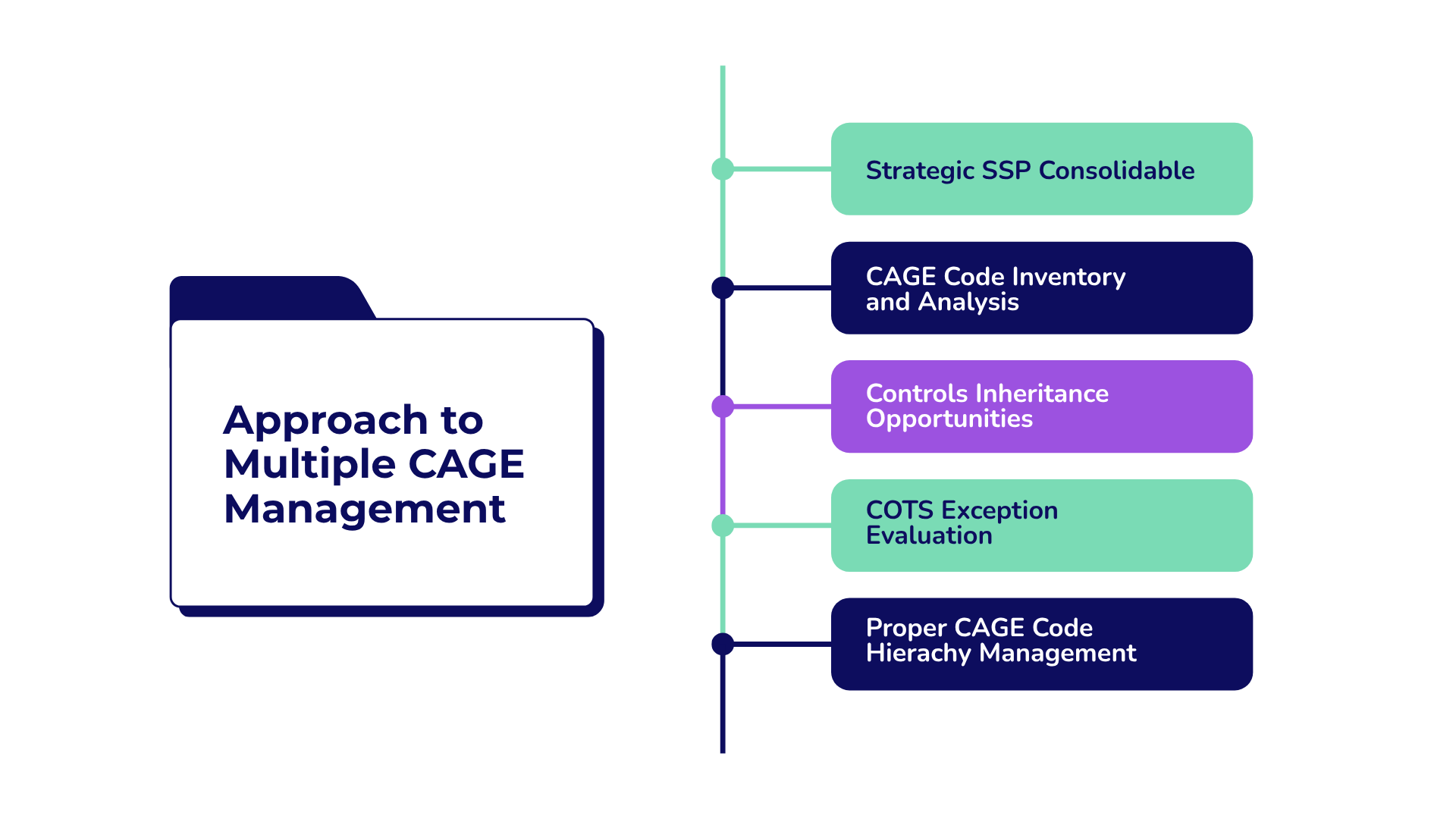
1. Strategic SSP Consolidation: Organizations can consolidate multiple CAGE codes under a single System Security Plan if they share common characteristics:
- Similar business functions and processes (same HR and entity-level controls)
- Shared network infrastructure
- Common security controls and procedures
- Unified IT management and oversight
The degree of vertical IT integration significantly affects the feasibility of using a single SSP for multiple CAGE codes. When mergers and acquisitions fuel growth and vertical IT system integration lags, the “One SSP for All” approach may not be viable.
Also, considerations for physical security controls are to be evaluated to ensure that if multiple organizations share the same SSP, the findings from separate controls across companies do not affect the certification of another company. Again, this consolidation is ideal for companies that share approximately 90% control commonality.
2. CAGE Code Inventory and Analysis: Begin by creating a comprehensive inventory of all CAGE codes, including their business functions, revenue sources, and information handling requirements. This inventory should identify which CAGE codes handle CUI versus FCI, as this distinction determines the required CMMC level.
Evaluate the DoD contract revenue associated with each CAGE code to determine if pursuing CMMC compliance is a sensible business decision for each entity. For CAGE codes with minimal DoD contract revenue, the cost of compliance may outweigh the benefits.
3. Control Inheritance Opportunities: Organizations should identify opportunities to inherit common controls, policies, and procedures among parent companies and subsidiaries. This inheritance approach can significantly reduce implementation effort and costs while maintaining security effectiveness.
For example, if multiple CAGE code entities share the same IT services, such as email systems, cloud services, antivirus protection, and monitoring capabilities, these controls can be inherited across multiple SSPs.
4. COTS Exception Evaluation: Evaluate whether any CAGE code entities qualify for Commercial Off-The-Shelf (COTS) exemptions, which can eliminate CMMC compliance requirements entirely. COTS products must meet specific criteria, including unchanged commercial availability, uniform pricing, and no government-specific modifications.
5. Proper CAGE Code Hierarchy Management: Maintain accurate CAGE code information and ensure the CAGE code hierarchy is correctly documented in the SAM record. This documentation is essential for the DoD’s Supplier Performance Risk System (SPRS) to recognize relationships between CAGE codes.
CAGE codes expire five years after the last update, so organizations should establish a process for regular review and renewal.
Assessment and Certification Considerations
When pursuing CMMC certification with multiple CAGE codes, several assessment considerations come into play:
- Assessment Scope Definition: A single CMMC assessment may cover more than one entity, but the assessment scope must be clearly defined and validated by the Certified Third-Party Assessment Organization (C3PAO). The assessment scope includes the boundaries within an organization’s networked environment that contain all assets to be assessed.
- CAGE Code Grouping Logic: The logic for grouping CAGE code entities into an SSP should be based on shared characteristics and the degree of IT vertical integration. Organizations should document their rationale for grouping CAGE codes to demonstrate a logical approach to compliance.
- Certification Status and Documentation: The C3PAO will issue a Level 2 Certificate of Status to a discrete information system, and the SSP identifies the system owned and operated by the Organization Seeking Certification (OSC). The certificate will include all CAGE codes affiliated with the assessment.
How Elevate can Help
Managing CMMC compliance across multiple CAGE codes requires a strategic approach that balances compliance obligations with operational efficiency. By understanding the relationship between CAGE codes and CMMC requirements, organizations can develop more effective compliance strategies that protect sensitive information while minimizing redundant efforts.
The key to success lies in identifying opportunities for control inheritance, strategic SSP consolidation, and proper CAGE code management. With careful planning and a thorough understanding of the organizational structure, companies can navigate the complexities of CMMC compliance across multiple CAGE codes while maintaining their competitive advantage in the government contracting marketplace.
We recognize that the intersection of CAGE code management and CMMC compliance represents one of the most complex challenges facing today’s defense contractors. Our comprehensive approach addresses these challenges head-on, providing organizations with the strategic guidance and technical expertise necessary to navigate this regulatory landscape successfully. Don’t let the complexities of CAGE code management and CMMC compliance jeopardize your position in the Defense Industrial Base. Partner with Elevate to develop a strategic approach that maximizes compliance efficiency while minimizing costs and administrative burden.
Get started on CMMC Compliance with our CMMC Assessment: Download here.