AI RISK MANAGEMENT
NIST AI Risk Management Framework
Implementation and Assessment Services
The NIST AI Risk Management Framework is voluntary, and it is also the closest thing the United States has to a recognized standard of care for AI. Texas TRAIGA makes alignment with it an affirmative defense. State legislatures reference it. Enterprise procurement teams ask for it. Elevate Consult builds AI risk programs against the framework’s four functions and produces the evidence that shows they operate, so an organization can answer a regulator, an auditor or a customer with records rather than intent.
THE FOUR FUNCTIONS
Govern, Map, Measure and Manage, built as operating controls
Effective January 1, 2026, TRAIGA provides an affirmative defense for organizations that comply with the NIST AI Risk Management Framework. Following Colorado’s repeal, that is the most significant statutory protection of its kind in the United States.
Govern
Policy, roles, accountability and culture
Establishes who owns AI risk, what the organization’s risk tolerance is, and how decisions get made and recorded. This is the function auditors test first, because everything downstream inherits it.
MAP
Context, purpose and risk identification
Builds the AI inventory, establishes the intended use and the foreseeable misuse of each system, and identifies the risks that follow from the context rather than from the model in isolation.
Measure
Assessment, testing and tracking
Defines how risk gets quantified and monitored: performance, bias, robustness, drift, and the thresholds that trigger action. Measurement without a threshold is reporting, not management.
Manage
Prioritization, response and monitoring
Allocates resources against measured risk, executes the response, and monitors whether the response held. Closes the loop back into Govern through documented decisions.
WHAT IT IS
A voluntary framework that carries real legal weight
The NIST AI Risk Management Framework, published as AI RMF 1.0 in January 2023, gives organizations a structured way to identify, measure and manage risk across the AI lifecycle. It is technology neutral, sector neutral, and deliberately written to apply from a single model to an enterprise portfolio.
Its practical authority comes from adoption rather than mandate. Texas TRAIGA, effective January 1 2026, provides an affirmative defense for organizations that comply with the framework. That makes it the most significant statutory safe harbor of its kind in the United States, and it became more significant in May 2026 when Colorado repealed SB 24-205 and removed the rebuttable presumption that statute had offered.
For organizations outside those specific statutes, the framework functions as documented evidence of reasonable care. It does not eliminate liability. It creates the record an organization relies on when liability is contested.
WHO NEED THIS
Organizations where AI risk has become a contractual or regulatory question
AI risk management stops being optional at a specific moment: when a customer, a regulator or an insurer asks for the record. The organizations below usually reach that moment before their program is ready.
Enterprises deploying generative AI
Organizations embedding LLMs or generative features into products or internal operations, where the risk surface changed faster than the governance did.
Regulated industries
Financial services, healthcare and critical infrastructure organizations where sector regulators have begun asking about AI risk management specifically.
Federal contractors and suppliers
Vendors whose contracts or customer security reviews now include AI-specific questions that a general security program does not answer.
Organizations with Texas exposure
Entities within scope of Texas TRAIGA, where documented AI RMF compliance is an affirmative defense rather than a best practice.
FRAMEWORK POSITIONING
How the AI RMF relates to the standards you already carry
The AI RMF is not a competing standard. It is the risk layer that other programs reference or extend, which means existing compliance work is usually reusable rather than duplicated.
ISO/IEC 42001
AI RMF is a risk framework; ISO 42001 is a certifiable management system standard
AI RMF work maps directly into ISO 42001 Clause 6 risk planning and Annex A controls
Only ISO 42001 produces an accredited certificate a buyer can verify
AI RMF is voluntary guidance; the EU AI Act is binding law with risk-tiered obligations
Risk assessment and documentation built for AI RMF supports Annex III high-risk conformity work
AI RMF alignment does not satisfy the Act, and Act compliance does not produce AI RMF conformity
EU AI ACT
CSF 2.0 governs cybersecurity risk; AI RMF governs AI-specific risk including bias and drift
Organizations running CSF 2.0 already have the governance scaffolding the Govern function needs
AI RMF adds risk categories that no cybersecurity framework covers
NIST CSF 2.0
CRI’s Financial Services AI RMF builds directly on the Govern, Map, Measure, Manage structure
Financial institutions should implement AI RMF through the FS AI RMF rather than alongside it
The sector framework adds control objectives and supervisory expectations NIST leaves open
CRI FS AI RMF
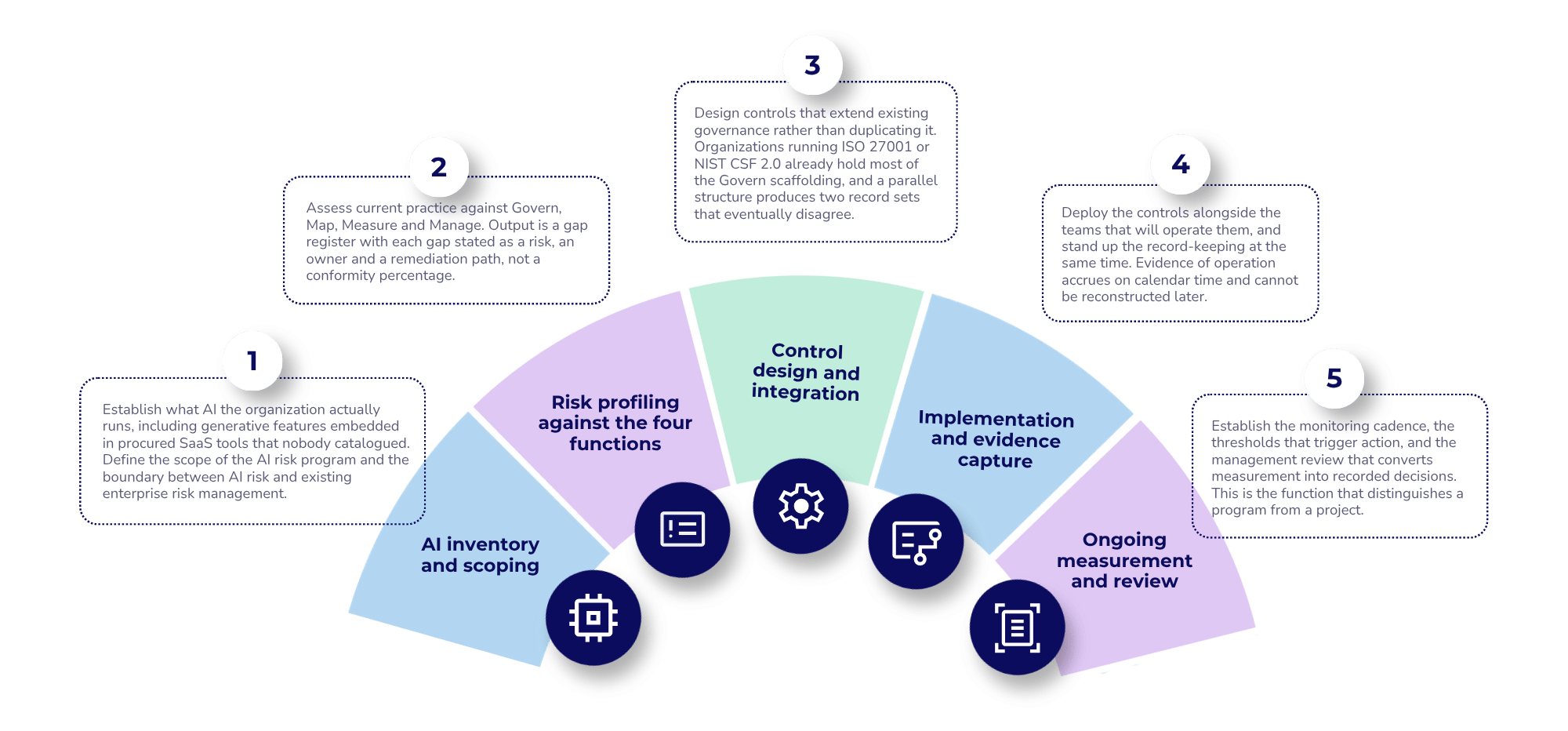
ENGAGEMENT PHASES
How the work runs
WHO THIS IS FOR
Roles Elevate works with on this standard
WHAT YOU GET
Structured outputs at each phase
Elevate Consult supports organizations through the full AI RMF lifecycle: inventory, risk profiling, control design, implementation and the ongoing evidence that keeps the program defensible after the first assessment.
AI inventory and risk register
A working inventory of AI systems in scope, each with its intended use, foreseeable misuse, risk classification and named owner, structured so it stays current rather than aging into a snapshot.
AI RMF gap assessment report
Function-by-function analysis against Govern, Map, Measure and Manage, with each gap carrying its risk, owner and remediation path, plus a mapping of existing compliance work that already satisfies part of the requirement.
Control design and policy set
AI risk policies, decision rights, escalation paths and control descriptions written to integrate with the management system the organization already runs.
Evidence and measurement framework
The monitoring cadence, thresholds, review artifacts and record structure that let the organization demonstrate the program operated, which is the part that carries weight with a regulator or an auditor.
GET STARTED
Ready to build an AI risk program that survives an audit?
Whether the driver is a customer security review, a Texas TRAIGA exposure, or a board asking what the organization’s AI risk position actually is, Elevate Consult provides the inventory, the gap assessment, the control design and the evidence framework that turn intent into a defensible record.
FAQ
Common Questions
Is the NIST AI Risk Management Framework mandatory?
No. The AI RMF is voluntary and non-binding. Its practical weight comes from adoption: Texas TRAIGA provides an affirmative defense for organizations that comply with it, several state statutes reference it, and enterprise procurement teams increasingly ask for alignment. Outside those specific contexts it functions as documented evidence of reasonable care rather than as a legal requirement.
Does AI RMF alignment protect us legally?
In Texas, alignment is an explicit affirmative defense under TRAIGA. Elsewhere it is evidence rather than protection. Colorado previously offered a rebuttable presumption for AI RMF compliance, but that provision was removed when SB 24-205 was repealed in May 2026. The framework produces the record showing an organization anticipated a risk, assessed it and acted, which is what matters when liability is contested.
How does the AI RMF relate to ISO 42001?
They complement each other. The AI RMF is a risk framework; ISO/IEC 42001 is a certifiable management system standard. Risk assessment and control work built for the AI RMF maps into ISO 42001 planning clauses and Annex A controls. The difference that matters commercially is that only ISO 42001 produces an accredited certificate a customer can verify.
We already run ISO 27001. How much of that carries over?
A substantial amount, on the Govern function especially. Risk registers, management review, internal audit, policy structure and escalation paths all transfer. What does not transfer are the AI-specific risk categories: bias, drift, explainability, foreseeable misuse and the behavior of models the organization procured rather than built. Those need new controls, not renamed ones.
How long does an AI RMF program take to stand up?
It depends on the AI inventory, whether an existing management system provides the governance scaffolding, and how many systems fall in scope. Two constraints do not respond to budget: building an accurate inventory takes longer than most organizations expect because generative features embedded in procured tools are routinely missed, and evidence of control operation accrues on calendar time.
Do we need this if we only use AI from vendors?
Yes, and often more urgently. Procured AI carries the same obligations to the organization deploying it, with less visibility into how it works. The Map function exists partly to surface exactly this: AI features embedded in SaaS tools that entered the environment through a procurement decision nobody flagged as an AI decision.