FedRAMP Consultant: What CR26 Changes About the Advisor Role for CSPs

Hiring a FedRAMP consultant in 2026 is a different decision than it was a year ago, because the Consolidated Rules for 2026 (CR26) rewrote the vocabulary, the deliverables, and the vetting criteria that separate a current advisor from a dangerous one. FedRAMP itself no longer uses the language most consultants were trained on, and it now tells cloud service providers directly that an advisor still speaking the old terminology is a warning sign. For a CSP evaluating who to trust with a federal market entry, that single shift reorders the whole vetting process. This article explains what FedRAMP actually recognizes as an advisor, what CR26 changed about the terminology and deliverables that advisor must master, and how to test a candidate before you sign. Why the FedRAMP Consultant Decision Changed Under CR26 The market word is consultant. FedRAMP’s word is Advisor, and under CR26 the gap between a current Advisor and an outdated one is now measurable in the terminology they use in the first conversation. FedRAMP renamed the game, and the terminology is now a vetting test CR26 did not invent the advisory role. FedRAMP has long listed Advisory Services in its Marketplace, and it still does, though it lists them without any formal quality review or endorsement. What CR26 changed is the entire model an advisor has to be fluent in. The program retired the vocabulary that defined FedRAMP for a decade and replaced it with a new structure built around Certification, Classes, and measurable security outcomes. FedRAMP has been unusually blunt about what this means for hiring. Its own guidance states that if an advisor offers to help you obtain a FedRAMP Authorization, or talks about impact levels of Low, Moderate, and High, that is an immediate warning that they are not following changes to FedRAMP, because FedRAMP no longer uses that terminology. The words a consultant chooses are now a live test of whether they are current or coasting on legacy knowledge. For the full picture of the rules driving this shift, see Elevate’s explainer on what the 2026 Consolidated Rules actually mean for cloud providers. The core problem: stale advisors are actively dangerous now An outdated advisor used to be merely inefficient. Under CR26, an outdated advisor is a liability, because the deliverables themselves changed. A consultant who builds you a traditional System Security Plan, sets up a continuous monitoring program in the old sense, and prepares a Plan of Action and Milestones is preparing artifacts that no longer match the program. Each of those has a CR26 replacement, and evidence assembled against the old model is rework waiting to happen. The risk compounds because FedRAMP moved from a requirements checklist to a capabilities model. A CSP that hires an advisor still thinking in terms of satisfying a static control list, rather than demonstrating measurable security outcomes, ends up with a program built on the wrong foundation. Fixing that after the fact costs far more than vetting properly at the start. Currency is also not a one time check. FedRAMP now communicates through community discussions and frequent updates rather than a static rulebook, so a capable advisor tracks those changes and can explain the reasoning behind them. Elevate’s recap of the 2026 Community Working Group updates for CSPs is one example of the moving context a current advisor is expected to follow closely. The cost of hiring the wrong advisor The cost of a stale advisor shows up in three ways. First, wasted effort: artifacts prepared against retired terminology and structures that have to be rebuilt. Second, lost time against hard deadlines, which matters because the CR26 transition runs on a fixed calendar that closes legacy paths on specific dates. Third, reputational exposure with the agency customer, because a provider whose advisor misunderstands the current program signals immaturity at exactly the moment it needs to signal readiness. None of these are hypothetical. They follow directly from the terminology and deliverable changes CR26 introduced, which is why the vetting bar is higher now than it has ever been. Consider the practical sequence: a provider engages a firm on the strength of a polished pitch, spends a quarter assembling a System Security Plan and a monitoring program in the legacy sense, then discovers at review time that the program expects a Security Decision Record and an outcomes based demonstration through Key Security Indicators. The wasted quarter is not just cost, it is a missed window against a calendar that does not pause, and it often lands at the exact moment an agency customer is deciding whether the provider looks ready. Vetting for CR26 currency at the start is the cheapest insurance against that outcome. Consultant vs Advisor vs Assessor: What FedRAMP Actually Recognizes Before vetting anyone, a CSP needs to understand the roles FedRAMP recognizes, because the market blurs three very different functions into the single word consultant. The FedRAMP Advisor (advisory service) The Advisor, or advisory service, is the role most buyers mean when they search for a FedRAMP consultant. An Advisor guides you through preparation, helps you understand the requirements, and coaches your team toward a defensible submission. FedRAMP acknowledges that providers new to the program will almost always benefit from a high quality advisory service, even though all the official guidance is publicly available. The important caveat is that FedRAMP lists advisory services in its Marketplace for public convenience only, without quality review and without endorsement. A Marketplace listing is not a credential. It confirms that the firm asked to be listed, nothing more, which puts the entire burden of quality assessment on you. The independent assessor, and why the two are not interchangeable The independent assessor is a separate, accredited role. Independent assessors are A2LA accredited, which advisors are not, and they perform the independent evaluation of your service. An advisor coaches; an assessor judges. A CSP works with an independent assessor regardless of whether it also hires an advisor, and the knowledge gained through that assessor partnership is part of the
FedRAMP Automation: When OSCAL Actually Saves You Time

FedRAMP automation is sold as a guaranteed shortcut to faster authorization, but the truth is more conditional: the underlying technology, OSCAL, only saves time under specific circumstances, and for some providers it adds work instead of removing it. The market is full of urgency-driven messaging tied to a 2026 deadline, yet FedRAMP itself has already softened the rule that drove most of that panic. This piece cuts through the noise. It explains where OSCAL genuinely accelerates FedRAMP readiness, where it does not, and how to decide whether adopting it now is a smart investment or premature overhead for your specific situation. What FedRAMP Automation Actually Means, and Where OSCAL Fits Before deciding whether automation saves you time, it helps to be precise about what is actually being automated. The confusion in this space comes from treating OSCAL and automation as the same thing. They are not. OSCAL Is the Format, Not the Automation OSCAL, the Open Security Controls Assessment Language, is a set of machine-readable formats developed by NIST in collaboration with FedRAMP. It expresses security control information as structured data in JSON, XML, or YAML rather than as narrative text in Word documents and spreadsheets. The critical point that vendor marketing tends to blur is that OSCAL is a language, not a tool. It ships with no automation capabilities of its own. By itself, OSCAL saves no time at all. The time savings come from the tooling that produces and consumes OSCAL, which is why FedRAMP has been explicit that it will not build that software and that industry must provide it. Our OSCAL explainer covers the format itself in depth. What OSCAL Structures OSCAL covers the entire lifecycle of security documentation through a layered set of models. Understanding these models clarifies where automation becomes possible, because each model is a place where structured data can replace manual effort. OSCAL model What it represents Catalog The control catalog, such as NIST 800-53 in machine-readable form Profile A tailored baseline selection for a specific use case Component Definition Reusable components and how they satisfy controls System Security Plan The system’s documented control implementation Assessment Plan and Results What is assessed, how, and the resulting findings POA&M The Plan of Action and Milestones The Component Definition model is where much of the genuine time savings live, because it lets you describe a reusable component once and import it across multiple authorization packages instead of rewriting the same control implementations by hand. The Mandate Is Real, but Narrower Than the Panic Suggests A great deal of FedRAMP automation marketing rests on the claim that machine-readable packages became mandatory for every provider in 2026. That framing is now outdated, and acting on it without understanding what actually changed can lead you to spend money on a timeline that does not apply to you. What RFC-0024 Originally Proposed In January 2026, FedRAMP released RFC-0024, which proposed requiring machine-readable authorization packages for all Rev5 providers, with an initial compliance date of September 30, 2026 and a final deadline of September 30, 2027 after which non-compliant services would lose certification. This is the version that drove the wave of deadline-focused messaging, and it is the version most third-party content still repeats. What FedRAMP Actually Decided After the public comment period closed, FedRAMP published its initial outcome and significantly revised the proposal in response to near-universal concern about the complexity and cost of converting legacy materials. The comprehensive machine-readable requirement now applies only to Rev5 Class D, the High baseline. For other Rev5 providers, FedRAMP committed to gradual adoption over a much longer period while still expecting all Rev5 providers to modernize within roughly two years. The final requirements and timelines were folded into the Consolidated Rules for 2026, and our FedRAMP CR26 breakdown covers where those rules landed. Where 20x Fits The picture differs for FedRAMP 20x, which was built around machine-readable submissions and automated validation from the start. RFC-0024 applied only to the Rev5 process and never governed 20x. If you are pursuing 20x, machine-readable data is not an optional add-on; it is the foundation of the path, validated through Key Security Indicators. The table below summarizes who actually faces what. Provider type Machine-readable requirement Practical timeline FedRAMP 20x Required by design, validated through KSIs In effect for the 20x path Rev5 Class D (High) Comprehensive per-service materials required Phased, with changes integrated twice yearly Other Rev5 (lower classes) Gradual modernization expected Within roughly two years, per CR26 The takeaway is that the existential deadline most providers were warned about does not apply to most providers. That changes the OSCAL decision from a panic into a deliberate question of timing and return. When FedRAMP Automation Saves You Time OSCAL and the tooling around it deliver real, sometimes dramatic, time savings, but only when the conditions favor it. These are the situations where adopting automation pays off. When You Run Multiple Offerings The strongest case for OSCAL is repetition. If you maintain several cloud service offerings, each with its own System Security Plan, the traditional approach forces you to document the same shared controls and components over and over in separate Word documents. OSCAL’s reusable component model lets you define a component once and import it across every package, which eliminates the copy-paste burden that consumes enormous effort at scale. The more offerings you maintain, the larger this saving becomes. When You Will Maintain Authorization Over Time Authorization is not a one-time event. Continuous monitoring, annual assessments, and significant change updates all require touching your documentation repeatedly over the life of the authorization. When your compliance data lives as structured information, updates propagate cleanly and validation runs automatically, which compounds the savings across every maintenance cycle. The reuse benefit that looks modest at initial authorization grows substantial over a multi-year authorization lifecycle. When You Have Tooling and a Mature Program OSCAL only saves time when paired with a platform or scripting pipeline that produces and validates it, and when the underlying security program is already
ISO 27001 vs NIST 800-53: How Much Transfers to Your FedRAMP Effort

ISO 27001 vs NIST 800-53 is the comparison that actually determines how much of your existing security program transfers when you pursue FedRAMP, because FedRAMP is built directly on the NIST 800-53 control catalog. The honest answer is encouraging at the foundation and sobering in the details. The two frameworks overlap heavily in concept, but the control-by-control mapping is partial, and FedRAMP demands a depth of technical implementation and a set of federal-specific controls that ISO 27001 never asks for. There is also a new development worth knowing, because a 2026 FedRAMP rule now creates a formal, if narrow, path to reuse an ISO 27001 certification for a temporary federal authorization. This piece breaks down exactly what overlaps, what does not, and how to sequence the work so your ISO 27001 investment does as much FedRAMP duty as it legitimately can. What Each Framework Actually Is, and Why the Comparison Matters for FedRAMP The two frameworks were built for different purposes, and that difference explains both the overlap and its limits. One is a globally portable management system; the other is a prescriptive federal control catalog. ISO 27001 in Brief ISO 27001 is an international standard for building and operating an information security management system. The 2022 version specifies 93 Annex A controls organized across four themes, Organizational, People, Physical, and Technological, alongside mandatory management clauses 4 through 10 that govern the ISMS itself. It is risk-driven by design, which means it tells you to identify risks and select controls to address them rather than dictating a fixed list of safeguards for every system. Certification comes from an accredited independent auditor on a three-year cycle. Our guide on ISO 27001 implementation covers how the risk treatment foundation gets built. NIST 800-53 in Brief NIST SP 800-53 is the US federal control catalog, and Revision 5 contains 1,196 controls across 20 control families. Unlike ISO 27001, it is prescriptive: it specifies which controls an organization must implement based on the impact level assigned to the system through a formal categorization process. A Low baseline involves roughly 125 controls, a Moderate baseline roughly 325, and a High baseline roughly 421. NIST 800-53 is not a standalone certification you earn; instead, it serves as the control foundation for federal compliance programs, including FISMA and FedRAMP. Why FedRAMP Makes This Comparison Concrete For a cloud vendor, the ISO 27001 vs NIST 800-53 comparison is not academic, because FedRAMP adopts NIST 800-53 as its control catalog. When you pursue FedRAMP, you are implementing a NIST 800-53 baseline plus FedRAMP-specific requirements layered on top. That is why the question “how much ISO 27001 work can I reuse in FedRAMP” reduces to “how much does ISO 27001 overlap with NIST 800-53.” Under the current FedRAMP structure, the former Moderate baseline corresponds to Class C, and our breakdown of the FedRAMP CR26 consolidated rules explains how those classes map to the legacy impact levels. Dimension ISO 27001:2022 NIST 800-53 Rev 5 Origin International standard (ISO/IEC) US federal standard (NIST) Structure 93 Annex A controls plus management clauses 4-10 1,196 controls across 20 families Approach Risk-based management system Prescriptive control catalog Certification Accredited independent auditor, three-year cycle No standalone certification; basis for FedRAMP and FISMA Role in FedRAMP Not a federal requirement on its own The control foundation FedRAMP is built on The structural contrast in that table is the root of everything that follows. A management system that selects controls based on risk will never line up perfectly with a catalog that prescribes hundreds of specific controls by mandate. How Much Overlaps: The Honest Number The overlap between the two frameworks is real and substantial, but the figure you will see quoted depends entirely on what is being measured. Treating any single percentage as gospel is a mistake. High Overlap at the Concept Level At the level of broad security domains, the overlap is high. Industry analyses place it as high as the mid-90s when the question is whether both frameworks address a given concept such as access control, incident response, or risk management. Both standards are fundamentally risk-driven and cover the same core territory of information security, so at this altitude they look very similar. This is why teams with a mature ISO 27001 program often recognize most of the FedRAMP control families immediately. Lower Overlap at the Control Level The picture changes when you map specific controls one to one. At that resolution, estimates drop, commonly to around 80 percent, because NIST 800-53 is far more granular and a single ISO 27001 control often corresponds to several NIST controls or only to a control enhancement. The authoritative reference here is NIST’s own published crosswalk between SP 800-53 Rev 5 and ISO/IEC 27001:2022, which maps the relationships directly. NIST attaches an explicit warning to that crosswalk: do not assume equivalency based solely on the relationship tables, because mappings are not always one to one and the analysis can be subjective. The table below shows where the overlap concentrates and where it thins out. Security domain Overlap with NIST 800-53 What it means for reuse Access control High Existing ISO controls map closely Cryptography High Strong conceptual alignment Incident management High Comparable objectives and evidence Risk assessment High Both are risk-driven at the core Audit logging High Direct control correspondence Privacy controls Low NIST has them; ISO 27001 has no direct counterpart Program management Low NIST-specific, no ISO equivalent The pattern is consistent: the technical and governance domains transfer well, while the federal-specific control families have no ISO counterpart and represent net-new work. What Transfers Well from ISO 27001 to FedRAMP Understanding what genuinely carries over lets you avoid rebuilding work you have already done. The transfer is strongest in two areas. Policy and Governance Foundation The management-system discipline that ISO 27001 forces you to build is a genuine head start for FedRAMP. A documented risk assessment methodology, defined risk ownership, established policies, internal audit processes, and management review cadence all map to expectations FedRAMP shares. If
FedRAMP vs CMMC: When Cloud Vendors Need One, the Other, or Both

FedRAMP vs CMMC is one of the most common points of confusion for cloud vendors entering the federal market, and getting it wrong is expensive in both directions. The two frameworks sound similar, both involve federal cybersecurity, both reference NIST standards, and both gate access to government business. But they govern different things, serve different customers, and are required under different circumstances. This piece breaks down exactly what each framework covers, when your business needs one, when it needs the other, and the specific scenario where you genuinely need both. What FedRAMP and CMMC Actually Are The fastest way to cut through the confusion is to understand that these frameworks answer two different questions. FedRAMP asks whether a cloud service is safe for a federal agency to use. CMMC asks whether a defense contractor is protecting sensitive government information across its own systems. What FedRAMP Governs FedRAMP, the Federal Risk and Authorization Management Program, governs cloud service providers that sell cloud products to federal agencies. If your business offers software as a service, infrastructure, or a platform that a federal agency will use to store or process its information, that use is within the scope of FedRAMP, and the agency can only adopt your service if it holds a FedRAMP Certification. The framework is built on the NIST SP 800-53 control catalog and exists so that agencies can rely on a single, standardized security assessment instead of evaluating every vendor independently. Our guide on FedRAMP for SaaS providers covers the foundational requirements in depth. What CMMC Governs CMMC, the Cybersecurity Maturity Model Certification, governs contractors in the Defense Industrial Base that handle sensitive government information under Department of War (DoW) contracts. It applies to your organization as a whole, or to the specific systems that store, process, or transmit Federal Contract Information and Controlled Unclassified Information. CMMC Level 2 is built on the NIST SP 800-171 control set and exists to verify that defense contractors actually implement the safeguards their contracts require, replacing the prior self-attestation model with third-party assessment. The CMMC certification requirements walk through what contractors must have in place before engaging an assessor. Side-by-Side Comparison The table below summarizes the core distinctions that determine which framework applies to your business. Dimension FedRAMP CMMC What it governs Cloud services sold to federal agencies Defense contractors handling FCI and CUI Primary customer Any federal agency using your cloud service The Department of War and its supply chain Underlying standard NIST SP 800-53 NIST SP 800-171 (Level 2) Information protected Federal data inside your cloud system Federal Contract Information and Controlled Unclassified Information Who assesses FedRAMP and recognized Independent Assessors C3PAOs at Level 2, DIBCAC at Level 3 Tiers Certification Classes A through D Levels 1, 2, and 3 Outcome FedRAMP Certification CMMC Certificate of Status A useful way to remember the distinction: FedRAMP certifies a product, while CMMC certifies an organization’s handling of information. The first travels with your cloud offering; the second travels with your role in the defense supply chain. The Core Difference: Cloud Service vs Defense Supply Chain The single most important distinction is the customer relationship each framework addresses. FedRAMP is about selling a cloud service to the government. CMMC is about being a contractor or subcontractor in the defense supply chain. These are not the same business activity, and many vendors occupy only one of them. A commercial SaaS company selling a project management tool to a civilian federal agency needs to think about FedRAMP, not CMMC, because it is providing a cloud service but is not a defense contractor handling CUI. A precision machining shop that manufactures parts for a defense prime and receives controlled technical drawings needs to think about CMMC, not FedRAMP, because it handles CUI but does not sell a cloud service to the government. The frameworks only converge in a specific set of circumstances, which is where most of the genuine confusion lives. When You Need FedRAMP FedRAMP becomes mandatory when a federal agency intends to use your cloud service within its information systems. The trigger is the agency’s use of your product, not your company size or your industry. You need FedRAMP when your business offers a cloud product that federal agencies will adopt to store, process, or transmit their information. This includes SaaS applications, cloud infrastructure, and platform services. The required assurance tier depends on the sensitivity of the data the agency will entrust to your system, ranging from the entry-level Class A through Class D for the most sensitive unclassified data, under the new Certification Class structure that replaced the former Low, Moderate, and High impact levels. If you are evaluating this path, our breakdown of the FedRAMP CR26 consolidated rules explains how the current framework is structured. What does not trigger FedRAMP is selling a non-cloud product, or selling a cloud product exclusively to commercial customers with no federal agency use. The framework is specific to cloud services consumed by the federal government. When You Need CMMC CMMC becomes mandatory when your DoW contract requires it, which happens when you handle Federal Contract Information or Controlled Unclassified Information in the course of performing that contract. The trigger is contract language combined with the type of information you handle. You need CMMC when you are a defense contractor or subcontractor and the relevant DFARS clause appears in your contract. Level 1 applies to contractors handling only Federal Contract Information and permits self-assessment. Level 2 applies to contractors handling Controlled Unclassified Information and, for most defense work, requires assessment by a Certified Third-Party Assessment Organization. Level 3 applies to the most sensitive programs and involves government-led assessment. Prime contractors must flow these requirements down to subcontractors based on the actual information each one handles, which means CMMC obligations cascade through the entire defense supply chain. Selecting the right assessor is its own challenge, and our guide on how to choose a CMMC C3PAO covers the criteria that matter. What does not trigger CMMC is performing federal
FedRAMP CR26: What the 2026 Consolidated Rules Actually Mean for Cloud Providers

FedRAMP CR26, the Consolidated Rules for 2026, is the most significant structural change the program has made in over a decade, and it arrived on schedule at the end of June. For any cloud service provider selling to federal agencies, the underlying security requirements have barely moved, but almost everything about how those requirements are labeled, documented, and assessed has changed. Elevate read the full ruleset so you don’t have to. This piece breaks down what changed, what stayed the same, and what it means for your roadmap between now and mandatory adoption, including one vulnerability deadline that lands in December 2026, ahead of the broader January 1, 2027 transition. What FedRAMP CR26 Actually Is FedRAMP CR26 is a single, consolidated rulebook that replaces the patchwork of memos, Requests for Comment, and notices that have governed the program since the FedRAMP Authorization Act passed. Understanding its structure matters because it changes how you will read and apply requirements going forward. From Scattered Memos to One Rulebook For the past two years, staying current with FedRAMP meant tracking a constant stream of RFCs and notices, with no fixed reference point. Providers consistently reported the same frustration: the rules kept changing, and there was no stable target to plan against. CR26 collapses that scattered guidance into one authoritative source organized into rulesets, subsets, and individual rules. The rules themselves are written as plain-language, declarative statements using the IETF RFC-2119 convention of MUST, MUST NOT, SHOULD, SHOULD NOT, and MAY. A rule reads as a responsible party, a force, an action, and the conditions under which it applies. This removes much of the interpretation gap that produced “ghost requirements” under the old narrative model, where commonly accepted interpretations were never actually written down. A Stable 30-Month Window The single most strategically important feature of CR26 is its shelf life. The ruleset is intended to hold from July 2026 through December 31, 2028, when it will be replaced by the next consolidated set. FedRAMP will still publish notices and minor adjustments during that window, but the structural pieces, including certification classes, the assessment model, and marketplace mechanics, are meant to stay put. For anyone trying to build a multi-year FedRAMP roadmap, this is the first realistic opportunity to do so in years. The compliance posture that earns certification in late 2026 will not be invalidated by a rule change in early 2027. Machine-Readable by Design CR26 maintains its source of truth as structured, machine-readable JSON published on GitHub, with the human-readable website serving only as a reference. The practical effect is that the FedRAMP requirements catalog now functions more like an API than a library shelf. If your governance, risk, and compliance pipeline can consume structured requirements, it can pull updates directly. This pairs with the program’s broader move toward machine-readable certification packages and connects to the same logic behind OSCAL-based documentation. The Terminology Changes That Affect Your Contracts and Documentation Most of CR26 changes labels, not controls. That sounds cosmetic, but if your contract language, sales collateral, or documentation templates hard-code the old terms, you have cleanup work ahead. The following table summarizes the shifts that matter most. Old term (pre-CR26) New term (CR26) What actually changed FedRAMP Authorized FedRAMP Certified Label only. Same controls, same boundary. Impact Levels (Low / Moderate / High) Certification Classes (A / B / C / D) New labels for existing baselines, increasing in assurance. System Security Plan (SSP) Security Decision Record (SDR) A living, verified record rather than a static narrative document. Third-Party Assessment Organization (3PAO) Independent Assessor New terminology plus stricter recognition rules. Authorization Package Certification Package Renamed to align with statutory language. The controls behind these labels have not materially changed. What changed is the vocabulary your team, your auditors, and your federal customers will use to describe them. “Authorized” Becomes “Certified” The single official label for all FedRAMP paths going forward is FedRAMP Certification or FedRAMP Certified. The term “FedRAMP Authorized,” which has appeared on vendor websites for years, is being retired as the operative phrase. This aligns with the FedRAMP Authorization Act, which defines a FedRAMP authorization as a certification by FedRAMP. A cloud service that is FedRAMP Authorized today becomes FedRAMP Certified under CR26, with the same controls and the same boundary. Impact Levels Become Certification Classes The FIPS 199 impact level labels of Low, Moderate, and High are being replaced by Certification Classes A through D. FedRAMP deliberately chose letters rather than numbers or the word “levels” to avoid confusion with the Department of War Impact Level system, which is a separate construct. The classes represent an increasing ladder of assurance, from minimal at Class A to significant at Class D. Certification Class Maps to (legacy baseline) Typical use Class A New pilot baseline Entry-level designation, often a step toward B, C, or D Class B Li-SaaS and Low Limited or low-sensitivity federal data Class C Moderate The majority of federal deployments, including most CUI Class D High The most sensitive unclassified government data If your offering is FedRAMP Authorized at the Moderate level today, the practical translation is that you are looking at Class C under CR26. Mapping your current baseline to the correct class is the right preparation activity right now, and it connects directly to the work covered in our guide on the FedRAMP Rev5 transition. The SSP Becomes a Security Decision Record CR26 replaces the traditional System Security Plan with the Security Decision Record. The SDR is a persistently maintained, verified, and validated record of the security decisions a provider makes over the lifecycle of a cloud service offering. It documents how applicable FedRAMP Practices are addressed, including implementation rationale, resulting customer risk, assessment findings, and supporting artifacts. The shift reflects the broader move away from static narrative documents toward records that stay current with the actual state of the system. 3PAOs Are Now Independent Assessors FedRAMP has retired the term “Third-Party Assessment Organization” in favor of “Independent Assessor,” aligning with the explicit terminology in
FedRAMP Continuous Monitoring: What Is Changing in 2026

FedRAMP continuous monitoring is about to change, and the timeline is short. In June 2026, FedRAMP issued two Public Notices that reshape how cloud service providers maintain a FedRAMP certification: one accelerates a vulnerability management overhaul tied to a new CISA directive, with a hard deadline of December 7, 2026, and another strips much of the legacy structure out of the Rev5 baselines. This article explains what is changing, by when, and what cloud service providers should do now. The Deadline That Matters Most On June 10, 2026, CISA published Binding Operational Directive 26-04, which reprioritizes vulnerability remediation across federal agencies based on public exposure, Known Exploited Vulnerability status, whether an exploit can be automated, and technical impact. In response, FedRAMP is accelerating its move away from legacy monthly scanning. Through Public Notice NTC-0014, FedRAMP will make its Vulnerability Detection and Response and Vulnerability Evaluation and Reporting rules mandatory for every cloud service offering that obtains or maintains a FedRAMP certification, effective December 7, 2026. This is a significant acceleration from the previously planned 2027 timeline. A grace period under a corrective action plan runs through March 7, 2027, and after that date FedRAMP certification will be revoked for any offering that is not following the rules. The blunt takeaway: the monthly vulnerability scanning that most Rev5 cloud services rely on today is no longer enough to satisfy the assurance agencies now require. How FedRAMP Continuous Monitoring Is Changing The new approach replaces a fixed monthly cadence with continuous, risk-based vulnerability management. In practice, providers are expected to determine whether vulnerabilities are reachable over the internet and whether they are likely exploitable, to assume by default that an exploit is automatable unless evidence shows otherwise, and to remediate Known Exploited Vulnerabilities on CISA timelines. Effort concentrates on the highest-risk exposures rather than treating every vulnerability the same way. For providers already authorized, this is the part of FedRAMP continuous monitoring most likely to require new tooling and process change. A practical view of the deliverables involved appears in this guide to FedRAMP continuous monitoring deliverables after an ATO. The Bigger Shift: Rev5 Baselines Are Being Simplified The second Public Notice, NTC-0013, summarizes outcomes from a series of earlier requests for comment and points to the FedRAMP Consolidated Rules for 2026, expected to be finalized by the end of June 2026. Two structural changes stand out. First, FedRAMP is removing the vast majority of FedRAMP-assigned control parameter values across all Rev5 baselines. Instead of inheriting fixed values, providers will set their own organization-defined values following NIST rules and document them for review. FedRAMP expects this to produce more secure implementations and more accurate documentation, because a FedRAMP-assigned minimum had often become a ceiling that providers did not exceed. Second, FedRAMP is removing nearly all FedRAMP-specific control guidance and consolidating the genuinely necessary requirements into a separate set of FedRAMP Rules. Alongside this, legacy document and spreadsheet templates give way to a machine-readable certification package built around a Certification Package Overview, a Security Decision Record, and a Secure Configuration Guide. For background on how the baselines and impact levels work, see the overview of the FedRAMP cloud security baseline and this explainer on FedRAMP impact levels. Why FedRAMP Is Doing This Both changes are part of FedRAMP 20x, the wider rearchitecture required by the FedRAMP Authorization Act and OMB Memorandum M-24-15. The aim is to reward commercial cloud offerings and automated assurance rather than government-specific versions and manual paperwork. FedRAMP has also confirmed that it will stop accepting new Rev5 certification requests on June 11, 2027, and that existing Rev5 certifications are expected to be retired no later than 2029. Providers weighing a fresh Rev5 effort should consider that it is a path being actively replaced. Key Dates for Cloud Service Providers What Cloud Service Providers Should Do Now Elevate Consult helps cloud service providers prepare for these changes through FedRAMP audit readiness, continuous monitoring support, vulnerability scanning, and penetration testing. Explore FedRAMP readiness support from Elevate Consult. How Elevate Consult Helps Elevate Consult advises cloud service providers on FedRAMP continuous monitoring, gap remediation, and audit readiness, with specialists in vulnerability scanning, penetration testing, and continuous compliance. With more than 18 years in regulated industries and over 500 penetration tests completed, the firm helps providers turn these new rules into a working program rather than a last-minute scramble. Elevate prepares and advises; it does not issue FedRAMP authorizations. Cloud service providers that want to be ready before December 7, 2026 can start a conversation with the Elevate team. Key Takeaways Frequently Asked Questions What is changing with FedRAMP continuous monitoring in 2026? FedRAMP continuous monitoring is shifting from a fixed monthly scanning cadence to continuous, risk-based vulnerability management. New Vulnerability Detection and Response and Vulnerability Evaluation and Reporting rules become mandatory for all FedRAMP cloud offerings on December 7, 2026, requiring providers to evaluate internet reachability, exploitability, and Known Exploited Vulnerability status rather than treating every vulnerability the same way. What is the FedRAMP vulnerability management deadline? The Vulnerability Detection and Response and Vulnerability Evaluation and Reporting rules are mandatory for all FedRAMP cloud offerings effective December 7, 2026. FedRAMP provides a grace period under a corrective action plan through March 7, 2027, after which a cloud service offering that is not following the rules will have its FedRAMP certification revoked. What is CISA BOD 26-04? CISA Binding Operational Directive 26-04, published June 10, 2026, directs federal agencies to prioritize vulnerability remediation based on public exposure, Known Exploited Vulnerability status, exploit automation, and technical impact. FedRAMP is aligning its rules to it so that cloud service providers meet the assurance agencies now require. Are FedRAMP-assigned control parameters going away? Largely, yes. In the Consolidated Rules for 2026, FedRAMP is removing the vast majority of FedRAMP-assigned control parameter values across all Rev5 baselines. Cloud service providers will instead set their own organization-defined values following NIST rules and document them for review by FedRAMP and agencies. When will FedRAMP Rev5 be replaced by FedRAMP 20x? FedRAMP will stop accepting new
Cybersecurity Compliance Frameworks: CMMC, ISO 27001, and FedRAMP

Companies pursuing federal or enterprise business quickly run into a wall of acronyms, and the most common question is which of the major cybersecurity compliance frameworks they actually need. CMMC, ISO 27001, and FedRAMP all signal that an organization takes security seriously, but they serve different markets, rest on different standards, and are earned in different ways. Choosing the wrong one wastes months and budget, while choosing the right combination can open doors that competitors cannot. This explainer breaks down what each framework is, how they compare side by side, where they overlap, and how to decide which one your organization needs. For teams that already know which path they are on, Elevate’s compliance advisory spans all three. The Three Frameworks at a Glance Each framework answers a different question about a different kind of trust, and that is the clearest way to tell them apart. CMMC The Cybersecurity Maturity Model Certification is the Department of War’s mechanism for protecting sensitive information across the Defense Industrial Base. Level 2, the tier most contractors need, is built on the 110 security requirements of NIST SP 800-171 and is assessed by an authorized C3PAO. Since late 2025 it has been a condition of award for many defense contracts, which makes it mandatory rather than optional for companies that want that work. Choosing a CMMC consultant early is how most contractors get there. ISO 27001 ISO/IEC 27001 is the international standard for an information security management system. Unlike the other two, it is voluntary and globally recognized, and any organization in any sector can pursue it. Certification is issued by an accredited certification body after a two-stage audit, and companies most often pursue it because customers, especially international ones, expect it as proof that security is managed systematically. FedRAMP The Federal Risk and Authorization Management Program governs how cloud service providers sell to United States federal agencies. It is based on NIST SP 800-53 and requires a rigorous authorization process involving a third-party assessor and a federal agency. For a cloud company that wants federal customers, FedRAMP is effectively the entry ticket to that market. CMMC vs ISO 27001 vs FedRAMP: A Comparison The frameworks are built differently and earned differently. The table below summarizes where they diverge. Dimension CMMC (Level 2) ISO 27001 FedRAMP Primary market Defense contractors in the DIB Any organization, worldwide Cloud providers selling to U.S. federal agencies Based on NIST SP 800-171 (110 requirements) ISO/IEC 27001 (ISMS) NIST SP 800-53 Mandatory? Yes, a condition of many DoD awards Voluntary, usually customer-driven Required to sell cloud services to federal agencies Assessed or certified by An authorized C3PAO An accredited certification body A 3PAO plus a federal agency authorization Scope Wherever CUI and FCI live A defined ISMS scope you choose The cloud service offering boundary Where the Frameworks Overlap Although they target different markets, these frameworks share a great deal of underlying DNA, and that overlap is an opportunity. CMMC and FedRAMP both trace back to NIST publications, and ISO 27001 covers many of the same control domains from a different angle. In practice, this means evidence and controls can often be reused across frameworks rather than rebuilt for each one. An organization with a mature ISO 27001 management system, for example, has already implemented many controls that map to NIST SP 800-171 or 800-53. Mapping controls across frameworks reduces duplicate work, lowers cost, and shortens timelines, which is why organizations pursuing more than one framework benefit from planning them together rather than in isolation. Which One Does Your Organization Need? The decision follows your market. If you want to win or keep Department of War contracts and you handle controlled unclassified information, CMMC is not a choice but a requirement. If you sell cloud services to United States federal agencies, FedRAMP is the path. If you serve commercial or international customers who want assurance that you manage security systematically, ISO 27001 is the recognized signal. Many organizations need more than one: a cloud company selling to both federal agencies and global enterprises may pursue FedRAMP and ISO 27001 together, while a defense-focused software vendor may combine CMMC with ISO 27001. The right move is to identify the markets you are pursuing, then build a single program that satisfies each applicable framework with as much shared evidence as possible. Book a Readiness Call with Elevate to map the frameworks your goals require and design one program that serves them all. Conclusion CMMC, ISO 27001, and FedRAMP are not competing options so much as different keys for different doors. CMMC is mandatory for defense work, FedRAMP is the path to federal cloud business, and ISO 27001 is the globally recognized signal of systematic security management. Because they share NIST and control-level DNA, an organization pursuing more than one can reuse evidence and avoid duplicate effort by planning them together. Identify your markets, then build once to serve them. Book a Readiness Call with Elevate to choose the right frameworks and build a program that scales across all of them. Key Takeaways CMMC, ISO 27001, and FedRAMP serve different markets, so the right framework, or combination, depends on the business you are pursuing. The most efficient path is rarely one framework at a time; it is one well-designed program that earns several frameworks from the same foundation of controls and evidence. FAQs Q1. What are the main cybersecurity compliance frameworks? For organizations pursuing federal or enterprise business, the three most common are CMMC, which protects defense information; ISO 27001, the international information security management standard; and FedRAMP, which governs cloud services sold to United States federal agencies. Each serves a different market and rests on a different standard. Q2. What is the difference between CMMC and FedRAMP? CMMC, based on NIST SP 800-171, applies to defense contractors that handle controlled unclassified information and is assessed by a C3PAO. FedRAMP, based on NIST SP 800-53, applies to cloud service providers selling to federal agencies and requires a third-party assessor plus an agency authorization. They serve different markets despite both
FedRAMP Continuous Monitoring: Life After Your ATO

Earning a FedRAMP Authorization to Operate is a milestone, but it is the start of the work, not the end of it. FedRAMP continuous monitoring is the ongoing discipline that keeps an authorization valid month after month, and it is where many cloud providers stumble, often because the partner who helped them reach the ATO disappeared once the certificate was issued. As the program shifts toward automation and continuous validation in 2026, the expectations for monitoring are rising rather than relaxing. This guide explains what FedRAMP continuous monitoring actually requires, why an ATO is the beginning rather than the finish line, how the 2026 changes affect it, and what to look for in a partner. For organizations planning the full journey, Elevate’s vendor-neutral compliance advisory is built to carry through authorization and beyond. What FedRAMP Continuous Monitoring Requires Continuous monitoring, often shortened to ConMon, is the set of recurring obligations a cloud service provider must meet to keep its authorization in good standing. The agency that granted the authorization relies on this stream of evidence to confirm the system stays secure over time. The Recurring Obligations At a minimum, ConMon includes monthly vulnerability scanning across operating systems, databases, and web applications, an annual penetration test, and ongoing management of the Plan of Action and Milestones, where findings are tracked and remediated within required timeframes. Providers submit monthly monitoring deliverables to the authorizing official, keep their inventory and documentation current, and file significant change requests when the system materially changes. An annual assessment by a third-party assessor rounds out the cycle. Capabilities such as managed vulnerability management and recurring penetration testing are what make this cadence sustainable. Why the Cadence Matters ConMon is not a formality. Missed scans, an unmanaged POA&M, or stale documentation erode the authorizing official’s confidence and can put the authorization at risk. The goal is to keep the security posture, and the evidence that proves it, from slipping between assessments so that authorization never dips. Why an ATO Is the Start, Not the Finish This is the point that catches providers off guard. An ATO reflects the system’s security at the moment it was authorized, but the system keeps changing: code ships, configurations drift, new vulnerabilities emerge, and personnel turn over. Without disciplined monitoring, the gap between the authorized state and the real state widens until an assessment or an incident exposes it. A common and costly mistake is treating authorization as a finish line and the partner who reached it as no longer needed. The providers that maintain authorization cleanly are the ones that treat ConMon as a permanent operational function rather than a project that ended at the ATO. How FedRAMP Is Changing in 2026 The program is moving toward automation, machine-readable evidence, and continuous validation. The traditional Rev.5 model remains active, while the newer FedRAMP 20x path emphasizes automation-ready architecture and evidence aligned to machine-readable expectations from the start. The 2026 updates also bring a standardizing label toward FedRAMP Certified and a shift from authorization levels to certification classes. For continuous monitoring, the direction is clear: less manual, periodic reporting and more automated, ongoing validation. Providers that build their monitoring to produce structured, machine-readable evidence will adapt to these expectations far more easily than those maintaining ConMon as a manual documentation treadmill. Building the evidence pipeline once, in a way that carries forward, avoids an expensive rebuild as 20x standards mature. What to Look For in a Continuous Monitoring Partner The most important quality is simple: a partner that stays after the ATO. Beyond that, look for vendor neutrality, so guidance fits your environment rather than a product you are being sold, and a partner that owns the full cadence of monthly scans, annual penetration testing, POA&M tracking, and documentation upkeep. The strongest partners also prepare your monitoring for the automation era so the program scales instead of consuming your team. A provider with current FedRAMP 20x experience can keep you aligned to where the program is heading, not just where it has been. Book a FedRAMP Strategy Assessment with Elevate to keep your authorization healthy and ready for what comes next. Conclusion FedRAMP continuous monitoring is the ongoing work that protects the investment an ATO represents. It means sustaining monthly scans, annual penetration tests, an actively managed POA&M, and current documentation, and increasingly it means producing machine-readable evidence as the program moves toward continuous validation. The providers that hold their authorization without drama are the ones that treat ConMon as a permanent function and choose a partner that stays for it. Book a Strategy Assessment with Elevate to operationalize monitoring that keeps your authorization from dipping. Key Takeaways FedRAMP continuous monitoring keeps an authorization valid after the ATO, and as the program automates in 2026 the expectations are rising rather than relaxing. The cloud providers that keep their authorization cleanly are the ones that treat continuous monitoring as a permanent function, not a project that ended the day the ATO was issued. FAQs Q1. What is FedRAMP continuous monitoring? It is the set of recurring obligations a cloud service provider must meet to keep its authorization valid, including monthly vulnerability scanning, an annual penetration test, ongoing POA&M management, monthly monitoring deliverables to the authorizing official, and an annual assessment. It provides the stream of evidence that confirms the system stays secure over time. Q2. What happens if a provider falls behind on ConMon? Missed scans, an unmanaged POA&M, or outdated documentation erode the authorizing official’s confidence and can put the authorization at risk. Continuous monitoring exists to keep the security posture and its evidence from slipping between assessments, so falling behind is a serious problem rather than a paperwork delay. Q3. Does an ATO mean the compliance work is finished? No. An ATO reflects the system’s security at the moment of authorization, but the system keeps changing as code ships and configurations drift. Without continuous monitoring, the gap between the authorized state and the real state widens, which is why ConMon is a permanent operational function rather than a one-time project. Q4. How
FedRAMP for SaaS Providers: Essential Requirements Cloud Vendors Must Meet

FedRAMP for SaaS providers is mandatory for any cloud vendor that creates, collects, stores, or transmits federal data, and almost everything about how you obtain it changed in 2026. The Consolidated Rules for 2026 (CR26) retired the word “authorization” in favor of “certification,” replaced the FIPS 199 impact level labels with Certification Classes, dissolved the Joint Authorization Board, and made FedRAMP 20x a real path rather than a pilot. Guidance written before June 2026 describes a program that no longer runs. This guide covers what FedRAMP for SaaS providers actually requires today: which Certification Class fits your product, how the Rev5 and FedRAMP 20x paths differ, the controls and documentation that survive the transition, and the continuous monitoring obligations that have quietly become the larger half of the commitment. What FedRAMP for SaaS Providers Means in 2026 Federal policy establishes FedRAMP as the sole pathway for cloud service providers to serve U.S. government agencies. A SaaS vendor cannot store or process government data without it, regardless of technical capability or market reputation, and the requirement applies equally to domestic and international providers. Certification, Not Authorization Start with the terminology, because it now carries legal precision. FedRAMP issues a FedRAMP Certification. A federal agency, not FedRAMP, issues the Authority to Operate for its own information system under the NIST Risk Management Framework. The FedRAMP Authorization Act defines a FedRAMP authorization as a certification by FedRAMP, so the new label simply aligns the vocabulary with the statute. “FedRAMP Certified” is now the single official designation across every path. “FedRAMP Authorized” is retired. A service holding a FedRAMP Certification is FedRAMP authorized for the purposes of meeting statutory and regulatory requirements, so nothing about your controls or your boundary changed. Your collateral did. Elevate’s explainer on FedRAMP certification versus an agency ATO covers the distinction that federal buyers will expect you to know. The Do Once, Use Many Model FedRAMP eliminates redundant security assessments through government-wide reuse. A provider completes certification once, and any federal agency can then draw on that package. Agencies reviewing an existing certification assess the standardized baseline, implement their customer responsibilities, and issue their own ATO based on their own risk determination. The reuse is substantial and it is the entire commercial case for the investment. The Government Accountability Office reported that the 24 CFO Act agencies collectively leveraged 1,478 FedRAMP authorizations as of April 2023, and that agency use of the program grew roughly 60 percent between 2019 and 2023. One certification, many agency customers. Certification Classes Replaced Impact Levels This is the change that invalidates most FedRAMP guidance published before mid-2026, and it is the one SaaS providers get wrong most often. How the Classes Map CR26 retired Low, Moderate, and High as names for FedRAMP certification baselines and replaced them with four Certification Classes. FedRAMP chose letters deliberately, avoiding both numbers and the word “levels,” to end the chronic confusion with the Department of Defense Impact Level system. Certification Class Replaces Paths available Class A New pilot tier, plus Legacy FedRAMP Ready Program path only, capped at two years Class B Low and LI-SaaS baselines Program or Agency, 20x or Rev5 Class C Moderate baseline Program or Agency, 20x or Rev5 Class D High baseline Agency path under Rev5 only, sponsor required Note what the table does not say. FIPS 199 impact levels still exist. Agencies still categorize their own information systems as low, moderate, or high, and FedRAMP explicitly instructs them not to treat a Certification Class as a one for one replacement for an impact level. What changed is that a FedRAMP baseline is no longer named after one. Elevate’s guide to FedRAMP Classes and controls and its breakdown of how the old levels map both cover the transition. A Class Is an Assurance Commitment, Not a Security Rating FedRAMP states directly that a Certification Class does not describe how secure a cloud service is. It describes the depth, frequency, and quality of the certification data a provider commits to supplying to agencies. A higher Class means more assurance information delivered on a tighter cadence, which raises both your initial effort and your recurring obligation. For a SaaS provider, this reframes the selection. You are not choosing how secure to be. You are choosing how much evidence you will produce continuously for federal customers, and therefore what it costs you to stay certified. Which Class a SaaS Product Needs Most SaaS products serving federal agencies land at Class C. GAO reported that approximately 76 percent of the authorizations agencies leveraged as of April 2023 were moderate-impact and 17 percent were high-impact, with the low baseline and its tailored SaaS variant together accounting for under 7 percent. Mapped onto CR26, roughly three quarters of the market sits at Class C. On the Rev5 path, Class B carries approximately 156 controls, Class C approximately 323, and Class D approximately 410. On the FedRAMP 20x path there is no control count at all, because assurance is demonstrated through Key Security Indicators and machine-readable evidence rather than a documented control set. Class D applies to systems supporting law enforcement, emergency services, financial operations, and healthcare, where compromise could produce severe or catastrophic consequences, and it is the only Class with no Program path and no 20x path. The Two Certification Paths: Rev5 and FedRAMP 20x FedRAMP for SaaS providers used to mean choosing between an Agency ATO and a JAB P-ATO. Neither exists. The Joint Authorization Board was dissolved, and with it the Provisional Authority to Operate. What replaced them is a choice on two separate axes: certification type and certification path. FedRAMP 20x Is No Longer a Pilot FedRAMP 20x began as a phased pilot, and much of the writing about it still describes that phase. With the finalization of CR26 at the end of June 2026, 20x is a formalized certification type with its rules published in the consolidated ruleset. Treating it as an experiment in a board presentation now dates you. 20x replaces the
FedRAMP 20X Assessment: What the New Model Means for Cloud Service Providers
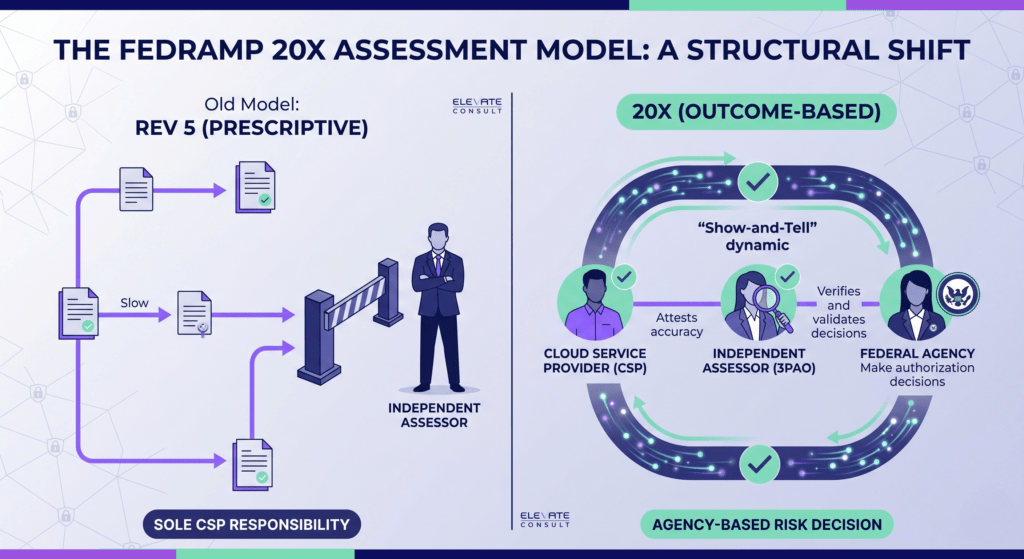
The FedRAMP 20X program is reshaping how cloud service providers demonstrate security to federal agencies. Independent assessors no longer issue pass-or-fail verdicts. They validate and verify. Agencies make the risk-based decision. This structural shift changes everything about how CSPs prepare for authorization, how assessors conduct reviews, and how the relationship between all three parties functions going forward. This piece distills what the May 2026 FedRAMP Community Working Group session revealed about assessment methodology, Key Security Indicators, and what CSPs can expect when they enter the 20X process. The Fundamental Shift: From Prescriptive Controls to Security Outcomes What FedRAMP 20X Is Actually Asking For Under Rev 5, controls came with one approved implementation path. Alternative approaches required extensive justification, and unwritten PMO preferences shaped what reviewers accepted regardless of what the baseline actually required. FedRAMP 20X replaces that framework with a different question entirely: what are you doing to achieve this security outcome, and how do you know it’s working? Key Security Indicators are not prescriptive requirements. They are outcome-based indicators of how seriously a business takes security. The KSI for executive support, for example, reads: “Executive support for achieving the provider’s security goals is persistently reviewed and demonstrated.” FedRAMP is not telling CSPs how to demonstrate executive support. It is asking CSPs to show what executive support actually looks like in their organization, and to prove it. This distinction matters because it means CSPs with genuinely mature security practices can present their actual environment rather than engineering documentation to match a template. Organizations that came to the 20X pilot with real executive involvement in security decisions produced more compelling KSI responses than those trying to reverse-engineer what reviewers wanted to see. Who Is Responsible for What One of the most consequential clarifications from the May 2026 CWG session involves accountability. Under the FedRAMP Authorization Act and M-24-15, the cloud service provider bears sole responsibility for the accuracy, completeness, and correctness of everything submitted for FedRAMP certification. The independent assessor’s role is to verify and validate that information, not to certify it. This is a meaningful departure from the 3PAO model established in the 2011 FedRAMP memo, where assessment organizations carried implicit gatekeeping authority. In the 20X framework, if a CSP attests that a security control is implemented and operational, they are signing a contract with the U.S. government on that claim. The independent assessor confirms the implementation is real and the documentation is accurate. FedRAMP makes the authorization decision. Assessors no longer recommend that agencies issue an ATO. How the Assessment Process Works Under 20X The Show-and-Tell Model Assessors at the May CWG session described 20X as a “show and tell” exercise. CSPs demonstrate how they are implementing each KSI, explain why they have made the security decisions they have made, and walk assessors through their environment in real time. Screen sharing, live dashboards, and direct access to configurations replace the screenshot-heavy documentation packages that characterized Rev 5 assessments. This makes the assessment more iterative and more conversational. Rather than presenting a completed package for review, CSPs and assessors work through KSIs together. If a CSP’s implementation raises questions, those questions get resolved in the session rather than through formal findings and resubmission cycles. Assessors confirmed that this model produces faster, more accurate results because both parties develop genuine understanding of the environment being assessed. Assessing One KSI, Not Thirty-Eight Controls A common point of confusion in the 20X transition involves the relationship between KSIs and the SP 800-53 controls they reference. A single KSI like the just-in-time access indicator maps to more than thirty underlying controls. That mapping exists as contextual guidance, not as a checklist. Independent assessors assess the KSI. They are not conducting a control-by-control review using the SP 800-53 mapping as a proxy. If a CSP is meeting the security capability that the KSI describes, the assessment reflects that, regardless of whether every related control is implemented in the traditional way. NIST SP 800-53A Revision 5 is explicit on this point: the failure of a single control, or even multiple controls, does not necessarily compromise the overall security capability an organization requires. This approach creates real flexibility for CSPs operating in constrained environments. A two-person engineering team does not need just-in-time access controls designed for enterprise-scale privilege management. If their existing MFA and SSO implementation achieves the security outcome, assessors document what they have built and agencies decide whether it is sufficient for their use case. What Assessors Are Looking For The shift from documentation review to outcome validation changes what good preparation looks like for a CSP. Assessors are not matching implementations against scripts. They are asking whether the CSP can articulate what they are doing, why they are doing it, and how they know it is working. CSPs that came to the 20X pilot having genuinely thought through their KSI responses outperformed those that approached the process as a compliance exercise. The difference was visible: organizations with real security cultures produced substantive, confident responses because they were describing decisions they had already made. Organizations trying to satisfy an external requirement produced thinner, more formulaic responses that required more follow-up. What Changed for Independent Assessors A Lighter Documentation Burden, Higher Technical Judgment The volume shift between Rev 5 and 20X is significant. FedRAMP Rev 5 assessed 323 controls. The 20X KSI set is in the range of forty to sixty indicators. The documentation burden drops accordingly, which assessors expect will reduce assessment costs for CSPs, particularly smaller vendors who could not absorb the overhead of full Rev 5 packages. The trade-off is that assessors are now exercising more technical judgment on fewer, more substantive questions. Rather than verifying that hundreds of cells in a compliance spreadsheet are correctly populated, assessors are reading narrative descriptions of security implementations and evaluating whether those implementations actually achieve the stated security outcomes. That requires deeper familiarity with the environments being assessed and less tolerance for generic, template-driven responses. QA in a Less Prescriptive Environment Quality assurance within assessment