
OSCAL brings a fresh approach to security compliance documentation. NIST’s Open Security Controls Assessment Language sets a standard for documenting, implementing, and assessing security controls in machine-readable form, making the whole process faster and less error-prone. Machine-readable compliance is now the clear direction of the FedRAMP program, and in 2026 FedRAMP moved from encouraging it to requiring it for part of the provider base, with the broader transition phased in over the following two years.
This guide explains what OSCAL is, how it accelerates FedRAMP authorization, where its real limits are, and exactly what the 2026 rules require of you.
What is OSCAL and what does it mean for FedRAMP?
The Open Security Controls Assessment Language (OSCAL) is a structured, machine-readable format for security control information. NIST created it to solve the scattered, inconsistent documentation that has long slowed the FedRAMP authorization process. It provides a shared language that helps cloud service providers, Third-Party Assessment Organizations (3PAOs), and agencies communicate the same way. OSCAL supports many frameworks, including FedRAMP, FISMA, HIPAA, NIST SP 800-53, ISO 27001, SOC 2, and PCI DSS. For providers earlier in their journey, our guide on FedRAMP for SaaS providers covers the foundational requirements OSCAL helps you document.
Standardizing Security Control Documentation
Security control documentation has long suffered from inconsistency. Organizations each develop their own way to document controls, which creates friction during assessment and authorization. OSCAL resolves this by defining a uniform structure for expressing security controls, implementation statements, assessment procedures, and results.
The standardization means stakeholders interpret security requirements consistently, controls and implementations map clearly, assessment evidence is documented precisely, and risk findings follow a standard expression. For cloud service providers pursuing FedRAMP authorization, this uniformity matters: misinterpretations and inconsistencies are exactly what create costly delays. When every party speaks the same language of controls, the process moves faster.
Replacing Word/Excel with XML, JSON, YAML
For years, compliance relied on static Word, Excel, and PDF documents. Those formats resist automation, require manual updates whenever frameworks or implementations change, and make control validation difficult. OSCAL replaces them with structured, machine-readable formats (XML, JSON, and YAML) that software can parse, automated processes can validate, tools can convert between representations, and users can query for specific control information. This shift from static documents to dynamic data is what enables automation across the entire compliance lifecycle.
Supporting FedRAMP, CMMC, and NIST RMF
Although NIST built OSCAL, its value spans multiple compliance frameworks. Organizations that must comply with overlapping standards struggle to maintain documentation across all of them. OSCAL’s common structure supports FedRAMP authorization packages, CMMC documentation, NIST Risk Management Framework artifacts, and other frameworks that reference NIST SP 800-53 controls. This lets an organization keep a single source of truth for its control implementations and generate framework-specific deliverables automatically when something changes, which substantially reduces the ongoing maintenance burden. This same multi-framework logic underpins FedRAMP’s own move to let providers reuse external assessments, which our RFC-0022 external frameworks guide explains in detail.
Key Benefits of Using OSCAL for FedRAMP

Image Source: Telos Corporation
OSCAL simplifies the FedRAMP authorization by turning documents into structured data and removing the bottlenecks that traditionally slow compliance work.
Faster SSP Creation and Validation
OSCAL changes how System Security Plans are created. The traditional approach to a FedRAMP-compliant SSP took hundreds of hours of manual writing. With validated OSCAL templates, that work can drop dramatically, with some vendors reporting SSP generation in a tiny fraction of the former time. OSCAL tools can also check for errors before submission, which cuts review cycles. One federal agency reduced its Authority to Operate documentation time from six weeks to three days. The gains come from machine-readable SSPs that the Program Management Office can review quickly, cleaner formatting that reduces back-and-forth, and error checking that happens before formal submission.
A reality check belongs here, though. The promise and the practice are not yet the same thing. In 2025, FedRAMP processed more than 100 Rev5 authorizations without a single submission that used OSCAL, and no formal participant in the FedRAMP 20x Phase One pilot used it to structure the required machine-readable materials. The tooling and time savings are real, but adoption is still catching up, which is precisely why the requirements below matter and why the question of timing deserves careful thought. Our analysis of when FedRAMP automation actually saves time breaks down exactly when adopting OSCAL pays off and when it adds overhead.
Improved Accuracy with Machine-Readable Formats
Machine-readable formats remove the human errors that creep into manual documentation. Assessments that used to take months can finish far faster and with fewer mistakes. Structured data keeps control implementations consistent, lets providers validate documentation before submitting, and gives assessors clear, standard formats that leave little room for confusion. The effect is that the process centers on security rather than paperwork.
Automation of SAP and SAR Generation
3PAOs gain the ability to automate how they plan, run, and report assessments. They can auto-generate Security Assessment Plans and Security Assessment Reports from templates, validate them automatically, and present them in different views. This links controls directly to test methods and evidence, showing exactly how requirements connect to proof. It also supports continuous authorization, letting providers monitor security continuously rather than in periodic snapshots.
Support for Multiple Frameworks Simultaneously
OSCAL lets an organization assess its controls once and reuse that work across many frameworks. Rather than repeating documentation for each standard, providers maintain one source of truth and let security changes propagate automatically across every framework’s documents. This keeps multi-framework compliance programs consistent and cuts maintenance work.
Limitations of OSCAL in Real-World Scenarios
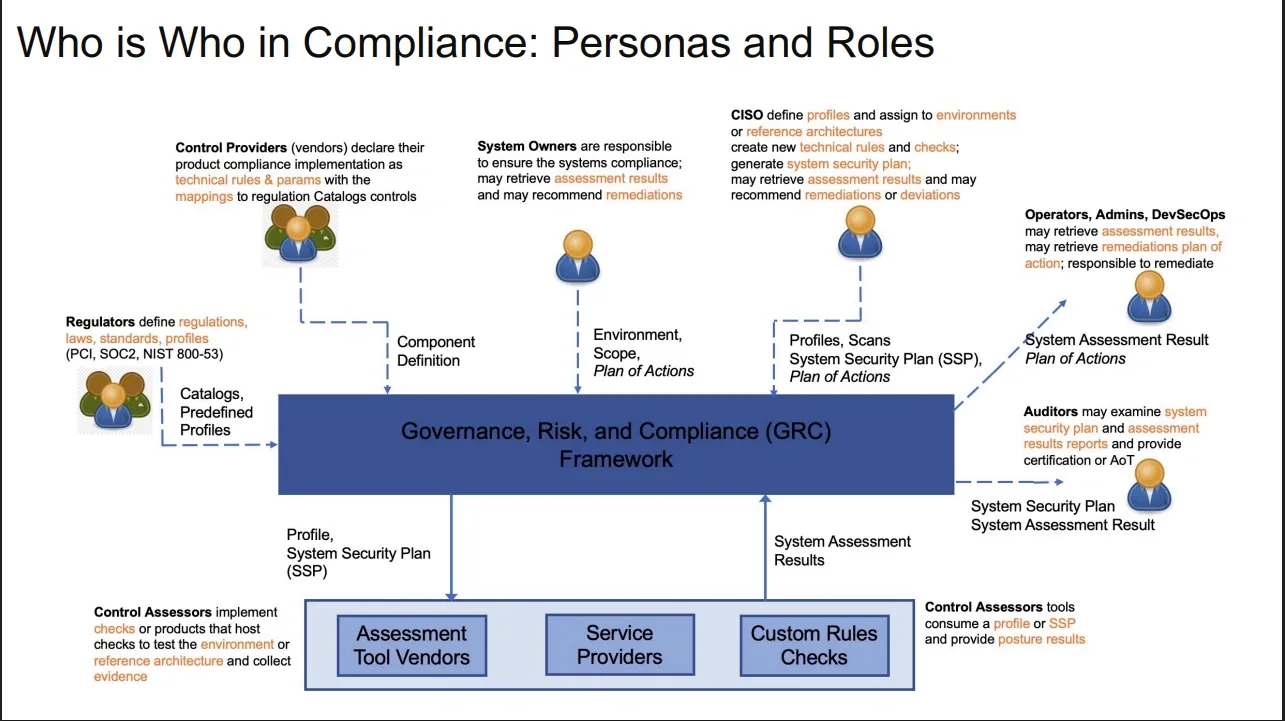
Image Source: Medium
OSCAL delivers real benefits, but the move from theory to deployment surfaces several practical challenges worth understanding before you commit.
No Built-in Automation Tools
The biggest adoption hurdle is that OSCAL is a language, not software you can deploy. It defines a communication protocol but does not hand you the tools to use it. Most security professionals lack the time, and sometimes the technical background, to recreate their control catalogs in JSON or XML by hand. Without supporting tools, the format can overwhelm users, and many practitioners are unwilling to absorb the conversion cost themselves.
Complexity in Multi-Component Environments
Systems with many components are where OSCAL gets hard. Modern cloud environments have numerous parts that each need different security profiles, which makes documentation intricate. Multi-tenancy and shared-responsibility models add still more work, and managing a separate profile for each component compounds the complexity. OSCAL helps, but documenting genuinely complex systems still consumes significant resources, and teams need time to learn and structure it correctly.
Redundancy in Control Updates
OSCAL reduces duplicate documentation but does not eliminate it. When something changes, teams must still update every related control across each affected component, which can mean substantial manual work when a single change ripples through the documentation. OSCAL’s design beats the old methods, but it does not magically remove all repetitive maintenance, and it has no built-in mechanism for prioritizing the controls that matter most to current risk. Organizations have to build that risk-based prioritization themselves.
Software tools now bridge the gap between OSCAL’s potential and practical use, wrapping the raw standard in usable interfaces and workflows.
Many compliance platforms let users convert existing Word-based System Security Plans into OSCAL with a single action, or author SSPs directly in OSCAL, eMASS, and Word formats. Modern tools also reduce redundant documentation through automated control mapping, creating direct linkage between controls and test methods, well-structured evidence documentation, and automated validation of control implementation.
For complex systems, OSCAL-aware tools maintain reusable security-capability libraries and evidence repositories, and some embed OSCAL models directly into governance, risk, and compliance platforms to compress authorization timelines from months to weeks. Perhaps most valuable is cross-framework synchronization: changes mapped in one framework propagate automatically to others, turning scattered compliance activities into one unified process. As NIST notes, these tools provide commodity tooling for basic operations, which is what makes OSCAL realistic for organizations across the technical-skill spectrum. For a direct comparison of the two approaches, see our breakdown of OSCAL versus traditional FedRAMP documentation.
The 2026 Machine-Readable Requirement: What FedRAMP Now Requires
This is the part of the picture that changed most recently, and it is the reason OSCAL has shifted decisively from a nice-to-have toward the default direction of the program. It is also the part most widely misreported, so the details matter.
RFC-0024 and What It Originally Proposed
On January 13, 2026, FedRAMP released RFC-0024, a proposal to require machine-readable authorization packages, including OSCAL, across the Rev5 process. As initially written, it proposed an initial compliance date of September 30, 2026 and a final date of September 30, 2027, after which non-compliant services could lose certification. That proposed version is what drove the wave of urgent, deadline-focused messaging across the industry, and much of the content you will still find online repeats it as though it were the final rule.
What FedRAMP Actually Decided
After the public comment period closed in March 2026, FedRAMP published its initial outcome and significantly revised the proposal in response to near-universal concern about the cost and complexity of converting years of legacy documentation. The comprehensive machine-readable requirement now applies only to Rev5 Class D, the High baseline. For other Rev5 providers, FedRAMP committed to a gradual transition over a much longer window, while still expecting all Rev5 providers to modernize their approach within roughly two years. The final requirements and timelines were folded into the FedRAMP Consolidated Rules for 2026, and our breakdown of FedRAMP CR26 covers where they landed. It is also worth noting that RFC-0024 applied only to the Rev5 process and never governed FedRAMP 20x.
The practical implication is more measured than the original proposal suggested. If you are a Rev5 Class D provider, comprehensive machine-readable materials are a near-term requirement, with significant changes integrated into your package twice a year. If you are a Rev5 provider at a lower class, you have a gradual runway rather than a hard cliff, which means you can plan a deliberate transition and time your investment to when it delivers a return. Either way, machine-readable evidence is the direction of travel, and OSCAL is the format in which it is most commonly expressed.
Where FedRAMP 20x Fits
FedRAMP 20x is the modernized authorization approach that replaces document-heavy, annual compliance with automated, continuous validation. Instead of the control-by-control narrative review, 20x evaluates Key Security Indicators (KSIs), which are measurable security outcomes that can be validated through automation. There are 56 KSIs for the Low baseline and 61 for Moderate. The shift is concrete: rather than writing a narrative stating that you enforce multi-factor authentication, your architecture must output machine-readable evidence demonstrating that MFA is active for your privileged users, and your system must flag a failed control immediately.
The program is rolling out in phases. The Phase One pilot tested KSIs and machine-readable validation for FedRAMP Low. Phase Two is a closed pilot with a small set of selected participants extending the model to Moderate, and Phase Three is expected to open 20x to all qualifying providers in Q3 2026. In the pilots, the automated approach has shown dramatically shorter authorization timelines than the legacy path. To qualify, your service generally must be hosted on FedRAMP-authorized infrastructure and built primarily on cloud-native services. Our overview of the FedRAMP 20x assessment model covers how the KSI-based path works in practice.
OSCAL is the connective tissue here. Whether you pursue 20x or remain on Rev5, the direction is the same: machine-readable evidence is becoming the substrate of FedRAMP compliance, and OSCAL is the format in which that evidence is expressed.
Getting Started with OSCAL for FedRAMP
OSCAL adoption looks daunting, but it breaks into manageable steps, and the direction of the program makes starting to plan now the prudent move.
Importing Existing SSPs into OSCAL Format
If you already have documentation, begin by converting your System Security Plans to OSCAL. You have options: FedRAMP’s official converters can turn Word and Excel SSPs into JSON or XML, third-party one-click tools can transform traditional documents, and you can author new SSPs directly using FedRAMP’s SSP OSCAL template. Conversion requires care to capture every control implementation, description, and policy attachment in OSCAL structure. Keeping a master compliance data source and using scripts to generate OSCAL files makes this repeatable rather than a one-time scramble.
Collaborating with 3PAOs Using OSCAL
OSCAL’s structure benefits 3PAOs directly, letting them document and plan audits in standardized models and exchange Security Assessment Plans and Reports with CSPs efficiently. Run your OSCAL files through FedRAMP-provided validators (available on GitHub) before submission to catch format problems early and reduce review cycles. Treat your OSCAL documentation like code: store it in version control, and track every control-implementation change as a properly tracked OSCAL update.
Preparing for the Machine-Readable Requirement
The requirement that applies to you depends on your path and class, so the first step is identifying which one that is. Rev5 Class D providers face a near-term comprehensive requirement, while other Rev5 providers have a gradual two-year runway and 20x providers operate in a machine-readable model from the start. Whatever your situation, build your master compliance data source, validate against FedRAMP’s tooling, and decide early whether you will adopt OSCAL-aware tooling or build internal capability. OSCAL implementation for a complex environment can be genuinely difficult, and many teams benefit from expert guidance to assess their current documentation and build a transition plan that fits both their architecture and the requirement that actually applies to them.
Conclusion
OSCAL represents a structural move toward automation and standardization in FedRAMP authorization. By turning static compliance documents into machine-readable data, it reduces SSP creation time, improves accuracy, and lets organizations validate their documentation before submission, eliminating costly review cycles and shortening the path to authorization. The benefits are real, but so are the limits: complex environments still demand significant effort, OSCAL ships no automation tools of its own, and adoption in practice has trailed the standard’s promise.
What changed in 2026 is the program’s clear commitment to machine-readable compliance. FedRAMP’s RFC-0024 proposal would have required it across all Rev5 providers on a fixed deadline, but after public comment FedRAMP narrowed the comprehensive requirement to Rev5 Class D providers and phased the broader transition over roughly two years, with the final rules set out in CR26. As FedRAMP 20x expands and new Rev5 certifications wind down in 2027, well-structured data models are becoming the foundation of federal compliance. Providers who adopt OSCAL deliberately, with the right tooling and a realistic transition plan matched to their actual requirement, will be the ones who keep their authorizations and move faster than competitors still wrestling with Word documents.
How Elevate Can Help
OSCAL adoption and the 2026 machine-readable requirement are exactly the kind of transition where the right plan saves both time and certification risk. Elevate Consult helps cloud service providers assess their current documentation, choose between OSCAL tooling and internal capability, convert existing SSPs, and build a transition plan matched to the requirement that actually applies to them, without disrupting an active authorization. Book a Readiness Call to map your current state and your path to a machine-readable program.
Key Takeaways
OSCAL transforms FedRAMP compliance from a manual documentation burden into an automated, structured process, and as of 2026 it is the program’s clear direction rather than an optional extra.
OSCAL replaces static Word and Excel documents with machine-readable XML, JSON, and YAML, enabling automated validation before submission and dramatically faster SSP creation. After public comment, FedRAMP narrowed the RFC-0024 machine-readable requirement so that comprehensive packages are required for Rev5 Class D (High) providers, with a gradual two-year transition for other Rev5 providers and the final rules set out in CR26. Adoption still trails the direction of travel: FedRAMP processed 100+ Rev5 authorizations in 2025 with zero OSCAL submissions, which is exactly why early, deliberate preparation matters. OSCAL supports multiple frameworks at once (FedRAMP, CMMC, NIST RMF, SOC 2, and more), letting organizations maintain one source of truth and cut redundant work. FedRAMP 20x uses Key Security Indicators (56 for Low, 61 for Moderate) validated through machine-readable evidence, with Phase Three expected to open to all qualifying providers in Q3 2026.
The shift to structured, machine-readable compliance is now the direction of the entire FedRAMP program. Organizations that adopt OSCAL deliberately gain faster authorizations and reduced overhead; those that wait without a plan risk scrambling when their class-specific requirement arrives.
FAQs
Q1. What is OSCAL and how does it benefit FedRAMP authorization? OSCAL (Open Security Controls Assessment Language) is a NIST-developed, machine-readable format for security documentation. It transforms traditional documents into structured data, significantly reducing System Security Plan creation time and improving accuracy through automated validation before submission.
Q2. Is OSCAL mandatory for FedRAMP? It depends on your path and class. FedRAMP’s RFC-0024 proposal would have required machine-readable packages across all Rev5 providers, but after public comment FedRAMP narrowed the comprehensive requirement to Rev5 Class D (High) providers, with a gradual two-year transition for other Rev5 providers and the final rules set out in the Consolidated Rules for 2026. FedRAMP 20x, separately, is built around machine-readable submissions from the start, so machine-readable evidence is effectively required on that path.
Q3. What are the key challenges in implementing OSCAL? OSCAL ships no built-in automation tools, so it requires either specialized tooling or technical expertise with structured data formats like JSON and XML. Documenting multi-component cloud environments remains resource-intensive, and OSCAL does not eliminate all redundant updates or provide built-in risk-based prioritization. Specialized software addresses many of these gaps.
Q4. How does OSCAL support multiple compliance frameworks? OSCAL lets organizations implement and assess controls once, then reuse that work across frameworks that reference NIST SP 800-53, including FedRAMP, CMMC, SOC 2, and PCI DSS. Maintaining a single source of truth eliminates much of the redundant documentation that comes with pursuing several standards.
Q5. What is FedRAMP 20x and how does it relate to OSCAL? FedRAMP 20x is a modernized authorization approach that replaces narrative, document-heavy compliance with automated, continuous validation through Key Security Indicators (56 for Low, 61 for Moderate). It depends on machine-readable evidence, which OSCAL expresses. After the Phase One and closed Phase Two pilots, Phase Three is expected to open 20x to all qualifying providers in Q3 2026.
.