
FedRAMP compliance remains a major challenge for cloud service providers who want to work with federal agencies. The complex requirements used to demand extensive resources, time, and specialized expertise. RFC-0022 has altered the map by offering new paths to achieve compliance.
Cloud providers can now use external security frameworks to speed up their FedRAMP compliance process. This fresh approach tackles various FedRAMP compliance levels while keeping security standards intact. The guidance also explains what FedRAMP compliance means for organizations that already have security certifications. FedRAMP compliance requirements often create bottlenecks in federal procurement cycles. This piece breaks down how RFC-0022 reshapes the scene of FedRAMP compliance management by letting you reuse assessment results from other frameworks.
This piece walks you through RFC-0022’s core components. You’ll learn to map your current frameworks to FedRAMP requirements, set proper system boundaries, and make smart verification choices. The practices we share will satisfy both your organization and federal agencies.
What RFC-0022 Changes in the FedRAMP Compliance Process
RFC-0022 brings a fundamental change to the FedRAMP compliance world by offering practical alternatives to traditional authorization. Small cloud service providers often couldn’t reach government contracts due to FedRAMP’s resource-heavy nature. Let’s get into the four major changes this framework brings to compliance.
Validated Level 1 Authorization Path
The new framework creates “FedRAMP Validated Level 1” pathway to make federal authorization available to cloud services. This path makes the compliance experience simpler while keeping federal agencies’ security standards intact. Not all cloud services pose equal risk to federal systems, so the framework allows assessment based on actual risk profiles.
Time-Bound Approval for Low-Risk Systems
Systems with minimal security risks can now receive temporary authorization. Cloud services can get approval that lasts up to one year. Agencies have enough time to test and implement these services within risk boundaries. Providers must either get full authorization or stop federal system access by the end date, which prevents endless use of partially assessed services.
Accepted External Security Frameworks
Cloud service providers can now use their existing security certifications for FedRAMP compliance. Companies no longer need to start their security assessment from scratch, whatever their previous investments in commercial security frameworks. The program now accepts several security assessments:
- SOC 2 Type II reports
- ISO/IEC 27001 certifications
- HITRUST certifications
- CMMC Level 2 assessments
- StateRAMP verifications
The framework recognizes that external assessments vary in security assurance. Audit firms, scope definitions, and evidence collection methods affect quality. Commercial frameworks often depend on management statements rather than technical testing, which creates uneven security confirmation.
Partial Reuse Without Formal Reciprocity
RFC-0022 creates a way to partly reuse existing materials instead of complete reciprocity between FedRAMP and other certification frameworks. Providers can link their current security evidence to FedRAMP Key Security Indicators through detailed documentation.
The Independent Verification & Validation (IV&V) requirement becomes optional in the new framework. All the same, IV&V remains highly recommended for certain risk profiles. Providers skipping this step must show strong evidence to justify their choice and prove audit quality.
Agency Authorizing Officials now have more responsibility. They must review all submitted materials carefully before giving authorization and document their risk acceptance reasoning. This balance keeps FedRAMP’s value in securing federal systems while removing duplicate assessment work for providers and agencies.
Step-by-Step Framework Mapping to FedRAMP Requirements
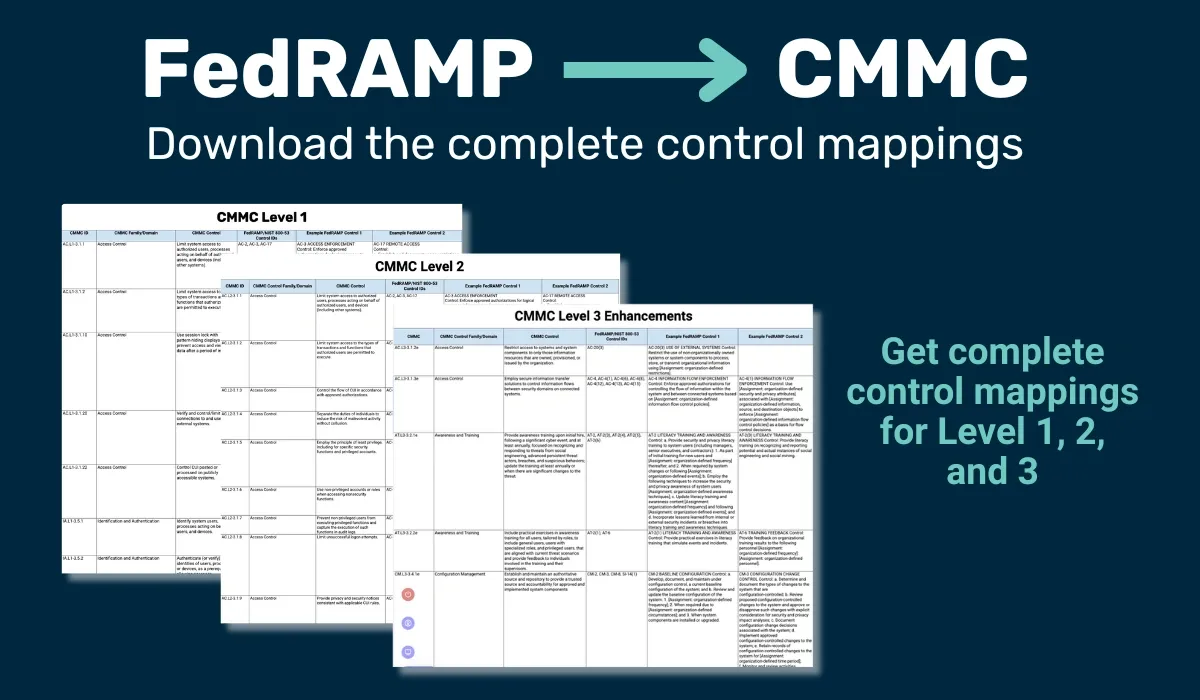
Image Source: Strike Graph
The technical foundation of RFC-0022 implementation focuses on mapping your security frameworks to FedRAMP requirements. This straightforward process creates clear connections that help federal agencies see how your security controls meet government standards without repeating assessments.
Analyzing Your Current Framework Controls
Your mapping work starts with a full analysis of your framework’s control structure. SOC 2 Type II and ISO 27001 organize security controls differently than FedRAMP, and you need to spot where they overlap:
- Look at your framework’s control objectives – SOC 2 organizes controls around Trust Services Criteria (security, availability, processing integrity, confidentiality, privacy), while ISO 27001 uses Annex A control categories
- Review control implementation evidence – Not all commercial audits provide the same depth based on the audit firm, scope, and evidence collection methods
- Find which controls address similar security concerns as FedRAMP Key Security Indicators
You should watch how your external assessment tested these controls. FedRAMP cares more about how well controls work rather than just their design – something commercial assessments often miss.
Connecting External Controls to FedRAMP KSIs
The next step links your framework controls to FedRAMP requirements. Your mapping should show exactly how each control meets federal security needs:
- Connect specific control activities to matching FedRAMP KSIs
- Write down the implementation methods that meet federal requirements
- Show how control testing confirms everything works
This explanation should prove that your controls protect systems according to federal standards. Just matching control numbers isn’t enough—you need to show they work the same way.
Building Complete Mapping Documentation
The next phase creates clear documentation that states your security position. Start by setting exact system boundaries, a key difference between commercial frameworks and FedRAMP compliance needs:
- Write down all systems and services in the assessment scope
- List components you’ve left out (with reasons)
- Explain third-party dependencies and their security duties
- Show data flows across system boundaries
Commercial audits often allow smaller boundaries that FedRAMP won’t accept. You’ll need more documentation than your external framework usually asks for. If you find this hard, you can Book a Readiness Call with FedRAMP specialists who’ll help with your mapping.
Flagging Potential Gaps in Framework Coverage
The final step identifies where your current framework might not meet FedRAMP standards. Common gaps include:
- Too much focus on management descriptions instead of technical proof
- Different testing depths across control families
- Poor boundary documentation, especially for third-party services
- Not enough testing to show controls work
FedRAMP wants proof that controls work well in real life, not just on paper. Your mapping should point out these gaps and show how you fixed them through extra testing.
Once you finish mapping, share both your external assessment materials and mapping explanation. Include full copies of commercial assessments, detailed documentation linking external controls to KSIs, clear scope definitions, and proof that controls work. Better documentation improves your chances of approval.
System Scope and Boundary Documentation Requirements
Security assessment in the FedRAMP validation process relies on well-defined system boundaries. Commercial frameworks let you be flexible with scoping, but FedRAMP just needs exact documentation of everything inside your security perimeter.
Components to Include in Federal Assessments
FedRAMP’s Validated Level 1 authorization needs clearer documentation of scope boundaries compared to regular commercial audits. SOC 2 and ISO 27001 assessments allow generous carve-outs, but FedRAMP requires you to define:
- All systems and services included in the assessment
- Components excluded (with justification)
- Third-party dependencies and their security responsibilities
- Data flows across system boundaries
You can reduce scope in commercial audits, but FedRAMP guidelines won’t let you do that. You’ll need to document your boundaries more extensively than your external framework asks for. This is the biggest difference between commercial security assessments and the FedRAMP compliance process.
Handling Third-Party Service Dependencies
Third-party dependencies make boundary questions complex. Your assessment might have risky blind spots that could put federal data security at risk if you don’t define these services properly.
Your documentation should explain:
- How third-party services connect with your core systems
- Which security responsibilities belong to you versus your vendors
- What evidence shows your vendors meet security standards
- How you keep track of third-party security practices
Poor boundary documentation for third-party services will get your FedRAMP package rejected. This becomes crucial for cloud services built on other cloud platforms where responsibility lines get blurry.
Avoiding Blind Spots in Boundary Definitions
A full boundary assessment confirms that your defined scope includes everything needed for federal security evaluation. Here’s how to check if your boundaries are complete:
Start by mapping all connection points between your system and external networks. Document how security controls cover each component within the boundary. Make sure all security-relevant components stay inside your defined perimeter.
Your mapping to Key Security Indicators (KSIs) needs a complete check of boundary completeness. This step often shows areas where commercial assessments might have taken shortcuts that don’t work for federal requirements.
Agency Authorizing Officials look closely at these boundary definitions as part of their risk decision authority when they approve Validated Level 1 systems. Your FedRAMP Validated Level 1 authorization ended up depending on getting these boundaries right.
Making Independent Verification Decisions
Independent Verification and Validation (IV&V) plays a vital role in the RFC-0022 framework. Traditional FedRAMP protocols required independent assessment. The new Validated Level 1 pathway now makes IV&V optional but still recommends it in certain cases. Cloud service providers seeking federal authorization must know when verification adds value and what evidence they should provide if they skip this step.
Scenarios Where IV&V Adds Value
IV&V might be optional now, but it brings real value in specific situations. Systems that handle moderately sensitive data benefit by a lot from independent verification. Even “low-risk” classifications can hide potential security concerns. Services with complex architectures or multiple third-party dependencies need objective validation that standard commercial assessments might miss.
You should think about IV&V if your external framework assessments didn’t include much technical testing. Many commercial audit firms focus on narrative descriptions instead of testing how well the controls actually work. IV&V gives both cloud service providers and federal agencies extra confidence in their risk decisions.
Required Evidence When Skipping Verification
RFC-0022 lists specific documentation you need to maintain proper assurance levels when you skip IV&V:
- A formal statement that explains why you’re skipping IV&V
- Full evidence that shows your existing assessments were rigorous enough
- Documentation that covers gaps between your external frameworks and FedRAMP KSIs
- Proof of your auditor’s qualifications and independence
- Clear evidence that shows operational testing beyond design compliance
Your Validated Level 1 package might face delays or rejection if you don’t provide this complete documentation. Security specialists can help review your situation and determine if your evidence supports skipping the IV&V process. You can Book a Readiness Call with them.
Testing Depth Across Control Categories
Security validation remains essential even without a complete FedRAMP assessment. Commercial audits often focus on certain control families while barely touching others. Federal security needs require consistent testing depth across all control categories.
You must document your scope boundaries clearly. Specify which systems went through assessment and which components you left out (with reasons). Show how you reviewed third-party dependencies. Federal contexts won’t accept the boundary carve-outs that commercial audits usually allow.
Technical validation proof matters more than narrative descriptions. Your controls must work effectively in practice, not just look good on paper. This operational evidence serves as the life-blood of federal confidence in your security posture, whatever your choice about formal IV&V in your compliance experience.
Best Practices for Federal Agencies
Agency responsibilities become the focus point when evaluating Validated Level 1 packages under the FedRAMP framework. Officials must make significant risk decisions through systematic approaches with limited independent verification. These approaches help maintain security standards in federal systems.
Standardized Templates for Package Review
A standardized template helps agencies review external framework evidence effectively. The template should verify:
- Auditor’s accreditation and independence credentials
- Depth and quality of operational effectiveness testing
- System boundary documentation completeness
- Testing coverage consistency across control categories
This standardized approach prevents security gaps and provides consistent evaluation across submissions. These templates give Authorizing Officials clear paths through unfamiliar commercial assessment formats. This becomes particularly helpful when they evaluate first-time submissions under the new Validated Level 1 process.
Risk Documentation Workflows
Risk acceptance processes are the foundations of defensible agency decisions. Officials need to complete three key steps for each Validated Level 1 authorization:
First, they must document specific reasons that make external framework evidence sufficient for federal purposes. Second, they should keep clear records of security gaps found during review. Third, they need to set explicit limitations on authorized use cases based on risk level.
This documentation protects the agency legally and supports decisions if security incidents happen later. RFC-0022 places more responsibility on Authorizing Officials. This makes formal risk acceptance workflows vital safeguards against quick or incomplete evaluations.
Periodic Reassessment Schedules
Regular reassessment matters most before specific trigger events occur. Agencies need fixed timeframes to review Validated Level 1 services before:
- Renewing time-limited authorizations
- Expanding previously authorized use cases
- Migrating services to higher sensitivity environments
These scheduled reviews help maintain security alertness without straining agency resources. Agencies should balance new breakthroughs with their core security duties through systematic review cycles.
Federal agencies can direct the streamlined FedRAMP compliance process confidently by implementing these practices. This helps them fulfill their mandate to protect government systems and data.
Conclusion
RFC-0022 framework has substantially changed FedRAMP compliance. The framework is now more available and federal security standards remain intact. Cloud service providers can now reuse existing security assessments instead of starting over, thanks to practical alternatives. These alternatives include Validated Level 1 authorization path, time-bound approvals for low-risk systems, and acceptance of external security frameworks.
Your current security frameworks’ mapping to FedRAMP requirements just needs methodical analysis and precise documentation. Commercial frameworks organize controls differently than FedRAMP. A careful review helps identify overlapping areas and potential gaps. FedRAMP requires clearer documentation than typical commercial audits permit, so defining system boundaries becomes crucial.
RFC-0022 makes Independent Verification and Validation optional, which provides flexibility. Organizations that skip this step must provide complete evidence. Federal agencies must adapt by using standardized review templates. They also need thorough risk documentation processes and regular reassessment schedules.
These changes require expertise. Companies can Book a Readiness Call with FedRAMP specialists to review their current security posture. FedRAMP specialists will guide them through their compliance experience. Both cloud service providers and federal agencies can achieve quicker authorization processes by implementing RFC-0022 guidelines carefully. This ensures government systems and data remain protected by security standards.
Key Takeaways
RFC-0022 revolutionizes FedRAMP compliance by introducing practical alternatives that leverage existing security frameworks while maintaining federal security standards.
• RFC-0022 creates accessible compliance paths through Validated Level 1 authorization, time-bound approvals, and acceptance of external frameworks like SOC 2 and ISO 27001.
• System boundary documentation requires precision – unlike commercial audits, FedRAMP demands explicit definition of all components, third-party dependencies, and data flows.
• Framework mapping needs operational evidence – connecting existing controls to FedRAMP KSIs requires proof of effectiveness in practice, not just design compliance.
• Independent verification becomes optional but strategic – organizations can skip IV&V with comprehensive evidence, though it’s recommended for complex systems.
• Agencies gain increased responsibility for risk decisions and must implement standardized review templates, documentation workflows, and reassessment schedules.
This framework enables cloud service providers to reuse existing security investments while giving federal agencies flexible yet secure authorization options, ultimately streamlining government procurement without compromising security standards.
FAQs
Q1. What changes does RFC-0022 introduce to the FedRAMP compliance process? RFC-0022 introduces several key changes, including a new Validated Level 1 authorization path, acceptance of external security frameworks like SOC 2 and ISO 27001, time-bound approvals for low-risk systems, and the ability to partially reuse existing security assessments without formal reciprocity.
Q2. How should organizations map their existing security frameworks to FedRAMP requirements? Organizations should analyze their current framework controls, connect them to FedRAMP Key Security Indicators (KSIs), build comprehensive mapping documentation, and identify potential gaps in framework coverage. This process requires careful examination of control objectives, implementation evidence, and testing methods.
Q3. What are the system boundary documentation requirements for FedRAMP compliance? FedRAMP requires precise documentation of system boundaries, including all systems and services in the assessment scope, explicitly excluded components, third-party dependencies, and data flows across system boundaries. This documentation must be more comprehensive than what is typically required for commercial audits.
Q4. Is Independent Verification and Validation (IV&V) mandatory under RFC-0022? IV&V is now optional under RFC-0022, but still highly recommended for certain scenarios. When opting to skip IV&V, organizations must provide comprehensive evidence demonstrating adequate audit rigor, address gaps between external frameworks and FedRAMP KSIs, and show proof of operational effectiveness testing.
Q5. What best practices should federal agencies follow when evaluating Validated Level 1 packages? Federal agencies should develop standardized templates for package review, implement risk documentation workflows, and establish periodic reassessment schedules. These practices help ensure consistent evaluation, proper risk acceptance processes, and ongoing security vigilance for authorized cloud services.