
Over 200,000 defense contractors and subcontractors worldwide now need CMMC compliance checklist preparation. The Department of Defense (DoD) spends about $445 billion each year on contracts. This makes cybersecurity standards mandatory for everyone working in the Defense Industrial Base (DIB).
The DoD has finalized CMMC and will include it as a requirement in contracts starting Q4 2025. This requirement affects the DIB of all sizes – from large contractors to small businesses, managed service providers, SaaS vendors, and subcontractors. Typical SMBs need 12 to 18 months to achieve CMMC Level 2 compliance. Starting preparation right away becomes crucial.
AS9100 manufacturers face unique challenges while implementing cybersecurity requirements. CMMC Level 1 covers simple safeguards for Federal Contract Information (FCI). Level 2 marks the most important increase in maturity that needs full implementation of all 110 NIST SP 800-171 controls. The complete rollout will make CMMC certification mandatory for all DoD contracts. Third-party assessments will apply to 95% of organizations handling Controlled Unclassified Information (CUI).
This piece offers a step-by-step CMMC compliance checklist crafted specifically for AS9100 manufacturers in the Defense Industrial Base. We’ll help you define your CUI scope and guide you through assessment preparation to make the compliance process work smoothly.
Understanding CMMC 2.0 for AS9100 Manufacturers
The Cybersecurity Maturity Model Certification (CMMC) brings a fundamental change to how the Department of Defense (DoD) assesses cybersecurity across the Defense Industrial Base. The DoD no longer accepts self-attestation. Aerospace manufacturers must now meet verifiable cybersecurity standards to qualify for DoD contracts.
CMMC vs AS9100: Scope and Overlap
AS9100 certification stands as the gold standard for aerospace manufacturers and focuses on quality management systems. In spite of that, this certification doesn’t deal very well with critical cybersecurity requirements needed for handling DoD data. A closer look reveals these key differences:
- Focus Area: AS9100 targets quality and safety of equipment used for aviation, space, and defense. CMMC specifically targets cybersecurity practices that protect sensitive information.
- Regulatory Framework: AS9100 serves as an internationally agreed-upon quality standard without legal force (though contracts often require it). The DoD mandates CMMC with clear legal implications.
- Assessment Method: Both standards need certification processes. CMMC adds third-party assessments for most contractors who handle Controlled Unclassified Information (CUI).
Companies with AS9100 certification might find their CMMC compliance trip easier. One source points out, “If you’re already ISO 27001 certified, you may find you have completed the majority of NIST SP 800-171, as well as ISO 9001 and AS9100”. This shows how these certification frameworks could work together despite their different goals.
Aerospace manufacturers should utilize their existing quality management frameworks as a starting point. They must remember that AS9100 alone won’t meet CMMC requirements.
Why CMMC Applies to Aerospace DIB Suppliers
Aerospace manufacturers form a vital part of the Defense Industrial Base. They handle extremely sensitive information that needs strong protection. The aerospace sector has unique features that make CMMC compliance crucial:
- Sensitive Data Volume: Aerospace operations use large amounts of Controlled Unclassified Information (CUI) and Federal Contract Information (FCI). This includes technical details about military aircraft capabilities.
- Advanced Technologies: The industry works with proprietary designs, advanced materials, and sophisticated electronic systems that could expose sensitive military capabilities.
- Supply Chain Complexity: Aerospace manufacturers must secure communications with specialized component suppliers worldwide. This makes cybersecurity a challenge at multiple levels.
These factors put aerospace DIB suppliers under intense scrutiny with CMMC. Most aerospace manufacturers need Level 2 certification, which requires third-party assessment and 110 security practices. This level fits companies that handle CUI, which covers almost every aspect of aerospace operations.
The risks run high as cyberattacks on defense contractors keep increasing. Hackers target manufacturers to steal blueprints, disrupt supply chains, and access classified projects. Non-compliance means more than lost contracts – it puts national security at risk.
The CMMC implementation follows clear phases with specific deadlines. The final rule took effect in late 2024, and contracts started including compliance requirements in 2025. Official sources state, “CMMC assessment requirements will be implemented using a four-phase plan over three years”. This gives aerospace manufacturers limited time to achieve compliance before it affects their DoD contract eligibility.
AS9100 manufacturers in aerospace should see CMMC compliance as more than just another regulation. It protects national security interests and their position in the defense supply chain.
Mapping CMMC Levels to NIST 800-171 and 800-172
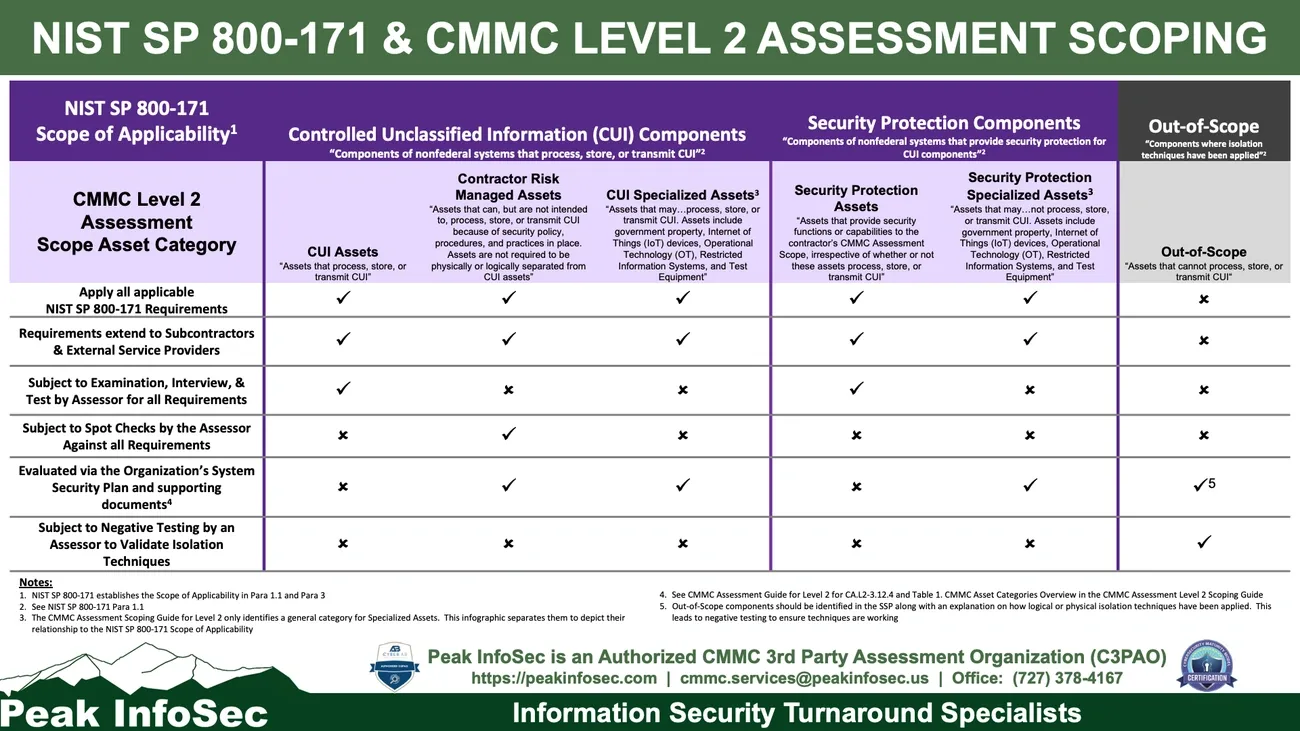
Image Source: Peak InfoSec
CMMC builds on NIST cybersecurity frameworks that have been around for years. It creates a tiered system that matches specific requirements to different sensitivity levels of DoD information. AS9100 manufacturers can develop their compliance checklist by learning about how each CMMC level connects to NIST standards.
Level 1: Foundational Controls for FCI
CMMC Level 1 sets up simple cybersecurity practices through 15 safeguarding steps from Federal Acquisition Regulation (FAR) Clause 52.204-21. This first level protects Federal Contract Information (FCI), which has data “provided by or generated for the Government under a contract” not meant for public release.
AS9100 manufacturers at Level 1 need to work with six control families:
- Access Control: Limiting system access to authorized users only
- Identification & Authentication: Creating uniquely identified users with secure authentication
- Media Protection: Properly sanitizing or destroying media containing FCI before disposal
- Physical Protection: Restricting physical access to facilities and systems with FCI
- System & Communications Protection: Implementing boundary protections and system separation
- System & Information Integrity: Addressing vulnerabilities through patching and malware protection
Contractors can do yearly self-assessments by themselves or get help from third parties. Companies must then submit their compliance confirmation in the Supplier Performance Risk System (SPRS). The assessment can cover an entire network or specific areas where FCI exists.
Level 2: 110 Controls from NIST SP 800-171
CMMC Level 2 marks a big step up in cybersecurity maturity. It has all 110 security controls from NIST SP 800-171 Rev 2. Contractors who handle Controlled Unclassified Information (CUI) must meet this level.
These 110 controls cover 14 different domains:
- Access Control
- Awareness and Training
- Audit and Accountability
- Configuration Management
- Identification and Authentication
- Incident Response
- Maintenance
- Media Protection
- Personnel Security
- Physical Protection
- Risk Assessment
- Security Assessment
- System and Communications Protection
- System and Information Integrity
Level 2 certification comes through self-assessment or third-party review by CMMC Third-Party Assessment Organizations (C3PAOs). The choice depends on how sensitive the CUI is. This level is much more complex than Level 1.
On top of that, it needs contractors to keep a System Security Plan (SSP) and Plans of Action & Milestones (POA&Ms) showing their progress. Yes, it is exactly what many aerospace manufacturers already do under DFARS Clause 252.204-7012.
Level 3: Advanced Threat Protection via NIST SP 800-172
CMMC Level 3 takes Level 2 further by adding select security requirements from NIST SP 800-172. Only contractors who handle the DoD’s most sensitive unclassified information and high-value assets need this expert-level certification.
The enhanced requirements focus on three key areas:
- Penetration-resistant architecture: Creating systems that resist sophisticated attacks
- Damage-limiting operations: Implementing measures to contain breaches if they occur
- Cyber resiliency and survivability: Ensuring systems can withstand and recover from attacks
Level 3 aims to protect against Advanced Persistent Threats (APTs) through stronger security measures. Government teams from the Defense Industrial Base Cybersecurity Assessment Center (DIBCAC) must do the assessment at this level.
This level adds 24 carefully chosen controls from NIST SP 800-172 to the existing 110 controls from Level 2. These extra requirements protect not just confidentiality but also integrity and availability. They help defend against sophisticated nation-state attacks on critical programs.
AS9100 manufacturers can use these tiered requirements to plan their security investments based on their information classification. Most aerospace contractors working with technical specifications will need at least Level 2 certification.
Step 1: Define Your CUI and FCI Scope
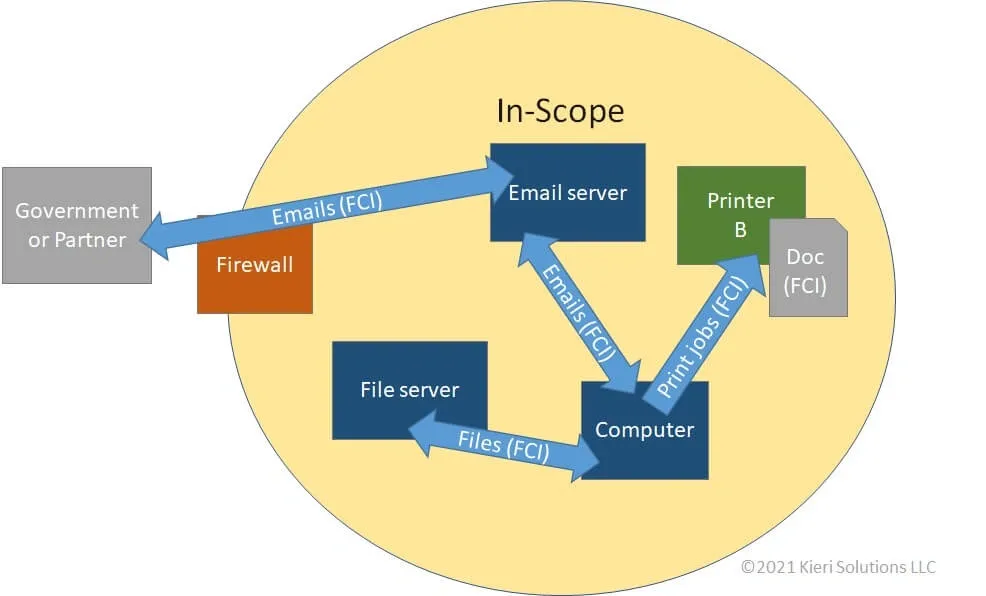
Image Source: CMMC Audit Preparation
A successful CMMC compliance checklist starts with defining your CUI and FCI scope correctly. This step is crucial because it shapes your entire implementation strategy. You need to know which systems, processes, and data need protection.
Identifying Controlled Unclassified Information (CUI)
Controlled Unclassified Information is sensitive but unclassified information that needs safeguarding according to laws, regulations, and government policies. AS9100 manufacturers must tell CUI apart from other information types because of their unique security requirements.
Federal Contract Information (FCI) has information “not intended for public release, that is provided by or generated for the Government under a contract”. The main difference here is clear: CUI qualifies as FCI, but not all FCI counts as CUI. CMMC Level 1’s simple safeguarding works for FCI, while CUI needs stronger Level 2 controls.
Aerospace manufacturing’s CUI typically has:
- Controlled Technical Information (CTI) – Blueprints, technical drawings, and design specifications
- Proprietary Manufacturing (MFC) – Parts or components based on technical drawings
- Defense-related information – Data concerning military capabilities or operations
- Export-controlled information – Materials subject to export restrictions
The DoD CUI Registry helps you learn if information is CUI. This trusted resource groups protected information types and lists their handling requirements. The registry has 18 organizational index groupings, such as critical infrastructure, defense, and export control.
CUI documents must have the “CUI” acronym at the top and bottom of each page, plus a designation indicator block. Documents without proper markings might still be CUI. Contractors should know how to spot unmarked CUI in their systems.
Mapping Data Flows Across AS9100 Processes
After identifying CUI, you should track how it moves through your organization. Data Flow Diagrams (DFDs) show CUI’s path through your systems and highlight weak spots and compliance gaps.
Start by checking all contracts to find where FCI or CUI shows up in your operations. Look for FAR 52.204-21 (for FCI) or DFARS 252.204-7012 (for CUI) clauses that list safeguarding requirements. Contract managers, legal teams, and federal work units should help identify processes with CUI.
CUI flows through internal departments, supplier networks, and classified/unclassified environments in aerospace manufacturing. Your DFD should follow CUI’s complete lifecycle:
- Process – Areas where teams access, edit, generate, or work with CUI
- Store – Places where CUI stays, both digitally and physically
- Transmit – Ways CUI moves between systems, including physical and digital transfers
Your scope should cover five asset types: CUI assets, security protection assets, contractor risk-managed assets, specialized assets, and out-of-scope assets. CUI assets that store, process, or transmit CUI need assessment against all 110 CMMC controls.
You might want to use enclave strategies or data segmentation to limit systems in scope. This approach can reduce your attack surface and save on compliance costs. Take a close look at Enterprise Resource Planning (ERP) systems, Computer-Aided Design/Computer-Aided Manufacturing (CAD/CAM) software, and physical CUI documents.
Products made using CUI aren’t technically CUI themselves, since CUI applies to information rather than physical items. Products under FAR 52.245-1 Government property might need extra protection during storage and shipping.
Careful identification and mapping create strong foundations for your CMMC compliance checklist. This groundwork lets you target security controls where they matter most.
Step 2: Conduct a Readiness Gap Assessment
The next step in your CMMC compliance process after defining your CUI scope is to assess your current cybersecurity measures. This assessment shows exactly where your security measures stand and what gaps need fixing.
Using the NIST 800-171 DoD Assessment Methodology
The NIST SP 800-171 DoD Assessment Methodology offers an objective framework to assess your implementation status across all required security controls. This scoring system forms the foundation of CMMC compliance and uses a 110-point scale that matches the total number of NIST SP 800-171 security requirements.
Here’s how the scoring system works:
- Perfect score: 110 points (all requirements implemented)
- Weighted requirements: Each security control has a point value (5, 3, or 1 points) based on its security effect
- Scoring process: Points get subtracted for each unimplemented requirement
- Potential outcome: Scores can drop below zero if major gaps exist
Requirements with bigger security effects carry more weight in scoring. To name just one example, see how failing to limit system access to authorized users (Basic Security Requirement 3.1.1) leads to a 5-point deduction. This happens because this fundamental control affects how well other access controls work. In contrast, failing to prevent identifier reuse for a set period (3.5.5) only takes away 1 point due to its smaller security effect.
You must submit your assessment results to the Supplier Performance Risk System (SPRS) to qualify for contract awards. This score shows your cybersecurity readiness without requiring a specific minimum for contract eligibility.
Book your Readiness Call with qualified assessors who know aerospace manufacturing environments to get a full picture of your compliance gaps.
Documenting Gaps in Access Control, Logging, and Encryption
AS9100 manufacturers often find specific security gaps during their readiness assessments. Knowledge of common problems helps set priorities for fixes:
Frequently Identified Documentation Gaps:
- Missing documented access control procedures
- Outdated or absent incident response plans
- Weak or inconsistent configuration management
- Poor risk management practices
- Lack of personnel security training and awareness
- Gaps in system monitoring and malware defenses
Technical Implementation Challenges:
- Missing or poorly implemented multi-factor authentication (MFA)
- Poor network segmentation
- Limited audit logging capabilities
- Encryption issues, especially with FIPS validation
Note that policies connect identifying vulnerabilities with implementing solutions. Your focus should be on creating specific, tailored policies instead of using vague language. Each policy should map directly to its corresponding CMMC requirement to establish clear traceability.
A good gap assessment starts with an inventory of CUI locations across your design files, simulation models, shared CAD environments, and project collaboration platforms. You can then assess how well your current setup matches required CMMC controls. This step helps you understand your exposure and set priorities.
Your assessment should combine gap analysis with readiness mock assessments. Gap analysis helps identify security weaknesses and set fix priorities. A mock assessment then confirms your implementation and prepares you for certification. This step-by-step approach makes your compliance efforts more effective.
Document each gap you find with specific recommendations to achieve compliance. This detailed documentation becomes the basis for your Plan of Action and Milestones (POA&M), which we’ll cover in upcoming sections.
Step 3: Build Your System Security Plan (SSP)
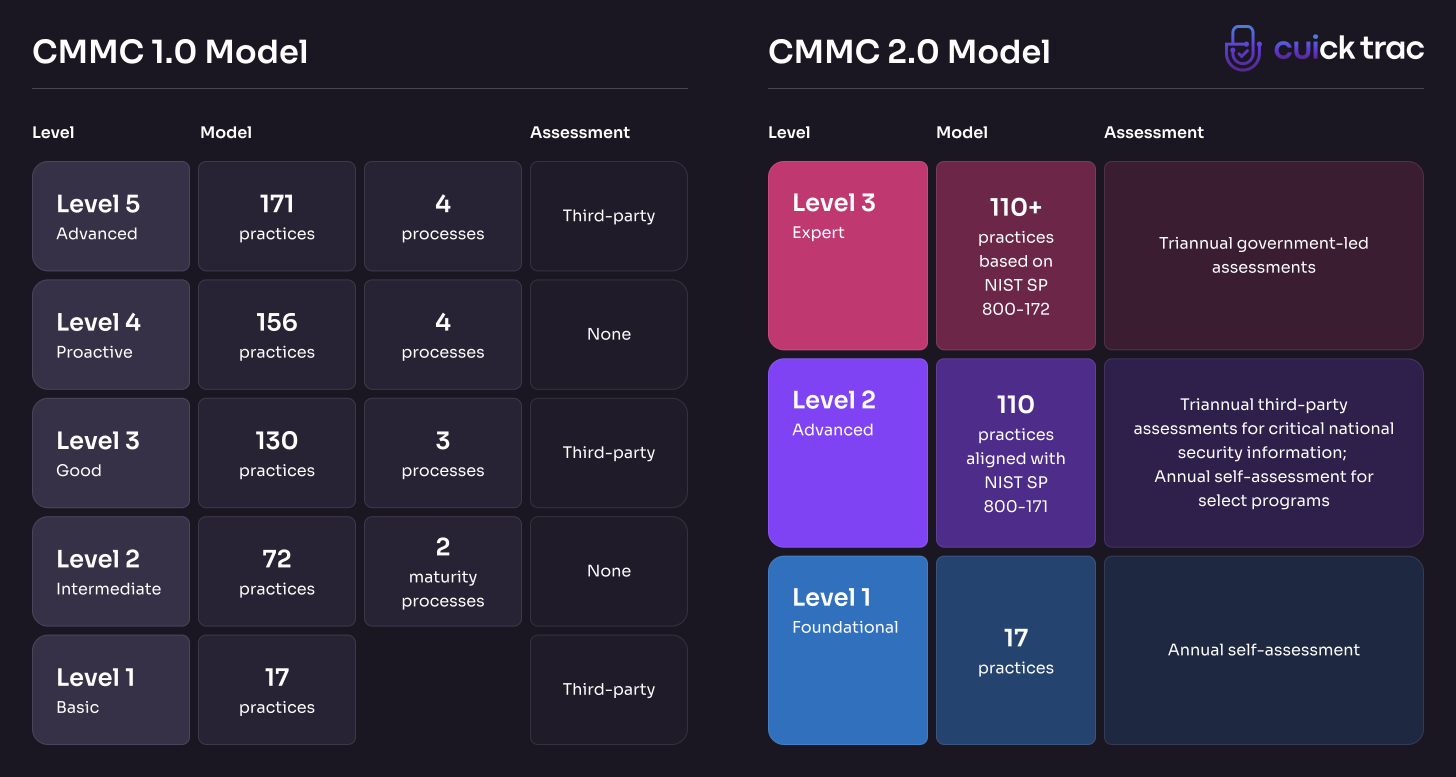
Image Source: Cuick Trac
A System Security Plan (SSP) is the foundation of your CMMC certification experience. This document will guide assessors through your organization’s security controls that protect Controlled Unclassified Information (CUI).
SSP Requirements for CMMC Level 2 Compliance
The official definition of a System Security Plan states it’s “the formal document that provides an overview of the security requirements for an information system or an information security program and describes the security controls in place or planned for meeting those requirements”. Aerospace manufacturers need a complete SSP to achieve CMMC Level 2. DFARS 252.204-7012 makes this requirement mandatory.
Your SSP needs to match all 110 NIST SP 800-171 controls and assessment objectives in NIST SP 800-171A. The document serves these vital functions:
- Documents security controls in your environment
- Assigns clear responsibilities for control implementation
- Shows compliance with solid evidence
- Spots gaps between your current position and requirements
A well-laid-out SSP must have these core elements:
- System Identification: Name your system, give it a unique ID, and categorize it based on data sensitivity.
- System Architecture: Add physical and logical diagrams that show system boundaries, components, and external connections.
- Roles & Responsibilities: List who owns and runs each part of your security program, from executives to daily admins.
- Control Implementation Details: Explain how you meet each requirement through specific policies, procedures, and tech.
- Appendices: Include hardware/software inventory, network diagrams, data flow docs, and supply chain details.
You can’t pass a CMMC assessment without a solid SSP. On top of that, it gives assessors their first look at how mature your security program is.
Version Control and Change Management Best Practices
Control CA.L2-3.12.4 states organizations must “develop, document, and periodically update system security plans that describe system boundaries, system environments of operation, how security requirements are implemented, and the relationships with or connections to other systems”. Updates are crucial – your SSP must evolve.
Good SSP management needs strong version control with detailed change logs. This creates a trail that shows how you manage compliance. CMMC requirement CM.L2-3.4.3 requires organizations to “track, review, approve or disapprove, and log changes to organizational systems”.
Configuration change control needs these key practices:
- A system to propose, justify, implement, and test changes
- Review and approval steps before implementation
- Records of changes to baseline configurations and settings
- Tracking of planned and unplanned changes
The core team often uses Configuration Control Boards or Change Advisory Boards to review changes. These boards should include people from all key departments.
Your SSP needs updates yearly at minimum, or after major IT changes. Changes could include new infrastructure, different tools, or staff changes that affect control ownership. You should also review it after security incidents to keep it current.
Strong version control and change management will create a living document that shows your real security status – ready for assessment anytime.
Step 4: Create a Plan of Action and Milestones (POA&M)
The Plan of Action and Milestones (POA&M) is your roadmap to fix identified security gaps as you work toward CMMC certification. This vital document lists all the tasks your organization needs to complete to strengthen your cybersecurity stance.
Prioritizing Remediation Tasks by Risk Level
Security gaps don’t all need the same level of attention. A consistent risk prioritization framework helps AS9100 manufacturers use their resources wisely for fixes. Here’s how to build your POA&M effectively:
Start by creating a resilient risk scoring system that rates each vulnerability on multiple factors. Your assessment should get into:
- How it might affect CUI confidentiality, integrity, and availability
- The chances of someone exploiting it, based on threat capabilities
- How exposed the vulnerable systems are (internet-facing vs. internal)
- What protective measures you already have that could lower the risk
- The business effect if someone exploits the vulnerability
This layered analysis gives you a better picture than basic technical severity ratings. Give each vulnerability clear risk levels (High/Medium/Low or numeric scores) with solid reasoning. Group your POA&M items by risk level to keep track of critical issues.
Note that assessors will inspect whether your priorities show real risk analysis rather than what’s easy to implement. They’ll look closely at high-risk vulnerabilities that have long fix times.
Tracking Progress and Assigning Ownership
You need clear ownership to fix things properly. Each POA&M item needs both an accountable owner and someone to implement the fix. The owner should have enough authority to make sure the work gets done, while the implementer needs the technical know-how to make the fixes.
Your POA&M must include these key details for each security gap:
- The relevant control
- The responsible party
- Planned actions to meet the control
- Start and completion dates
- Milestones with interim completion dates
- Actual actions taken
- Current status (ongoing or complete)
CMMC rules state that you must close POA&Ms within 180 days of the Conditional CMMC Status Date. Your Conditional CMMC Status expires if you don’t close them in time.
The Organization’s Self-Assessment (OSA) handles POA&M closeout assessment for Level 2 Self-Assessment. An authorized C3PAO must handle Level 2 Certification Assessment closeouts.
A well-managed POA&M helps AS9100 manufacturers fix security gaps step by step, protect their DoD contracts, and build stronger cybersecurity for the long run.
Step 5: Implement Technical and Administrative Controls
Your POA&M is now in place, and the next vital phase focuses on implementing technical and administrative controls needed for CMMC compliance. These safeguards are the foundations of your defense against cyber threats that target sensitive aerospace data.
Multifactor Authentication and Endpoint Protection
MFA is a basic requirement to get CMMC Level 2 certification. Practice IA.L2-3.5.3 requires MFA setup for local and network access to privileged accounts and network access to non-privileged accounts. This security layer checks user identity through multiple credentials – what you know (password), what you have (token), and sometimes what you are (biometric).
The first step is to identify all privileged accounts that have elevated permissions and access to CUI. These accounts need extra protection through MFA. Practice MA.L2-3.7.5 also needs MFA for nonlocal maintenance sessions through external connections. AS9100 manufacturers can streamline compliance since modern ERP systems come with built-in MFA features.
Network Segmentation and Zero Trust Architecture
Zero Trust works on a simple principle: “never trust, always verify.” This ensures only authenticated and authorized users can access sensitive information. The framework matches CMMC requirements perfectly by focusing on three core principles: verify explicitly, use least privilege access, and assume breach.
Beyond MFA, you need micro-segmentation strategies to separate different parts of your IT environment. This limits how far an attacker can move if they breach your system. Each resource access attempt gets verified based on user identity, device health, location, and data classification.
Microsoft’s Zero Trust workbook shows how security offerings map to Zero Trust models. It includes over 76 control cards that line up with TIC 3.0 security capabilities. AS9100 manufacturers find this resource helpful when setting up strong network security controls.
Security Awareness Training for AS9100 Teams
Without doubt, human error leads to most vulnerabilities – it plays a role in over 80% of data breaches. CMMC 2.0 needs security awareness training at both Level 1 and Level 2, with three specific controls:
- Risk Awareness (AT.L2-3.2.1): Managers, administrators, and users must understand security risks
- Role-Based Training (AT.L2-3.2.2): Personnel must learn to handle security-related duties
- Insider Threat Awareness (AT.L2-3.2.3): Teams must learn to spot and report potential insider threats
Your AS9100 organization’s training should match different roles: executives need to grasp compliance requirements, IT teams must set up security controls, and general employees should know how to spot phishing attacks and handle CUI safely. Level 2 compliance requires you to document all training activities as assessment evidence.
Step 6: Prepare for the CMMC Assessment
Image Source: www.cmmcaudit.org
The final phase of your CMMC trip focuses on assessment preparation—a key step that determines certification success. Your preparation becomes more crucial as certification requirements show up in contracts throughout 2025.
Working with a Certified Third-Party Assessor (C3PAO)
Only 58 accredited C3PAOs exist today, so early scheduling helps you avoid getting pricey delays. These assessors give unbiased feedback on your security posture and are a great way to get insights into best practices. C3PAOs typically won’t confirm your booking until they feel confident about your success—you should expect detailed pre-assessment talks to review your readiness.
Evidence Collection: Logs, Policies, and Screenshots
Strong CMMC programs build evidence collection into their daily operations. You need a detailed control matrix that connects each CMMC requirement to its policy, owner, evidence storage, and review schedule. Of course, evidence falls into four types: documentation, artifacts, physical reviews, and screen shares. A well-laid-out evidence package with clear examples for each control helps improve your assessment speed.
Mock Interviews and Internal Audit Readiness
Organizations that complete formal readiness validation before assessment achieve near-perfect first-pass rates. Book your Readiness Call to experience a simulated assessment that mirrors your official evaluation. This preparation gives your team valuable practice to answer potential assessor questions. The rehearsal confirms your security controls work properly and can be traced easily. A full mock assessment spots any gaps before your official evaluation starts.
Conclusion
CMMC compliance is a major task that AS9100 aerospace manufacturers in the Defense Industrial Base must undertake. This piece outlines a complete approach to getting certified. It starts with defining CUI scope correctly and ends with full assessment preparation.
AS9100 certification gives aerospace manufacturers a strong base. However, it doesn’t deal very well with key cybersecurity requirements needed for CMMC compliance. Our six-step checklist creates a path specifically designed for DIB manufacturers who handle sensitive defense information.
Time is crucial right now. CMMC requirements will show up in contracts starting Q4 2025, and implementation usually takes 12-18 months. Companies need to act now. Those who tackle compliance early gain an edge over competitors, while delays could make them ineligible for contracts.
CMMC implementation does more than meet contract needs. It builds your security defenses and protects both intellectual property and national security interests. The well-laid-out steps here – from scope definition to assessment preparation – help aerospace manufacturers direct their way through these complex regulations quickly.
We know AS9100 manufacturers face unique hurdles implementing cybersecurity requirements. Early talks with qualified assessors through readiness calls and gap assessments boost first-pass certification rates by a lot.
A successful CMMC certification needs careful preparation, detailed documentation, and methodical implementation of required controls. This investment secures your position in the defense supply chain and shows your steadfast dedication to protecting America’s most sensitive information assets.
Key Takeaways
CMMC compliance is mandatory for aerospace manufacturers in the Defense Industrial Base, with requirements appearing in DoD contracts starting Q4 2025 and affecting over 200,000 contractors worldwide.
• Start immediately: Implementation takes 12-18 months for typical SMBs, making early preparation critical for contract eligibility • Define CUI scope first: Accurately identify Controlled Unclassified Information across your AS9100 processes to determine required protection levels • Conduct thorough gap assessments: Use NIST 800-171 methodology to evaluate current security posture and prioritize remediation efforts • Build comprehensive documentation: Create detailed System Security Plans and POA&Ms as mandatory evidence for Level 2 certification • Implement technical controls systematically: Deploy multifactor authentication, network segmentation, and security awareness training across all systems handling CUI • Prepare early for assessment: Schedule with C3PAOs well in advance and conduct mock assessments to ensure first-pass certification success
CMMC represents more than regulatory compliance—it’s a strategic investment in cybersecurity that protects intellectual property, strengthens national security, and maintains your competitive position in the defense supply chain. Organizations that act now gain significant advantages over those who delay implementation.
FAQs
Q1. What is CMMC and why is it important for aerospace manufacturers? CMMC (Cybersecurity Maturity Model Certification) is a framework that ensures defense contractors have adequate cybersecurity practices in place. It’s crucial for aerospace manufacturers as it’s becoming mandatory for DoD contracts, protecting sensitive information and maintaining eligibility for defense work.
Q2. How long does it typically take to achieve CMMC compliance? For most small and medium-sized businesses, achieving CMMC compliance usually takes between 12 to 18 months. This timeline covers the entire process from initial assessment to implementation of required controls and final certification.
Q3. What are the key steps in preparing for CMMC certification? The key steps include defining your CUI scope, conducting a gap assessment, creating a System Security Plan (SSP) and Plan of Action & Milestones (POA&M), implementing required technical and administrative controls, and preparing for the official assessment with mock audits.
Q4. How does CMMC differ from AS9100 certification? While AS9100 focuses on quality management in aerospace manufacturing, CMMC specifically addresses cybersecurity practices. AS9100 alone is not sufficient for CMMC compliance, which requires additional security controls and third-party assessments for handling Controlled Unclassified Information.
Q5. What happens if a company fails to achieve CMMC certification? Failing to achieve CMMC certification can result in the loss of eligibility for DoD contracts. As CMMC requirements are being phased into contracts starting in 2025, non-compliant companies risk losing existing contracts and being unable to bid on new ones in the defense sector.