

Cyber Security Compliance · FFIEC
FFIEC Cybersecurity Examination Readiness
Life After the Cybersecurity Assessment Tool
The FFIEC Cybersecurity Assessment Tool was removed from the FFIEC website on 31 August 2025 and is no longer maintained. Examiner expectations for a cybersecurity self-assessment did not change. Only the tool went away. Institutions that have not moved off the CAT are now self-assessing against a framework that its own publisher retired, which is a conversation an examiner will start rather than one the institution can avoid. Elevate Consult maps existing CAT-based maturity work onto NIST CSF 2.0 or the CRI Profile so nothing already built is wasted.
2026 UPDATE
What changed and what did not
The CAT was retired, not replaced by the FFIEC
The FFIEC removed the Cybersecurity Assessment Tool from its website on 31 August 2025 and decided not to update it to reflect newer government resources. It did not issue a successor tool of its own. What it did was point institutions toward existing frameworks.
Examiner expectations are unchanged
The retirement of a tool does not retire the expectation that an institution can demonstrate a structured cybersecurity self-assessment, a documented risk profile, and evidence of maturity across governance, controls, third-party dependency and incident response. Those questions still get asked.
The recommended successors are NIST CSF 2.0 and the CRI Profile
Both are risk-informed and more flexible than the CAT’s fixed maturity model. NIST CSF 2.0 added the Govern function in 2024 and applies across sectors. The CRI Profile is built for financial services on the NIST CSF foundation and harmonizes thousands of regulatory expectations into a single control objective set.
Prior CAT work is not wasted
Maturity assessments, control inventories and evidence produced under the CAT map onto both successors. The transition is a mapping exercise rather than a restart, and treating it as a restart is the most expensive available option.
Why this still matters
A retired tool is a finding waiting to happen
An institution presenting CAT-based results in an examination now has to explain why it is using a framework its publisher withdrew. That is a defensible conversation if the institution has a documented transition plan and a target framework. It is not defensible if the answer is that nobody noticed.
The practical risk is not the tool itself. It is that the CAT’s fixed structure encouraged institutions to treat maturity as a score rather than as a risk position, and examiners have moved toward asking what the institution actually decided based on the assessment.
For most institutions the Safeguards Rule carries the heaviest operational burden, because it is the one that requires demonstrable technical controls and recurring testing rather than disclosures.
Choosing a successor
NIST CSF 2.0 or the CRI Profile
The choice depends on institutional size, regulatory footprint and how many other frameworks the institution already carries. Both are valid answers to an examiner.
NIST CSF 2.0
Cross-sector, outcome-based
Six functions: Govern, Identify, Protect, Detect, Respond and Recover. Govern was added in the 2024 revision and covers organizational context, risk strategy, roles, policy, oversight and supply chain risk. Voluntary, widely recognized, and the foundation the CRI Profile builds on.
CRI Profile
Financial sector, regulatory harmonization
Built by the Cyber Risk Institute on the NIST CSF foundation, harmonizing thousands of regulatory expectations into 318 control objectives called diagnostic statements, with four impact tiers that scale scope to the institution’s systemic footprint.
CIS Controls
Technical control baseline
A prioritized set of defensive actions. Useful as a technical implementation layer underneath either framework rather than as a substitute for a risk-based assessment.
Keeping the CAT
Not recommended
The tool is withdrawn and unmaintained. Continuing to use it requires explaining the choice to an examiner, and it will not reflect changes in regulatory expectation going forward.
Our process
Map, assess, transition
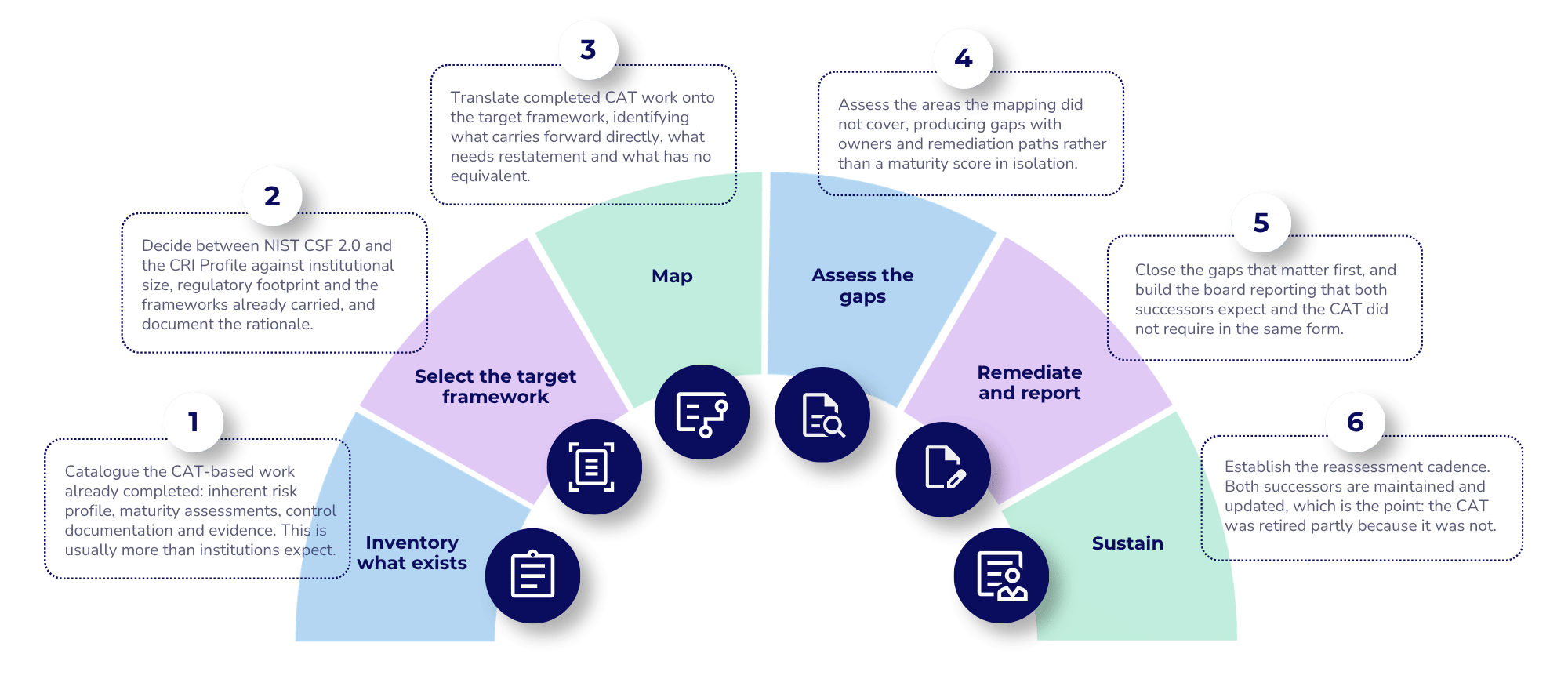
Elevate approaches the transition as a mapping problem first and an assessment problem second, because the work already done usually covers more of the target framework than institutions expect.
Current-state mapping
Map existing CAT inherent risk profile and maturity results onto the target framework so completed work carries forward rather than being redone.
Framework selection
Assess which successor fits the institution’s size, regulatory footprint and existing framework portfolio, with the rationale documented for the examiner who asks why.
Gap assessment against the target
Assess current practice against the selected framework, with each gap stated as a risk with an owner and a remediation path.
Governance and board reporting
Structure the assessment output for board and senior management reporting, which both successors weight more heavily than the CAT did.
Third-party dependency review
Assess vendor relationships, contract oversight and third-party risk against the target framework’s expectations, which is where examiners have increased attention.
Examination readiness
Prepare the documentation package and the narrative that explains the transition, the current position and the remediation plan in the terms an examiner uses.
ENGAGEMENT PHASES
How the work runs
WHO THIS IS FOR
Roles Elevate works with on this standard
GET STARTED
Ready to move off the CAT ?
Elevate Consult maps your existing assessment work onto NIST CSF 2.0 or the CRI Profile, assesses the gaps the mapping leaves, and builds the documentation that explains the transition in the terms an examiner uses.
FAQ
Common Questions
Is the FFIEC Cybersecurity Assessment Tool still available?
No. The FFIEC removed the CAT from its website on 31 August 2025 and decided not to update it to reflect newer government resources. It is no longer maintained and the FFIEC did not issue a replacement tool of its own.
What replaced the FFIEC CAT
No single tool did. Regulators point institutions toward existing frameworks, principally NIST Cybersecurity Framework 2.0 and the CRI Profile. Both are risk-informed and maintained, which the CAT no longer is. The CIS Controls are also referenced, though they function better as a technical implementation layer than as a risk assessment framework.
Did examiner expectations change when the CAT was retired?
No. The expectation that an institution conducts a structured cybersecurity self-assessment, maintains a documented risk profile and can evidence its maturity remains. Only the tool went away. An institution still needs to answer the same questions, using a framework it can defend.
Is our previous CAT work wasted?
No. Inherent risk profile results, maturity assessments, control inventories and evidence map onto both NIST CSF 2.0 and the CRI Profile. The transition is a mapping exercise. Treating it as a restart is the most expensive way to handle it and produces no additional assurance.
Which successor should we choose?
It depends on size, regulatory footprint and how many frameworks the institution already carries. NIST CSF 2.0 is cross-sector, outcome-based and widely recognized beyond financial services. The CRI Profile is purpose-built for the sector, harmonizes a large volume of regulatory expectations into a single control objective set, and scales through impact tiers. Institutions serving enterprise customers outside financial services often find NIST CSF 2.0 travels better.
What happens if we have not transitioned yet?
Nothing automatic, but the position weakens with time. An institution presenting CAT-based results can defend the position if it has a documented transition plan and a target framework. Without one, the explanation is that the institution did not notice its framework was withdrawn, which invites a broader question about how the program is maintained.