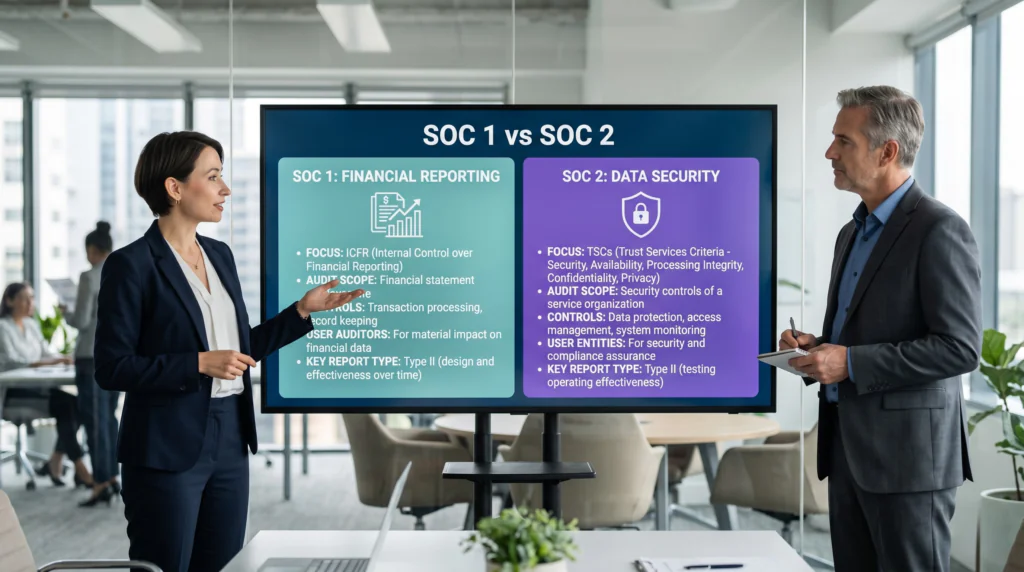
When a customer or partner asks for “a SOC report,” they could mean one of two very different things, and confusing them wastes time and money. SOC 1 vs SOC 2 is one of the most common points of confusion in compliance, because the reports share a name and a structure but answer completely different questions. SOC 1 is about controls that affect your customers’ financial reporting, while SOC 2 is about how you protect their data. Knowing which one applies, or whether you need both, determines what you scope, who you involve, and how you spend your budget. This explainer breaks down what each report covers, the key differences side by side, and how to tell which one your organization actually needs. If you already know SOC 2 is the goal, Elevate’s SOC 2 readiness support can take it from there.
What Is SOC 1?
A SOC 1 report addresses a service organization’s controls that are relevant to its clients’ internal control over financial reporting. It exists because when one company outsources a process that touches its financials, that process becomes part of the client’s own financial control environment. SOC 1 is performed under the AICPA’s SSAE 18 attestation standard.
The organizations that typically need SOC 1 are those whose services could affect a customer’s financial statements: payroll providers, payment processors, billing and claims processors, and software platforms that calculate or record financial data. The primary audience is the client’s finance team and, importantly, the client’s own external auditors, who rely on the SOC 1 report when auditing the client’s books.
What Is SOC 2?
A SOC 2 report addresses controls relevant to the Trust Services Criteria, which cover data security and related operational qualities. Security, often called the common criteria, is required in every SOC 2 report. The other four categories, Availability, Processing Integrity, Confidentiality, and Privacy, are optional and included only when they are relevant to the commitments a company makes to its customers.
SOC 2 is the report most technology and service companies are asked for today. The organizations that need it are SaaS providers, cloud services, managed service providers, and any vendor that stores or processes customer data. The primary audience is the customer’s security and procurement teams, who use the report to decide whether a vendor is safe to trust with their data. For most B2B software companies, SOC 2 is the trust signal that unblocks enterprise deals.
SOC 1 vs SOC 2: The Key Differences
The two reports are built the same way and are both issued by a licensed CPA firm, but they serve different purposes, audiences, and decisions. The comparison below summarizes where they diverge.
| Dimension | SOC 1 | SOC 2 |
|---|---|---|
| Primary focus | Controls over financial reporting | Controls over data security and operations |
| Question it answers | Could this service affect our financial statements? | Is our data protected with this vendor? |
| Based on | SSAE 18 (AICPA) | Trust Services Criteria (AICPA) |
| Who typically needs it | Payroll, payments, billing, and platforms affecting clients’ financials | SaaS and service providers that store or process customer data |
| Primary audience | Clients’ finance teams and their auditors | Clients’ security and procurement teams |
| Report types | Type I and Type II | Type I and Type II |
In short, SOC 1 is a financial-reporting assurance, and SOC 2 is a data-protection assurance. Neither is more advanced than the other, and one is not an upgrade of the other. They simply answer different questions for different stakeholders.
Which One Does Your Organization Need?
The deciding factor is what your service actually does for your customers. If your platform or process could influence the numbers on a customer’s financial statements, SOC 1 is likely in scope. If customers are entrusting you with their data and want assurance it is secure, SOC 2 is the report they will ask for. The fastest way to confirm is to look at the security and vendor questionnaires your prospects send, since they usually name the report they expect.
Some organizations need both. A fintech or financial-operations platform, for example, may affect clients’ financial reporting and also hold sensitive data, which means SOC 1 satisfies the finance and audit side while SOC 2 satisfies the security side. When both apply, a single program can be designed so overlapping controls and evidence are reused across the two reports rather than duplicated. A SOC 1 and SOC 2 consulting partner can help map that overlap. Book a Readiness Call with Elevate’s SOC specialists to confirm which report, or combination, fits your services.
Type I or Type II?
Both SOC 1 and SOC 2 come in two report types, and the distinction applies the same way to each. A Type I report evaluates whether controls are designed appropriately at a single point in time, while a Type II report evaluates whether those controls operated effectively over a period that commonly runs from three to twelve months. Most sophisticated buyers ultimately want a Type II, because it proves the controls work in practice. Many organizations lead with a Type I to satisfy an urgent request, then complete a Type II observation window. Understanding what a SOC 2 readiness assessment covers helps you prepare for either type before the audit begins.
Conclusion
SOC 1 vs SOC 2 comes down to a simple question: are you assuring customers about their financial reporting, or about the security of their data? SOC 1 covers controls over financial reporting and speaks to finance teams and auditors, while SOC 2 covers data security and speaks to security and procurement teams. Some organizations need both, and when they do, a well-designed program reuses controls across the two. Identify what your service does, check what your customers are asking for, and scope accordingly. Book a Readiness Call with Elevate to confirm the right report for your organization and build a program that holds up under audit.
Key Takeaways
SOC 1 and SOC 2 share a name and structure but answer different questions, so the right choice depends on what your service does for your customers.
- SOC 1 is about financial reporting – It covers a service organization’s controls that affect clients’ internal control over financial reporting and is relied on by clients’ finance teams and auditors.
- SOC 2 is about data security – It covers controls against the Trust Services Criteria, with Security required, and is the report most technology and service companies are asked to provide.
- Neither is an upgrade of the other – SOC 1 and SOC 2 serve different purposes and audiences, so one is not more advanced than the other.
- Some organizations need both – Providers whose services affect clients’ financials and also hold sensitive data may need both, and overlapping controls and evidence can be reused across the two reports.
- Both come in Type I and Type II – Type I evaluates control design at a point in time and Type II evaluates operating effectiveness over a period, with most buyers ultimately expecting a Type II.
The simplest way to decide is to read your customers’ security and vendor questionnaires, since they usually name the SOC report they expect you to provide.
FAQs
Q1. What is the difference between SOC 1 and SOC 2? SOC 1 reports on a service organization’s controls that are relevant to clients’ internal control over financial reporting, while SOC 2 reports on controls relevant to data security and related criteria. In short, SOC 1 is a financial-reporting assurance and SOC 2 is a data-protection assurance, aimed at different audiences.
Q2. Do I need SOC 1 or SOC 2? It depends on what your service does. If your platform or process could affect a customer’s financial statements, such as payroll or payment processing, SOC 1 is likely in scope. If customers want assurance that the data they entrust to you is secure, SOC 2 is the report they will request. Checking the questionnaires prospects send is the fastest way to confirm.
Q3. Can a company need both SOC 1 and SOC 2? Yes. Organizations whose services affect clients’ financial reporting and also hold sensitive data, such as many fintech platforms, often need both. A single program can be designed so overlapping controls and evidence are reused across the two reports rather than duplicated.
Q4. Is SOC 2 more common than SOC 1? Among technology and SaaS companies, SOC 2 is requested more often because those buyers are focused on data security. SOC 1 is essential for services that affect clients’ financials. One is not harder or better than the other; they simply apply in different situations.
Q5. Who issues a SOC 1 or SOC 2 report? Both reports must be issued by an independent licensed CPA firm. A consulting firm cannot issue the report for its own client, but it can perform the readiness assessment, remediation, and evidence preparation that get an organization ready for the CPA firm’s audit.