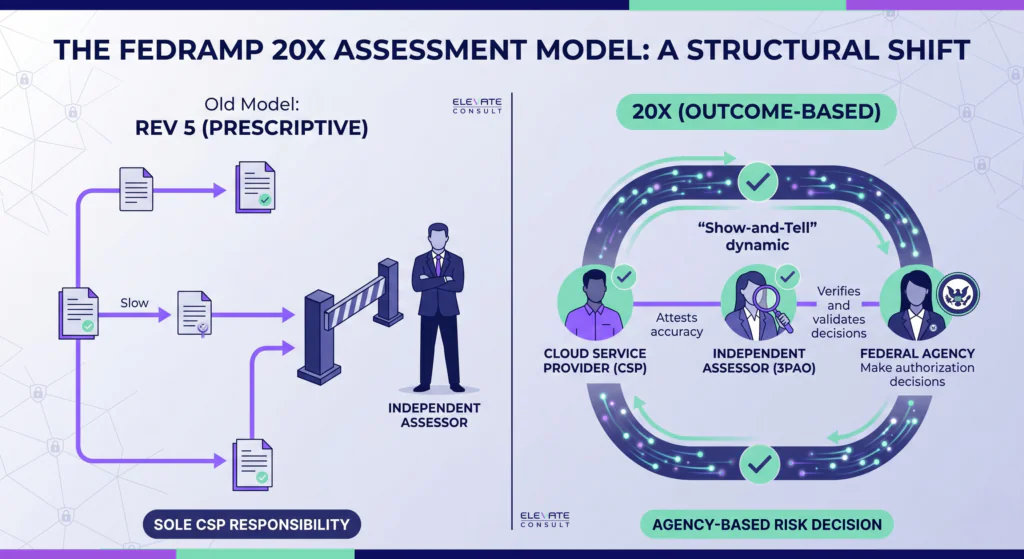
The FedRAMP 20X program is reshaping how cloud service providers demonstrate security to federal agencies. Independent assessors no longer issue pass-or-fail verdicts. They validate and verify. Agencies make the risk-based decision. This structural shift changes everything about how CSPs prepare for authorization, how assessors conduct reviews, and how the relationship between all three parties functions going forward. This piece distills what the May 2026 FedRAMP Community Working Group session revealed about assessment methodology, Key Security Indicators, and what CSPs can expect when they enter the 20X process.
The Fundamental Shift: From Prescriptive Controls to Security Outcomes
What FedRAMP 20X Is Actually Asking For
Under Rev 5, controls came with one approved implementation path. Alternative approaches required extensive justification, and unwritten PMO preferences shaped what reviewers accepted regardless of what the baseline actually required. FedRAMP 20X replaces that framework with a different question entirely: what are you doing to achieve this security outcome, and how do you know it’s working?
Key Security Indicators are not prescriptive requirements. They are outcome-based indicators of how seriously a business takes security. The KSI for executive support, for example, reads: “Executive support for achieving the provider’s security goals is persistently reviewed and demonstrated.” FedRAMP is not telling CSPs how to demonstrate executive support. It is asking CSPs to show what executive support actually looks like in their organization, and to prove it.
This distinction matters because it means CSPs with genuinely mature security practices can present their actual environment rather than engineering documentation to match a template. Organizations that came to the 20X pilot with real executive involvement in security decisions produced more compelling KSI responses than those trying to reverse-engineer what reviewers wanted to see.
Who Is Responsible for What
One of the most consequential clarifications from the May 2026 CWG session involves accountability. Under the FedRAMP Authorization Act and M-24-15, the cloud service provider bears sole responsibility for the accuracy, completeness, and correctness of everything submitted for FedRAMP certification. The independent assessor’s role is to verify and validate that information, not to certify it.
This is a meaningful departure from the 3PAO model established in the 2011 FedRAMP memo, where assessment organizations carried implicit gatekeeping authority. In the 20X framework, if a CSP attests that a security control is implemented and operational, they are signing a contract with the U.S. government on that claim. The independent assessor confirms the implementation is real and the documentation is accurate. FedRAMP makes the authorization decision. Assessors no longer recommend that agencies issue an ATO.
How the Assessment Process Works Under 20X
The Show-and-Tell Model
Assessors at the May CWG session described 20X as a “show and tell” exercise. CSPs demonstrate how they are implementing each KSI, explain why they have made the security decisions they have made, and walk assessors through their environment in real time. Screen sharing, live dashboards, and direct access to configurations replace the screenshot-heavy documentation packages that characterized Rev 5 assessments.
This makes the assessment more iterative and more conversational. Rather than presenting a completed package for review, CSPs and assessors work through KSIs together. If a CSP’s implementation raises questions, those questions get resolved in the session rather than through formal findings and resubmission cycles. Assessors confirmed that this model produces faster, more accurate results because both parties develop genuine understanding of the environment being assessed.
Assessing One KSI, Not Thirty-Eight Controls
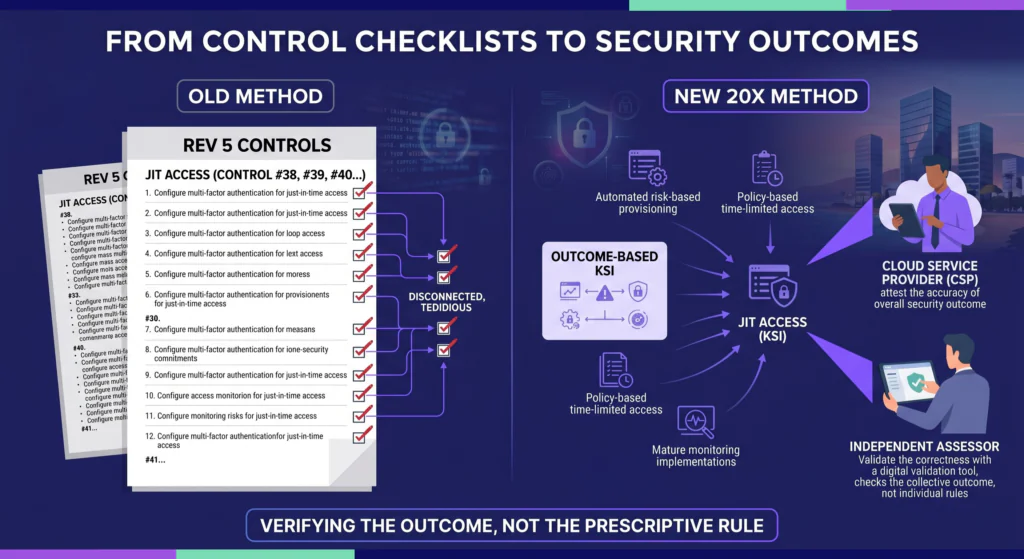
A common point of confusion in the 20X transition involves the relationship between KSIs and the SP 800-53 controls they reference. A single KSI like the just-in-time access indicator maps to more than thirty underlying controls. That mapping exists as contextual guidance, not as a checklist.
Independent assessors assess the KSI. They are not conducting a control-by-control review using the SP 800-53 mapping as a proxy. If a CSP is meeting the security capability that the KSI describes, the assessment reflects that, regardless of whether every related control is implemented in the traditional way. NIST SP 800-53A Revision 5 is explicit on this point: the failure of a single control, or even multiple controls, does not necessarily compromise the overall security capability an organization requires.
This approach creates real flexibility for CSPs operating in constrained environments. A two-person engineering team does not need just-in-time access controls designed for enterprise-scale privilege management. If their existing MFA and SSO implementation achieves the security outcome, assessors document what they have built and agencies decide whether it is sufficient for their use case.
What Assessors Are Looking For
The shift from documentation review to outcome validation changes what good preparation looks like for a CSP. Assessors are not matching implementations against scripts. They are asking whether the CSP can articulate what they are doing, why they are doing it, and how they know it is working.
CSPs that came to the 20X pilot having genuinely thought through their KSI responses outperformed those that approached the process as a compliance exercise. The difference was visible: organizations with real security cultures produced substantive, confident responses because they were describing decisions they had already made. Organizations trying to satisfy an external requirement produced thinner, more formulaic responses that required more follow-up.
What Changed for Independent Assessors
A Lighter Documentation Burden, Higher Technical Judgment
The volume shift between Rev 5 and 20X is significant. FedRAMP Rev 5 assessed 323 controls. The 20X KSI set is in the range of forty to sixty indicators. The documentation burden drops accordingly, which assessors expect will reduce assessment costs for CSPs, particularly smaller vendors who could not absorb the overhead of full Rev 5 packages.
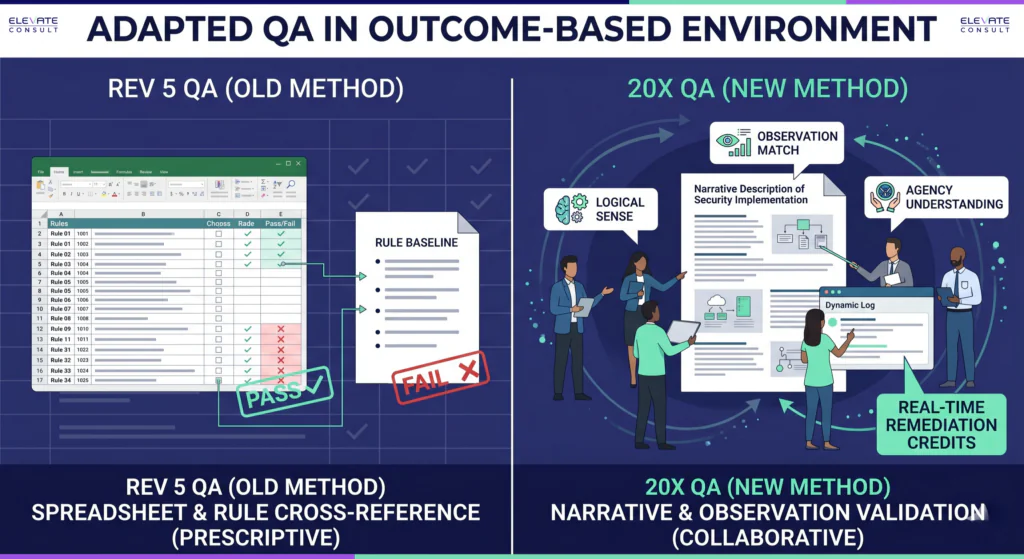
The trade-off is that assessors are now exercising more technical judgment on fewer, more substantive questions. Rather than verifying that hundreds of cells in a compliance spreadsheet are correctly populated, assessors are reading narrative descriptions of security implementations and evaluating whether those implementations actually achieve the stated security outcomes. That requires deeper familiarity with the environments being assessed and less tolerance for generic, template-driven responses.
QA in a Less Prescriptive Environment
Quality assurance within assessment firms has adapted. Under Rev 5, QA reviewers could cross-reference findings against a known baseline. Under 20X, QA focuses on whether the write-up accurately reflects what was observed, whether the KSI is meaningfully addressed, and whether the information is organized so agencies can understand it without difficulty.
Assessors described the 20X QA process as more collaborative than Rev 5. Rather than checking documentation completeness, QA reviewers are evaluating whether the narrative makes sense in the context of the specific system being assessed, and whether the iterative changes CSPs made during the assessment are captured accurately so they receive credit for remediating issues in real time.
The Continuous Assessment Model and What It Means for CSPs
Tighter Relationships, More Frequent Touchpoints
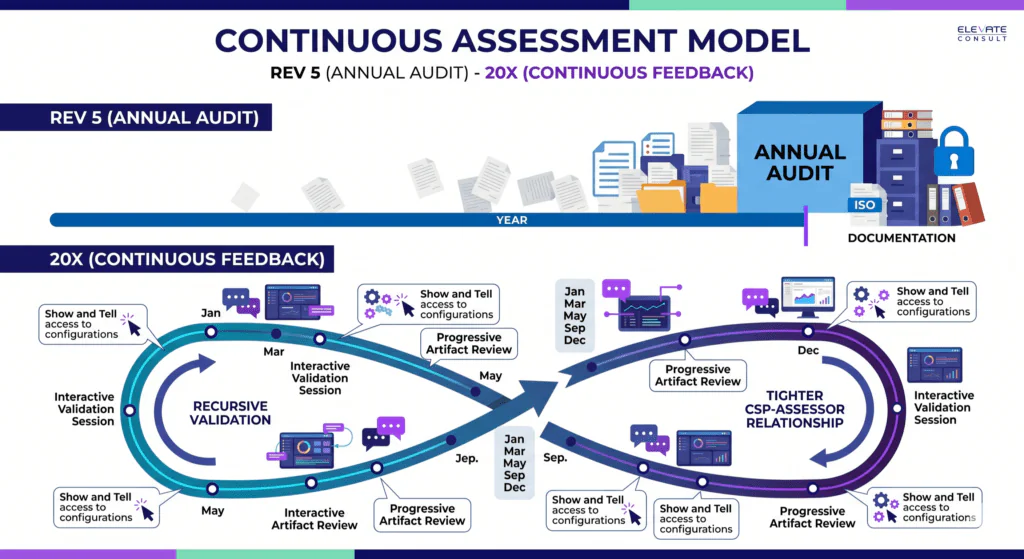
Rev 5 authorizations operated on annual cycles. Large Rev 5 providers were cautious about making significant changes because significant changes triggered review processes with their own timelines and overhead. FedRAMP 20X is designed for continuous evolution. CSPs may work with their independent assessors four, five, or six times a year as their environments change.
This creates a fundamentally different relationship between CSPs and assessors. Rather than an annual audit conducted by a team that has to rebuild context from scratch each time, 20X expects assessors to maintain working familiarity with the CSPs they serve. That continuous involvement lets assessors provide more specific, more current feedback, and lets CSPs course-correct without waiting for a formal findings cycle.
Progressive Certification and the Betterment Model
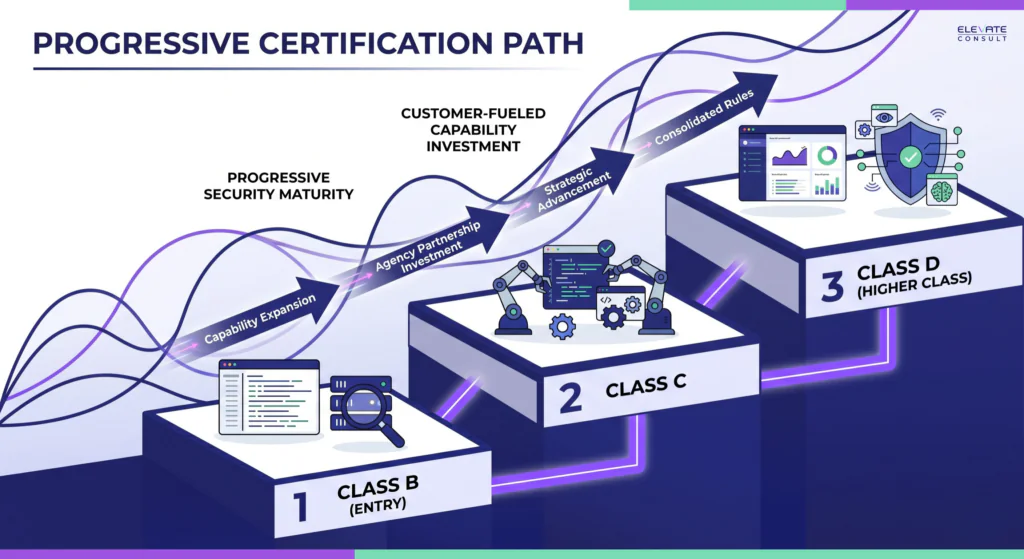
One of the more significant practical implications of 20X involves how certification interacts with ongoing development. Under Rev 5, a CSP had to meet the full standard to receive authorization. Under 20X, a CSP can achieve a lower-class certification, begin working with federal agency customers, and use that relationship to justify investment in higher-class security capabilities over time.
An agency may look at a Class B certification and tell a CSP that they have a concern about a specific implementation. If the CSP addresses that concern, the agency will contract with them. That creates a direct commercial incentive for security improvement that the Rev 5 model never provided. CSPs that demonstrate good-faith improvement have a path to Class C or Class D certification as their customer base grows and their security investment scales accordingly.
Commercial and Federal Pipelines Coming Together
A persistent frustration under Rev 5 was the divergence between commercial and federal product versions. Compliance requirements forced CSPs to maintain separate development pipelines, which meant federal agency customers often received older, less capable versions of the products their commercial counterparts used.
The 20X model reduces the pressure to maintain separate pipelines by focusing on security outcomes rather than implementation prescriptions. If a commercial development practice achieves the security outcome a KSI requires, there is no compliance reason to replicate it in a separate federal-only environment. The expectation is that this convergence will close the gap between what federal agencies have access to and what commercial customers receive.
Practical Preparation for CSPs Entering 20X
Come As You Are
The strongest advice from experienced 20X assessors is to approach the process as a genuine representation of your security environment rather than an optimization exercise. CSPs that spent time trying to anticipate what reviewers wanted to see produced weaker packages than those that described what they actually built and why.
Prepare to explain your security decisions in plain language. Assessors need to understand your environment well enough to write about it credibly. That requires honest, direct communication about what is in place, what is not, and why you made the tradeoffs you made. Assessors are not looking for perfection. They are looking for accuracy.
Build the Automation Infrastructure Early
20X places greater emphasis on continuous monitoring and automated validation than Rev 5. CSPs entering the 20X process should expect to invest in engineering work upfront to build the monitoring pipelines and dashboards that demonstrate ongoing security posture. Assessment costs with independent assessors are expected to be lower under 20X, but that savings assumes CSPs arrive with mature automation infrastructure in place.
Organizations that defer this investment will find themselves doing the same engineering work under assessment pressure that they could have completed on their own schedule. The upfront investment pays back in lower ongoing assessment costs and more credible KSI responses.
Monitor the Consolidated Rules for 2026
FedRAMP is publishing the Consolidated Rules for 2026 incrementally at fedramp.gov/preview/2026. The rules are actively in development and comments are enabled on every page. Assessors raised during the May CWG that they want clearer guidance on what materials are expected for each KSI, and FedRAMP has indicated that specificity is coming. CSPs and their assessors should monitor these updates regularly, as the rules will define what “required mandatory artifacts” look like for each KSI and what agencies can expect from authorization packages going forward.
Conclusion
FedRAMP 20X changes the authorization process at a structural level. CSPs are responsible for the accuracy of what they submit. Independent assessors verify and validate. Agencies make the risk-based decision. The KSI framework rewards organizations that have built genuine security cultures and penalizes those that approach compliance as a documentation exercise. Assessors who participated in the pilot described the process as more honest, more efficient, and more useful than the Rev 5 model it is designed to complement. For CSPs considering the 20X path, the work begins not with documentation but with a clear-eyed assessment of what your security environment actually looks like and whether you can describe it credibly to someone who has never seen it before. Book a Readiness Call to assess your current posture against the 20X KSI framework before engaging an independent assessor.
Key Takeaways
FedRAMP 20X fundamentally repositions how cloud service providers, independent assessors, and federal agencies share responsibility for authorization decisions.
- CSPs bear sole legal responsibility for the accuracy of everything submitted for FedRAMP certification, with independent assessors providing verification and validation rather than gatekeeping authority.
- KSIs assess security outcomes, not control implementations. A single KSI may reference dozens of SP 800-53 controls, but assessors evaluate the KSI, not the underlying control list.
- 20X assessment costs are expected to be lower than Rev 5 due to reduced documentation volume, but CSPs must invest in automation infrastructure upfront to realize those savings.
- Continuous assessment replaces annual audit cycles, creating tighter CSP-assessor relationships and more frequent opportunities to reflect security improvements.
- Progressive certification allows CSPs to enter the federal market at a lower class and earn investment in higher-class capabilities through agency partnerships.
The Consolidated Rules for 2026 are available for comment at fedramp.gov/preview/2026. CSPs and assessors should engage with that process now while the rules are still being shaped.
FAQs
Q1. What is the difference between verification and validation in the FedRAMP 20X context? Verification is confirmation through objective evidence that specified FedRAMP rules, controls, indicators, or other certification data requirements have been fulfilled. Validation is confirmation through objective evidence that implemented security capabilities are suitable for their intended FedRAMP certification use and support expected security outcomes. Both are the responsibility of the independent assessor; neither constitutes a recommendation to issue an ATO.
Q2. Do CSPs still need to map their implementations to SP 800-53 controls under 20X? No. Assessors assess KSIs, not the SP 800-53 controls that appear in KSI reference materials. Those mappings exist as contextual guidance to help CSPs understand what security capabilities a KSI is designed to capture, but a CSP that meets the KSI outcome is not required to implement every referenced control in a prescribed way.
Q3. How does the progressive certification model work under FedRAMP 20X? CSPs can achieve a lower-class certification (Class B, for example) and begin working with federal agency customers before investing in the capabilities required for higher classes. Agency relationships can then create commercial incentives for security improvement, with CSPs advancing to Class C or Class D as their environment matures and their customer base grows.
Q4. What should CSPs prioritize when preparing for a 20X assessment? CSPs should prioritize honest documentation of their actual security environment, investment in monitoring automation and validation pipelines, and the ability to articulate security decisions and tradeoffs clearly. Attempting to optimize documentation for anticipated reviewer preferences produces weaker results than describing what is genuinely in place.
Q5. Where can CSPs and assessors find the Consolidated Rules for 2026? The Consolidated Rules for 2026 are available in preview at fedramp.gov/preview/2026. Comments are enabled on each page, and FedRAMP is updating content regularly. Deadline information for both the Rev 5 and 20X paths is available at the provider updating deadlines pages linked from that URL.