
The FedRAMP Rev 5 transition represents a transformation in federal cloud security compliance that every contractor must understand by 2026. We’re seeing sweeping changes to authorization processes and documentation requirements that will affect how you maintain federal contracts. More importantly, the change from Excel-based templates to machine-readable formats requires immediate attention.
We’ll explain FedRAMP updates in detail and cover what NIST 800-53 Rev 5 is and how it shapes the new framework. This piece walks you through mandatory deadlines and technical documentation changes. You’ll also get a practical implementation roadmap to ensure your compliance.
Understanding FedRAMP Rev 5: What Changed from Rev 4
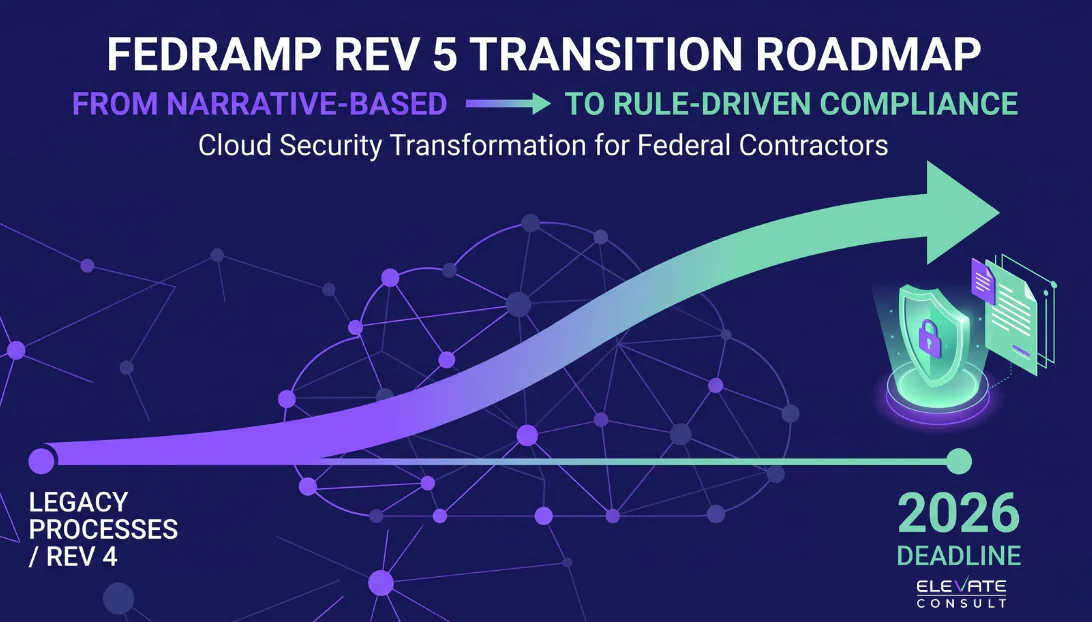
Federal contractors face an adjusted compliance framework with the FedRAMP Rev 5 transition. The changes go beyond simple updates to extend into how you document controls, submit authorization packages, and maintain ongoing compliance. You need to learn the mechanisms behind the security control framework to understand these modifications.
What is NIST 800-53 Rev 5
NIST 800-53 Rev 5 serves as the security and privacy control baseline that FedRAMP builds upon. This National Institute of Standards and Technology publication defines the security controls federal systems must implement. FedRAMP had to arrange its authorization framework when NIST updated their controls from Rev 4 to Rev 5. The revision introduces updated control families and modified control language. It also brings refined implementation guidance that affects every cloud service provider seeking federal authorization.
Key Differences Between Rev 4 and Rev 5
The FedRAMP Rev 5 transition brings several technical and procedural changes that contractors must address:
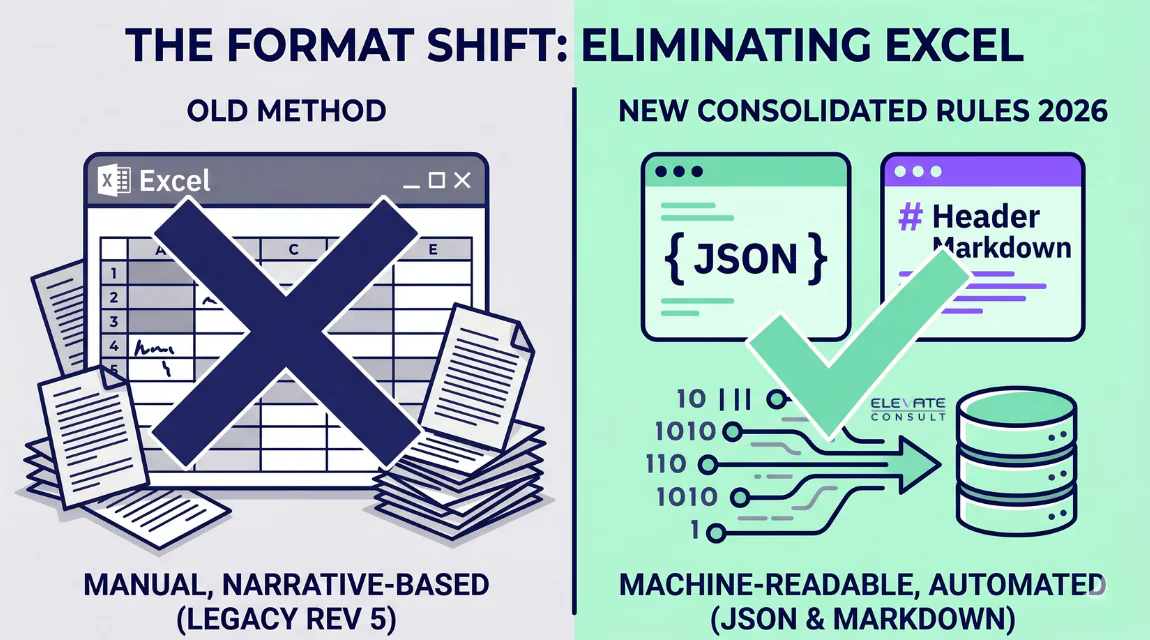
- Rule-Driven Format: FedRAMP is moving away from narrative-based documentation toward a rule-driven format. This change standardizes how you demonstrate compliance and reduces ambiguity in authorization requirements.
- Machine-Readable Templates: Templates are migrating from Excel to JSON and Markdown formats. This change enables automated processing and validation of your authorization packages.
- Mandatory Balance Improvement Releases (BIRs): Rev 5 Balance Improvement Releases become mandatory requirements rather than optional updates. BIRs will be integrated into the rules framework. You must implement them within specified timeframes.
- NIST Control References: Baseline templates will reference NIST controls instead of embedding the full control text. This approach keeps documentation current when NIST makes updates without requiring template revisions.
- Legacy Rev 5 Processes: The term “Legacy Rev 5 Processes” has been introduced to distinguish older procedures from the new Consolidated Rules 2026 framework.
The Consolidated Rules 2026 began incremental public release on May 4. It packages these changes into a unified framework. You can review the preview at fedramp.gov/preview/2026.
FedRAMP 20x vs Rev 5 Approach
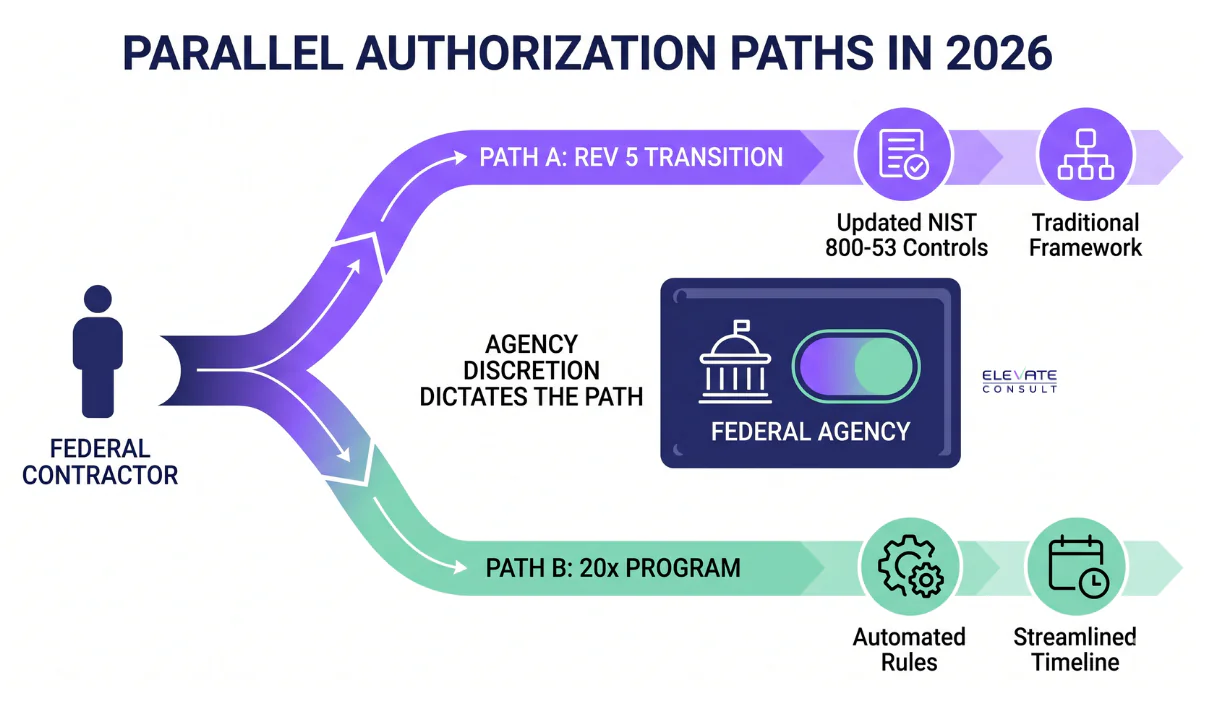
FedRAMP has positioned the 20x program as the preferred path forward. However, observers at the May 6, 2026 CWG meeting noted some softening in how aggressively FedRAMP is promoting 20x over Rev 5. FedRAMP wants the 20x program’s streamlined approach, but some industry participants believe agencies may not be fully bought into the FedRAMP 20x program, though this remains an informal read of the situation rather than an official position.
You now have two parallel paths available. The Rev 5 approach maintains the traditional authorization framework with updated controls and templates. The 20x program offers a more automated, rule-based system designed to reduce authorization timelines. Federal agencies retain discretion over which path they require. This creates a split landscape for contractors to traverse.
To cite an instance, you’ll follow the Rev 5 transition process if your agency customer hasn’t committed to the 20x program. You gain flexibility as agency priorities evolve through 2026 when you understand both approaches. The key difference lies in how you structure your authorization packages and maintain ongoing compliance monitoring under each framework.
New Consolidated Rules Framework for 2026
FedRAMP began rolling out the Consolidated Rules 2026 framework on May 4, 2026, marking a move toward standardized, rule-based compliance processes. This framework packages the Rev 5 transition requirements into a unified structure available at fedramp.gov/preview/2026. The changes affect how you format authorization packages, maintain ongoing compliance, and interact with federal agencies throughout the authorization lifecycle.
Machine-Readable Templates: JSON and Markdown
The transition away from Excel-based templates represents one of the most important operational changes in the Consolidated Rules 2026. You must now submit authorization documentation in JSON and Markdown formats. These machine-readable formats enable automated validation and processing of your submissions. Manual review time drops and data structures become standardized across all cloud service providers.
JSON templates structure your control implementation data in a format that federal systems can parse without human intervention. Markdown files handle narrative documentation with consistent formatting. Both formats integrate more naturally with modern development workflows and version control systems than Excel spreadsheets. Converting existing documentation becomes necessary if you’ve been maintaining authorization packages in Excel. You’ll also need to establish new processes for template management.
Balance Improvement Releases (BIRs) Requirements
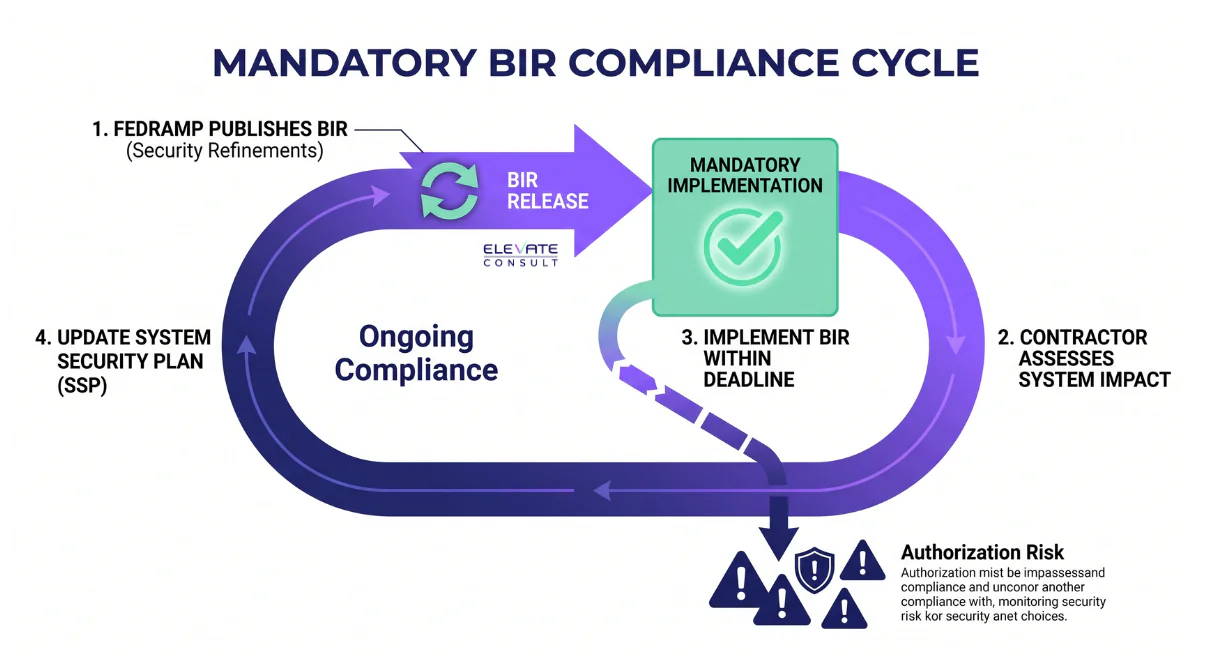
Balance Improvement Releases under Rev 5 move from optional updates to mandatory compliance requirements. BIRs now are part of the rules framework itself. You must implement them within specified timeframes to maintain your authorization status. Cloud service providers could adopt BIRs at their discretion before. That flexibility no longer exists.
Each BIR addresses specific security control refinements or clarifications identified after the original Rev 5 release. FedRAMP publishes a BIR and you’ll receive a deadline for implementation. You must update your System Security Plan as well. This change will give all authorized systems consistent security baselines as the program evolves. Your authorization standing with federal agencies could be at risk if you fail to meet BIR deadlines.
Legacy Rev 5 Processes Explained
FedRAMP introduced the term “Legacy Rev 5 Processes” during the May 6, 2026 CWG meeting to distinguish older procedures from the new Consolidated Rules approach. This terminology helps separate documentation and authorization methods used before the Consolidated Rules 2026 release from current requirements. Any Rev 5 processes established before May 2026 fall under this legacy designation.
You’ll encounter this term when reviewing historical authorization packages or comparing your current documentation against earlier submissions. The distinction matters because legacy processes may not line up with machine-readable template requirements or the rule-driven format now in force.
Control Baseline Template Updates
Baseline templates no longer embed full NIST control text. Templates reference NIST 800-53 Rev 5 controls by identifier instead. This approach keeps templates current when NIST updates control language without requiring FedRAMP to reissue templates. NIST makes periodic control refinements and embedding static text created version control problems and documentation drift.
Cloud service providers own authorization data under the new framework. You control whether to share your authorization information through Trust Centers or keep it private. This clarification resolves ambiguity about data ownership and gives you discretion over public disclosure of your compliance status.
Mandatory Compliance Deadlines for Federal Contractors
Meeting compliance deadlines requires understanding that FedRAMP now operates two parallel authorization paths. The program published separate deadline guidance for Rev 5 and 20x transitions. This creates distinct timelines that depend on which framework your agency customer requires. You’ll find these schedules at fedramp.gov/preview/2026/providers/updating/deadlines/rev5/ and the corresponding 20x path at fedramp.gov/preview/2026/providers/updating/deadlines/20x/.
Rev 5 Transition Timeline
The Rev 5 deadline structure follows the Consolidated Rules 2026 framework that began incremental public release on May 4, 2026. Contractors with existing Rev 4 authorizations must transition their documentation to meet Rev 5 control baselines and template requirements. This path maintains the traditional FedRAMP authorization approach and incorporates updated NIST 800-53 Rev 5 controls.
FedRAMP’s recent change away from aggressively pushing the 20x program over Rev 5 is especially relevant for contractors, some attendees of the May 6, 2026 CWG meeting observed what appeared to be a less aggressive push toward 20x, though FedRAMP has not issued an official statement reversing its position. Industry observers have speculated that agency adoption of 20x may be slower than anticipated, though this has not been officially confirmed. This means more contractors will follow the Rev 5 timeline rather than migrate to the newer program. This development affects your planning timeline. You may have prepared for 20x requirements only to find your agency customer prefers the Rev 5 process.
The Rev 5 path requires you to adopt machine-readable templates and implement mandatory BIRs. You must update control implementation documentation according to the new baseline references. Your transition deadline depends on your current authorization status and the specific requirements your authorizing agency establishes.
20x Program Migration Dates
The 20x program offers a separate migration timeline designed for contractors and agencies ready to adopt the efficient authorization approach. FedRAMP positioned 20x as the preferred future direction. However, the pullback noted in the May 2026 guidance creates uncertainty about widespread adoption.
You’ll follow deadlines published at the dedicated 20x path if your agency customer commits to the 20x framework. This timeline is different from Rev 5 requirements because 20x uses a rule-driven format from the start rather than transitioning from narrative-based documentation. The 20x approach assumes you’re building authorization packages in the new format rather than converting existing materials.
Contractors pursuing new authorizations might find 20x timelines more straightforward since you’re not managing a transition. Existing authorizations face more complexity in either case, whether updating to Rev 5 or migrating to 20x.
Authorization Package Submission Requirements
FedRAMP will issue a combined notice addressing outcomes for RFC-0026 through RFC-0030. These Requests for Comment cover various aspects of the authorization package submission process under both Rev 5 and 20x frameworks. The combined notice consolidates guidance that affects how you structure and submit documentation.
Your submission requirements depend on which path you’re following. Rev 5 packages use the updated control baseline templates with NIST control references. 20x submissions follow the rule-driven format established in that program. Both paths require machine-readable templates rather than Excel-based documentation, but the specific JSON and Markdown structures are different between frameworks.
Track both deadline URLs to understand requirements as FedRAMP publishes updates throughout 2026.
Technical Documentation and Template Changes
Template format changes under the FedRAMP Rev 5 transition just need immediate operational adjustments from contractors. The change affects how you create authorization packages and how you store, version, and update compliance documentation throughout your authorization lifecycle.
Moving Away from Excel-Based Templates
Contractors can no longer rely on Excel spreadsheets to submit authorization packages. Organizations accustomed to spreadsheet-based workflows face a technical barrier with the migration to JSON and Markdown formats. JSON structures your control implementation data in key-value pairs that federal validation systems can process without human intervention. Markdown handles your narrative documentation with formatting that renders the same way across different platforms.
You must establish new toolchains to manage templates because of this change. Version control systems like Git work naturally with JSON and Markdown. You can track changes to authorization packages with granular precision. Excel’s binary format couldn’t provide this level of detail. Automated validation scripts can parse machine-readable templates to flag inconsistencies before submission and reduce back-and-forth with assessors.
The template conversion represents a one-time effort for contractors who maintain multiple authorizations. You’ll extract data from existing Excel files and restructure it according to the new schemas FedRAMP publishes.
NIST Control Reference Updates
Baseline templates now reference NIST 800-53 Rev 5 controls by identifier rather than embedding full control text. This technical decision stems from NIST’s practice of updating control language from time to time. FedRAMP avoids template obsolescence by referencing controls instead of copying text when NIST publishes clarifications or modifications.
You’ll cite the NIST control identifier and describe your specific implementation approach when you document control implementation. The control text itself resides in the official NIST publication, which you reference as your authoritative source.
Authorization Data Sharing Rules
Your authorization data belongs to you as the cloud service provider. FedRAMP clarified during the May 6, 2026 CWG meeting that you retain ownership and control discretion over this information. This ruling resolves previous ambiguity about whether authorization details were public information or proprietary data.
CSP Trust Center Requirements
Trust Centers serve as public repositories where you can share authorization information with potential agency customers on a voluntary basis. You’re not obligated to participate, though. The decision to share or withhold your authorization data through Trust Centers rests entirely with you. This flexibility allows you to balance transparency with competitive considerations when marketing your services to federal agencies.
Implementation Roadmap for Contractors
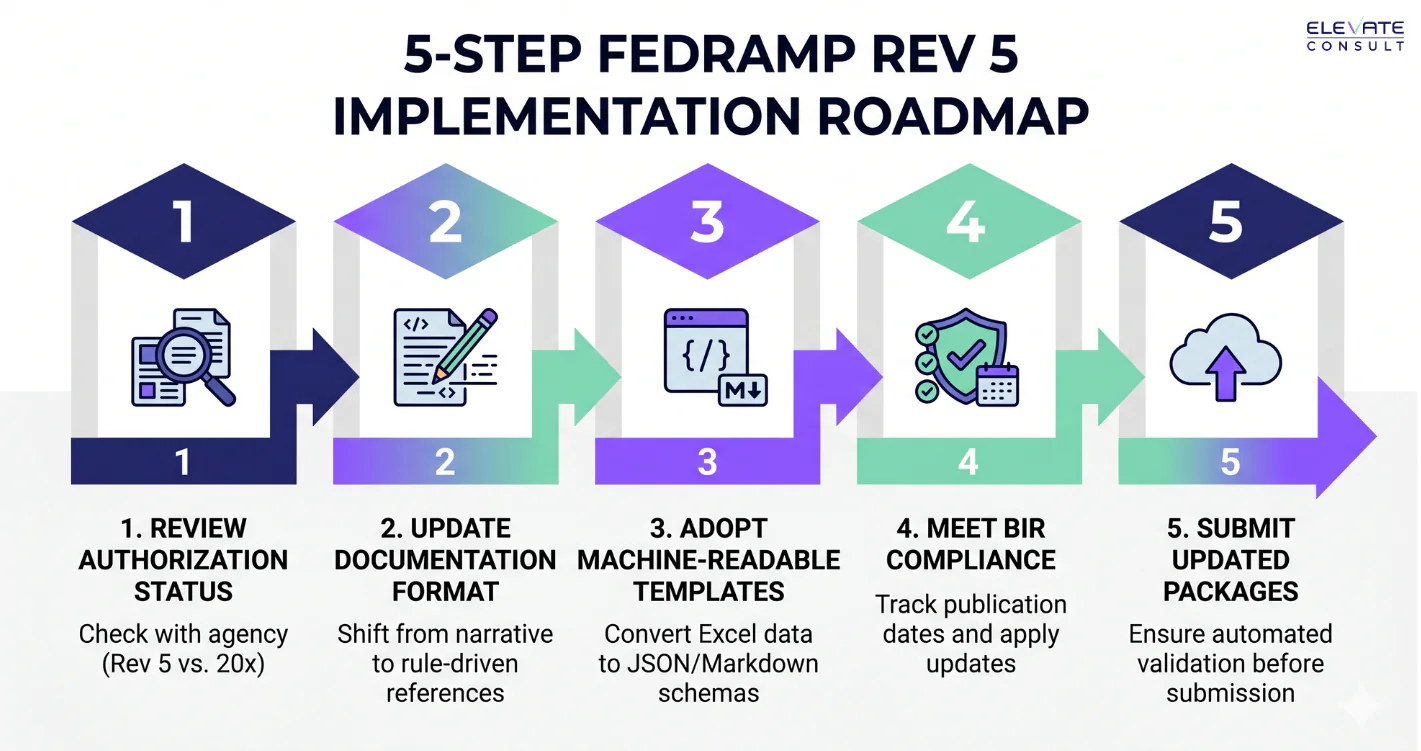
Navigating the FedRAMP Rev 5 transition just needs a structured approach that addresses technical, procedural, and timeline requirements. We’ve broken down the implementation process into five sequential steps that line up with the Consolidated Rules 2026 framework.
Step 1: Review Current Authorization Status
Determine whether your authorization follows the Rev 5 or 20x path. Check with your authorizing agency to confirm their preference, as this decision drives all subsequent actions. Agencies that haven’t committed to the 20x program will require you to follow Rev 5 procedures. Document your current control baseline version and identify gaps between your existing authorization and Rev 5 requirements. If you’re uncertain about your compliance status or need expert guidance on which path to pursue, Book a Readiness Call to assess your specific situation.
Step 2: Update Documentation Format
Change your documentation from narrative-based descriptions to the rule-driven format that FedRAMP now mandates. This change affects how you structure System Security Plans and control implementation statements. Verify that your documentation references NIST 800-53 Rev 5 controls by identifier rather than embedding full control text. Review each control implementation against the updated baseline to ensure they line up.
Step 3: Adopt Machine-Readable Templates
Convert your authorization packages from Excel to JSON and Markdown formats. This technical migration requires establishing new workflows for template management and validation. Set up version control systems to track changes in your machine-readable documentation. Test your converted templates against FedRAMP’s validation schemas before submission to catch formatting errors early.
Step 4: Meet BIR Compliance
Implement all mandatory Balance Improvement Releases within the specified timeframes. Track BIR publication dates and establish internal processes to assess each release’s effect on your system. Update your System Security Plan to reflect BIR implementations and collect evidence that demonstrates compliance. Monitor the FedRAMP website for new BIR announcements, as these requirements now form part of the rules framework.
Step 5: Submit Updated Packages
Submit your authorization package according to the deadlines published at fedramp.gov/preview/2026/providers/updating/deadlines/. Verify your submission uses the correct template format and has all required documentation. Maintain your authorization by tracking ongoing BIR releases and template updates as FedRAMP refines the Consolidated Rules 2026 framework.
Conclusion
The FedRAMP Rev 5 transition requires action now from federal contractors navigating compliance in 2026. So we’ve covered the split between Rev 5 and 20x paths, the move to machine-readable templates, and mandatory BIR requirements that reshape your authorization process. The five-step implementation roadmap helps you meet these new requirements. Uncertainty about which path applies to your specific authorization situation warrants expert guidance, so Book a Readiness Call to clarify your compliance strategy. Contractors who address template conversions now and track published deadlines will maintain their federal authorizations without disruption as the Consolidated Rules 2026 framework takes full effect.
Key Takeaways
Federal contractors must navigate significant changes in FedRAMP compliance requirements by 2026, with new documentation formats and mandatory deadlines that could impact authorization status.
• Two parallel authorization paths exist: Rev 5 transition and 20x program, with agencies retaining discretion over which framework they require for contractors.
• Excel templates are eliminated: All authorization packages must now use machine-readable JSON and Markdown formats for automated processing and validation.
• Balance Improvement Releases become mandatory: Previously optional BIRs are now required compliance elements with specific implementation deadlines that affect authorization standing.
• Documentation ownership clarified: Cloud service providers retain full control over their authorization data and can choose whether to share it through Trust Centers.
• Immediate action required: Contractors must review current authorization status, convert documentation formats, and track published deadlines at fedramp.gov/preview/2026 to maintain federal contracts.
The transition represents more than template updates—it’s a fundamental shift toward rule-driven compliance that requires strategic planning and technical adaptation to ensure continued federal market access.
FAQs
Q1. What is the main difference between FedRAMP Rev 4 and Rev 5? FedRAMP Rev 5 introduces a rule-driven format replacing narrative-based documentation, requires machine-readable templates in JSON and Markdown instead of Excel, makes Balance Improvement Releases (BIRs) mandatory rather than optional, and references NIST controls by identifier instead of embedding full control text. These changes standardize compliance demonstration and enable automated processing of authorization packages.
Q2. Do federal contractors have to choose between Rev 5 and the 20x program? No, contractors don’t choose independently. Your authorizing federal agency determines which path you must follow. While FedRAMP initially pushed the 20x program, agencies have expressed concerns about fully adopting it, meaning many contractors will follow the Rev 5 transition process. You should confirm with your specific agency customer which framework they require for your authorization.
Q3. Why is FedRAMP moving away from Excel-based templates? Machine-readable formats like JSON and Markdown enable automated validation and processing of authorization packages, reducing manual review time and standardizing data structures across all cloud service providers. These formats also integrate better with modern development workflows and version control systems, allowing granular tracking of changes and automated consistency checks before submission.
Q4. What are Balance Improvement Releases and why are they now mandatory? Balance Improvement Releases (BIRs) are specific security control refinements or clarifications issued after the initial Rev 5 release. Under the new framework, BIRs have shifted from optional guidance to mandatory compliance requirements with specified implementation deadlines. You must implement each BIR within the given timeframe and update your System Security Plan accordingly to maintain your authorization status.
Q5. Where can contractors find the official compliance deadlines for the FedRAMP transition? Official compliance deadlines are published at fedramp.gov/preview/2026/providers/updating/deadlines/. There are separate timelines for the Rev 5 path and the 20x program path. Your specific deadline depends on your current authorization status and which framework your authorizing agency requires, so you should monitor both URLs for updates throughout 2026.