Continuous Monitoring for Audit-Ready Evidence

Continuous compliance monitoring exists to close one specific gap: the distance between what a policy says and what the system is actually doing right now. Most compliance programs do not fail on the control. They fail on the evidence, because a control that was true in January and never checked again is not the same thing as a control that is true today, and an assessor cannot grade intent. Continuous monitoring is what keeps documentation and operational reality pointing at the same thing, all year, instead of only in the week before an audit. This article covers what continuous monitoring actually means for audit readiness, why point-in-time evidence fails under real assessor scrutiny, what a defensible monitoring program has to include, and how it changes the audit itself when it is built correctly. The Gap Continuous Monitoring Closes Every compliance program has a policy layer and an operational layer, and the two drift apart by default, not by negligence. A policy says access is reviewed quarterly. The operational reality is whichever person last remembered to run the review, whenever that happened to be. A policy says vulnerabilities are patched within a defined window. The operational reality is whatever the patch queue actually looked like on any given day. Continuous monitoring is the discipline that keeps those two layers honest with each other, by checking the operational reality against the documented control on an ongoing basis rather than reconstructing it once a year under audit pressure. Point-in-Time Evidence Does Not Hold Up A screenshot taken the week before an audit proves one thing: that the control was true in that specific week. It says nothing about the other fifty-one weeks of the year, and a competent assessor knows this. The reason continuous monitoring has become a baseline expectation across frameworks, not an optional maturity upgrade, is that point-in-time evidence answers a narrower question than the one the audit is actually asking. The audit is asking whether the control operates. A single screenshot can only answer whether the control existed once. What Continuous Monitoring Actually Requires A working continuous monitoring program has three components that have to function together. The first is a defined cadence for each control category, since not every control needs the same check frequency; access reviews, vulnerability scans, and configuration checks each have their own reasonable interval. The second is an automated or semi-automated way to pull evidence on that cadence without relying on someone remembering to do it manually. The third is a record of the evidence itself, timestamped and attributable, so that when an assessor asks for six months of history, the answer is a query, not a scramble. Matching Cadence to Control Category Not every control drifts at the same speed, and treating them all identically wastes effort on some categories while under-checking others. Access rights change whenever someone joins, leaves, or changes role, so access-related controls warrant a tighter check interval than something that changes rarely. Vulnerability exposure changes as new flaws are disclosed and new assets are deployed, which argues for near-continuous scanning rather than a periodic check. Configuration drift tends to happen gradually, often through unreviewed changes, and benefits from a cadence tied to the deployment pipeline rather than a fixed calendar date. Physical or vendor-relationship controls typically change slowly enough that a longer interval is genuinely defensible, provided the interval is documented and followed consistently rather than treated as a suggestion. The specific interval a given framework requires for a given control category should come from that framework’s own published rules, not from a generic industry rule of thumb, since mandated cadences vary and change over time. What stays constant across frameworks is the underlying design principle: match the check frequency to how quickly the underlying risk actually changes, and document the reasoning so an assessor can see the cadence was chosen deliberately rather than defaulted to whatever was easiest to automate first. Why Compliance Teams Get This Wrong The most common failure is not the absence of a monitoring program. It is a program that exists on paper and produces evidence only when someone is specifically looking for it, which functions identically to no program at all from an audit perspective. The Screenshot Trap A team that manually captures evidence once a quarter is not running continuous monitoring, even if the resulting folder of screenshots looks organized. The tell is what happens between captures. If a control could fail silently for two months before the next scheduled screenshot catches it, the monitoring is not continuous, it is periodic, and periodic monitoring reconstructs the same point-in-time problem on a slightly longer cycle. Mapping evidence for audit readiness at scale is the discipline that prevents this trap, and it depends on evidence capture being built into the system doing the work, not bolted on afterward by whoever remembers to check. Ownership Ambiguity Kills Cadence A monitoring cadence only holds if someone is accountable for it running, and that accountability breaks down quietly when no single person owns a given control. A RACI structure for control ownership that names who is responsible for each control’s evidence, not just who is broadly aware of it, is what keeps a monitoring cadence from silently lapsing when priorities shift. Continuous monitoring tooling can automate the check itself, but it cannot substitute for a named owner who is accountable when the check fails. What a Defensible Monitoring Program Looks Like An assessor evaluating a continuous monitoring program is not grading the tooling. They are grading whether the evidence the tooling produces is trustworthy, complete, and traceable back to a named control. Requirement, What an Assessor Checks, What Teams Commonly Produce Instead For a control like access review, the requirement is a periodic, documented review of who has access to in-scope systems. What an assessor looks for is dated review records, a named reviewer, and evidence that changes identified during the review were actually actioned, not just noted. What teams commonly produce instead is a current access
NIST CSF Assessment: Tiers, Scoping, and What You Get Back

A NIST CSF assessment measures how well an organization’s cybersecurity program aligns with the NIST Cybersecurity Framework, and it returns something more useful than a pass or fail: a picture of where you stand, where you want to be, and a prioritized path between the two. Because the framework is voluntary and outcome-based rather than a checklist, an assessment against it is less about compliance and more about understanding and improving your security posture in a structured, widely recognized way. This guide explains what a NIST CSF assessment measures, the implementation tiers it uses, the scoping choices that shape it, and the deliverables you get back. The reason organizations choose the NIST CSF is that it is a common language for cybersecurity that boards, insurers, partners, and regulators all recognize, without being tied to a single industry or mandate. An assessment against it gives you a defensible, framework-based view of your program that you can communicate upward and use to direct investment, which is why the output matters as much as the score. What a NIST CSF Assessment Measures The assessment evaluates your cybersecurity program across the framework’s core Functions, which in the current version of the framework are six: Govern, Identify, Protect, Detect, Respond, and Recover. Govern, added in the 2.0 version of the framework, addresses how cybersecurity risk is governed and integrated into the organization’s broader risk management, and it sits alongside the long-standing Functions that cover understanding your assets and risks, protecting them, detecting events, responding to incidents, and recovering from them. The assessment looks at how well your program delivers the outcomes each Function describes, rather than whether you have specific technologies in place. That outcome orientation is what makes the framework adaptable across organizations of very different sizes and sectors, and it is why a good assessment focuses on capability and results rather than a rigid control checklist. The measurement across all six Functions is what produces a rounded view of the program rather than a narrow one. The Implementation Tiers The NIST CSF expresses the maturity of an organization’s risk management through four Implementation Tiers, which describe how rigorous and integrated the cybersecurity risk practices are. The tiers are not a grade to maximize but a way to characterize where the organization sits and where it should aim. Tier Name What it describes Tier 1 Partial Risk management is ad hoc and largely reactive Tier 2 Risk Informed Risk awareness exists but is not consistent organization-wide Tier 3 Repeatable Risk management is formalized and applied consistently Tier 4 Adaptive Practices are continuously improved and adapt to change The tiers matter because the right target is not automatically Tier 4 for everyone; it is the tier that fits the organization’s risk, resources, and obligations. A small organization with modest risk may sensibly target Tier 2 or 3, while a large enterprise handling sensitive data has reason to aim higher. The assessment identifies your current tier and helps you set a target tier that is appropriate rather than aspirational, which is what keeps the improvement plan realistic. Current and Target Profiles Alongside the tiers, the framework uses Profiles to capture the specifics of where an organization stands and where it intends to go. A Current Profile describes the cybersecurity outcomes the organization is achieving today across the Functions, while a Target Profile describes the outcomes it needs or wants to achieve. The distance between them is the heart of the assessment, because that gap is what the organization actually needs to close. Profiles are what make the framework tailorable, since the Target Profile is set to the organization’s own risks, obligations, and priorities rather than to a universal standard. A defense-adjacent organization and a retailer will have very different Target Profiles even using the same framework, and a strong assessment builds the Target Profile deliberately rather than defaulting to a generic one. The Current-to-Target gap is then what drives the roadmap. How to Scope the Assessment Scope determines how useful and how efficient the assessment is, and it deserves a deliberate decision rather than a default. The first choice is breadth: whether the assessment covers the whole organization or a defined part of it, such as a business unit or a specific environment. A whole-organization assessment gives the broadest picture, while a scoped one goes deeper on a narrower area, and the right choice depends on what the assessment is meant to inform. The second choice is emphasis, since an organization can weight the assessment toward the Functions that matter most to its risk, giving more attention to detection and response, for instance, if that is where its exposure concentrates. Scoping the assessment to the organization’s actual risk profile, rather than treating every Function and every part of the business identically, is what produces a result that guides real decisions instead of a uniform report that guides none. What You Get Back The deliverables are where the assessment proves its worth, and they should be specified before the work begins. A complete assessment returns your current Implementation Tier and Current Profile, a Target Profile set to your risk and goals, and a gap analysis that shows precisely where your current state falls short of your target across the Functions. The most valuable deliverable is the prioritized roadmap that turns that gap analysis into a sequence of improvements, ranked so that the investments with the greatest risk-reduction value come first. That prioritization is what lets the assessment direct security investment rather than merely describe a state. Instead of spreading budget evenly or chasing the latest tool, an organization can invest in the specific gaps that move it toward its Target Profile most effectively, which is the practical payoff of the whole exercise. An executive summary that frames the picture for leadership completes the package, making the results usable by decision-makers and not just the security team. Elevate’s NIST CSF assessment and compliance services are built to deliver that prioritized, decision-ready output. When to Run a NIST
Third Party Risk Assessment: Process, Scope, and Scoring

Third party risk assessment is how an organization understands and manages the security and compliance risk that its vendors, suppliers, and partners introduce, and it has become one of the most important controls in any security program because so many breaches now arrive through a trusted third party rather than the front door. A vendor with access to your data or systems extends your attack surface and your compliance obligations into an organization you do not control, and a structured assessment is the way to see and manage that exposure. This guide explains the assessment process, how to scope and tier third parties, the scoring models that prioritize them, and how vendor findings feed your broader compliance programs. The reason this matters more every year is that organizations depend on more third parties than ever, and regulators and frameworks have responded by making third party risk management an explicit requirement rather than a nice-to-have. A weak vendor is now a documented liability, so a defensible assessment process is both a security necessity and a compliance one. Understanding how to run it well is what turns a sprawling vendor list into a managed risk. What a Third Party Risk Assessment Is A third party risk assessment evaluates the risk that an external party poses to your organization by virtue of its access to your data, systems, or operations. It asks a focused set of questions: what does this vendor touch, how sensitive is it, how well does the vendor protect it, and what would happen to you if the vendor failed or was breached. The output is an understanding of each third party’s risk and a basis for deciding whether and how to work with them. The assessment is distinct from an internal security review because the subject is an organization you do not control, so it relies on a combination of what the vendor tells you, the evidence it provides, and independent signals about its security posture. That reliance on external attestation is what makes a disciplined process, with tiering and scoring, so important, because you cannot simply inspect a third party the way you can your own environment. The Third Party Risk Assessment Process A sound assessment follows a repeatable process rather than treating each vendor as a one-off, which is what makes it scalable across a large vendor population. Inventory and Tiering The process begins by knowing who your third parties are and which ones matter most, because you cannot assess what you have not inventoried, and not every vendor warrants the same scrutiny. Building a third party inventory and then tiering it by risk, based on the sensitivity of the data each vendor touches and how critical it is to your operations, focuses effort where it counts. A vendor with deep access to sensitive data is a different risk from one that handles nothing of consequence, and tiering is what lets you apply proportionate rigor rather than assessing everyone identically. Assessment and Evidence With vendors tiered, each is assessed to a depth that matches its tier, typically through a security questionnaire supported by evidence. The questionnaire captures the vendor’s controls and practices, while evidence such as certifications, audit reports, and independent attestations substantiates the answers, since a questionnaire alone is a claim rather than proof. Higher-tier vendors warrant deeper evidence and independent validation, while lower-tier vendors may be covered by a lighter review, and matching the depth to the tier is what keeps the program both rigorous and sustainable. Remediation and Monitoring Assessment is not the end, because an assessment that identifies risks and does nothing about them is as useless as an internal one. Findings that exceed your risk tolerance need remediation, whether by the vendor fixing the issue, by contractual safeguards, or by your own compensating controls, and the risk needs to be monitored over time because a vendor’s posture changes. A point-in-time assessment captures a moment, so the strongest programs re-assess on a cadence tied to tier and monitor for signals between assessments. How to Tier Third Parties Tiering is the backbone of a scalable program, and a clear tiering model is what lets an organization assess hundreds of vendors without treating them all the same. The table below shows a common tiering structure based on the risk each vendor represents. Tier Typical criteria Assessment depth Critical Access to your most sensitive data or critical systems Deep review, strong evidence, ongoing monitoring High Significant data access or an important operational role Full questionnaire and supporting evidence Medium Limited access to less sensitive data Standard questionnaire Low Minimal risk, no sensitive data or access Lightweight or baseline check The tiers are a means of allocating scrutiny in proportion to risk, so the exact criteria matter less than applying them consistently. A vendor’s tier should drive how deeply it is assessed, how much evidence is required, and how often it is re-assessed, which turns a flat vendor list into a risk-ranked program where the highest-risk relationships get the most attention. Vendor Scoring Models Scoring translates an assessment into a comparable measure of risk, so vendors can be ranked and prioritized rather than each judged in isolation. Scoring models range from a straightforward risk rating derived from the vendor’s tier and questionnaire responses, to more structured models that weight responses by the importance of each control and produce a numeric score. The specific model matters less than that it is consistent, so that a high-risk vendor is visibly high-risk across your whole population and remediation effort flows to the vendors that need it most. A useful score does more than rank; it drives decisions about whether to onboard a vendor, what safeguards to require, and how closely to monitor them. As with an internal risk assessment, the value is not in the number itself but in the action it prompts, so a scoring model should connect directly to your decisions rather than sitting as an abstract rating in a spreadsheet. How Vendor Findings Feed Your Compliance
Internal Audit Outsourcing: Models, Costs, and Control Tradeoffs

Internal audit outsourcing lets an organization access internal audit expertise and independence without building and maintaining a full in-house function, and for many organizations it is the more sensible way to get a capable audit function at a manageable cost. The decision is not simply whether to outsource but how, because the sourcing model, from a full outsource to a lighter co-source, carries real tradeoffs in cost, control, and independence that a board and audit committee should weigh deliberately. This guide compares the models, explains the cost logic behind them, and lays out the control tradeoffs that matter at the governance level. The reason the sourcing decision belongs at the board level is that internal audit is a governance function, not just an operational one. Internal audit gives the board and audit committee independent assurance over the organization’s controls, risk management, and governance, so how that function is staffed affects the quality and independence of the assurance the board relies on. Treating the outsourcing decision as a governance choice rather than a procurement one is what leads to the right model. What Internal Audit Outsourcing Means Internal audit is the function that independently evaluates whether an organization’s controls, risk management, and governance processes are working, and reports that assessment to leadership and the audit committee. It is distinct from a readiness audit or a certification assessment, a distinction drawn in the guide to readiness audit versus internal audit. Outsourcing it means engaging an external firm to perform some or all of that work, rather than staffing the entire function with employees. The external firm brings the methodology, the specialized skills, and the independence of an outside perspective, while the organization retains ownership of the function through its audit committee. Outsourcing does not mean handing away accountability. The audit committee still owns the internal audit function and its oversight even when the work is performed externally, so outsourcing is a delivery choice rather than a transfer of responsibility. Understanding that distinction is important, because the board remains answerable for the quality of assurance regardless of who performs the audits. Common Outsourcing Models Internal audit outsourcing comes in a few models that differ mainly in how much of the function the external firm carries. Choosing among them is the core of the sourcing decision, because each fits a different starting point. Model How it works Best fit Full outsource An external firm performs the entire internal audit function Organizations without an in-house audit team Co-source An external firm supplements the in-house team Teams needing specialized skills or added capacity Staff augmentation External auditors fill specific roles temporarily Covering gaps or peak workloads Project or rotational The firm handles specific audits or specialized areas A defined audit need, such as an IT or cyber audit The models exist on a spectrum from fully external to lightly supplemented, and the right point on it depends on whether the organization has an internal audit team at all and what that team can and cannot do. The two that dominate the decision for most organizations are full outsource and co-source, which is where the meaningful tradeoffs concentrate. Full Outsource vs Co-Source The choice between full outsource and co-source is the central decision, and it turns on whether the organization has, or wants, an internal audit team of its own. Full outsourcing hands the entire function to an external firm, which suits organizations that have no in-house audit team and do not want to build one, giving them a complete, professional audit function without the cost and effort of hiring, training, and retaining specialists. The firm supplies the methodology, the leadership, and the full range of skills, and the organization gets a mature function quickly. Co-sourcing keeps an in-house team and brings in an external firm to supplement it, which suits organizations that have an audit function but need specialized skills it lacks, such as IT or cybersecurity audit, or extra capacity during busy periods. The in-house team retains its institutional knowledge and day-to-day presence, while the firm fills the specific gaps. The tradeoff between them is essentially reach versus retention: full outsourcing maximizes access to external expertise and independence, while co-sourcing preserves internal knowledge and control while topping up capability where it is needed. Cost Logic The cost of internal audit outsourcing follows the model and the scope rather than a fixed rate, so the useful way to understand it is through its logic. Full outsourcing is compared against the fully loaded cost of building and running an in-house function, which includes not just salaries but recruiting, training, tools, and the difficulty of retaining specialized auditors, and for many organizations the outsourced function costs less than the internal one it replaces while providing broader expertise. Co-sourcing costs scale with the specific gap being filled, so a co-source arrangement that adds cybersecurity audit expertise to an existing team prices differently from one that adds general capacity. The drivers behind the number are the scope and coverage the function requires, the specialization involved, and how much of the work the external firm carries. Because those vary widely, the reliable way to understand cost is a scoped engagement rather than a published rate, and the comparison that gives it meaning is against the alternative of building the equivalent capability internally. Framing the cost against that alternative, rather than in isolation, is what shows whether outsourcing is the efficient choice for a given organization. Control Tradeoffs Boards Should Weigh Beyond cost, outsourcing internal audit carries control tradeoffs that a board should weigh explicitly, because they affect the quality and independence of the assurance the board depends on. The clearest benefit is independence and objectivity: an external firm has no internal relationships or politics to navigate, which can make its assessments more candid than an in-house team’s. It also brings access to specialized expertise that few organizations can justify employing full-time, and the flexibility to scale coverage up or down as needs change without hiring or layoffs. The tradeoffs run
Cybersecurity Compliance Consulting: How to Choose the Right Firm

Cybersecurity compliance consulting is a high-stakes purchase, because the firm you choose largely determines whether you pass an audit, meet a contract requirement on time, and spend your budget on progress rather than rework. The market is crowded and uneven, ranging from deep specialists to generalists who learn your framework on your budget, and the difference is not always visible in a proposal. This buyer guide explains what cybersecurity compliance consulting actually covers, the engagement models available, the credentials worth verifying, and the vetting questions that expose a weak firm before you hire it. The cost of choosing wrong is rarely just the fee. A firm that misreads a framework, staffs your engagement with juniors, or delivers a plan that does not survive an assessor sets you back on the one thing you cannot easily recover, which is time against a deadline. Treating the selection as a structured evaluation rather than a price comparison is what protects you from that, and the sections below give you the structure. What Cybersecurity Compliance Consulting Covers Cybersecurity compliance consulting is the work of getting an organization ready to meet, and keep meeting, a security framework it is held to. That spans a wide set of frameworks, from CMMC and FedRAMP for defense and federal work to ISO 27001, SOC 2, HIPAA, and DORA for commercial and regulated sectors, and a strong firm brings genuine depth in the specific frameworks you face rather than a surface familiarity with all of them. The work itself typically moves through a recognizable arc: assessing where you stand against the framework, identifying the gaps, planning and often executing the remediation, building the policies and evidence the framework requires, and supporting you through the assessment and the ongoing compliance that follows. Some firms stop at advice and hand you a plan, while others carry the work through implementation, and knowing which you need is the first decision. The full range of compliance work is laid out across Elevate’s cyber security compliance solutions. Engagement Models Cybersecurity compliance consulting is delivered through a few engagement models, and matching the model to your situation is as important as choosing the firm, because the right expertise on the wrong model still wastes money. The models differ in scope and duration rather than in the quality of the work. Engagement model How it works Best fit Project-based Scoped to a single framework or a defined goal, such as a readiness effort A specific, finite compliance objective Ongoing advisory A continuing relationship guiding compliance over time Maintaining compliance across cycles and changes Compliance as a service Compliance managed as a delivered, ongoing service Organizations wanting compliance run for them Fractional leadership Senior security leadership on a part-time basis Needing direction without a full-time hire The models are not mutually exclusive, and a common pattern is to start with a project for a specific framework and move to an ongoing relationship once the immediate goal is met. Where the need is less a single project and more a lack of security leadership, a fractional model such as a vCISO fits better than a scoped project, and where the goal is to have compliance managed rather than advised, compliance as a service is the closer match. Choosing the model honestly, against how you will actually use the firm, prevents paying for more or less than you need. Credentials and Capabilities to Check Once you know the model, the evaluation turns to whether a firm can actually deliver, and a proposal alone will not tell you. Two dimensions matter most, and both can be verified rather than taken on faith. Framework Expertise The single most important thing to verify is genuine depth in the specific framework you face, because compliance frameworks are detailed and current, and a firm that knows them in general will cost you in the specifics. Ask which frameworks the firm specializes in, who the named subject matter experts are, and how current they are on the framework’s real state, since these frameworks change. A firm advising on CMMC today, for instance, should be able to speak precisely to the current suspension of third-party assessment and what remains in force, and a firm advising on FedRAMP should know the consolidated 2026 ruleset rather than the superseded templates. Depth shows in specifics, and the framework spokes such as the guide to choosing a CMMC consultant go deeper on what that looks like framework by framework. Track Record and Independence The second dimension is evidence that the firm has done this successfully and can be trusted to act in your interest. A track record is quantifiable: years in the work, number of clients served, audit pass rate, and client retention are all fair questions, and a firm with nothing to point to is telling you something. Elevate, for context on what a substantiated record looks like, brings more than 18 years in the work, over 500 clients, an 85 percent client retention rate, and a 100 percent audit pass rate. Independence matters just as much, because a firm that both advises you and assesses you carries a conflict of interest, whereas an independent advisor has no incentive except your success. In frameworks like CMMC, where the advisor and the certifying assessor must be separate, that independence is not just good practice but a structural requirement. Questions That Expose Weak Firms The most efficient way to separate strong firms from weak ones is to ask a handful of questions that a weak firm cannot answer well. Ask a firm to describe a specific outcome it delivered on your exact framework, because a firm that can only speak in generalities has probably not done the specific work. Ask who will actually staff your engagement and whether the senior experts in the pitch will be the people doing the work, since bait-and-switch to junior staff is a common and costly pattern. Ask how the firm handles the current state of your framework, and listen for precision, because a firm
vCISO Cost: Retainer, Hourly, and Project Pricing Compared

vCISO cost is best understood not as a single price but as the product of a pricing model and the drivers behind it, because the same virtual CISO can cost very different amounts depending on how the engagement is structured and what it demands. The three common models, retainer, hourly, and project, bill in different ways and suit different needs, and on top of the model sit factors like company size and compliance load that move the number up or down. This guide compares the three models and explains what actually drives vCISO cost, so you can estimate where your own engagement would land and get an accurate quote. The reason there is no simple published rate for a vCISO is that the role is scoped to each organization. A vCISO leading a light advisory relationship for a small company and one running an intensive compliance program for a regulated mid-size firm are doing different amounts of work at different seniority, so a single figure would mislead more than it helped. Understanding the models and drivers is what lets you reason about cost honestly and compare quotes on a like-for-like basis. The Three vCISO Pricing Models vCISO cost is structured through one of three billing models, and the first step in understanding a quote is knowing which model it uses, because the same total can be packaged very differently. Pricing model How you are billed What it suits Cost behavior Retainer A fixed recurring fee for a defined scope or block of time Ongoing, continuous leadership needs Predictable and budgetable Hourly A rate applied to the hours actually used Episodic or variable needs Flexible but less predictable Project A fixed fee for a defined deliverable A finite goal, such as a compliance program Predictable for that scope, ends when the project does The models are not better or worse in the abstract; each fits a different pattern of need, and the right one is the one that matches how you will actually use the vCISO. Choosing a model that fits prevents the two common ways organizations waste money on cost: paying a continuous retainer for what is really an occasional need, or repeatedly scoping hourly work for what is really an ongoing role that a retainer would cover more cheaply. Retainer Pricing The retainer is the most common model for ongoing vCISO relationships, and it works by fixing a recurring fee, usually monthly, in exchange for a defined scope of leadership or a block of time. Its appeal is predictability: the organization knows its cost in advance and can budget for it, and the vCISO commits to a consistent presence rather than reacting to each request. Retainer cost scales with the amount of leadership the scope requires, so a light advisory retainer costs less than one that includes hands-on program leadership, and the model rewards organizations that know roughly how much leadership they need on a steady basis. Hourly Pricing Hourly billing charges for the time actually used at an agreed rate, and it suits organizations whose needs are episodic or hard to predict. Its strength is flexibility: you pay for what you use and nothing more, which is efficient when the need is genuinely occasional. Its weakness is the mirror image, because cost becomes unpredictable when usage rises, and an engagement that starts as occasional advice can become expensive if it quietly grows into ongoing leadership. Hourly works best as a way to access senior input for specific questions rather than as the billing model for a continuous role. Project Pricing Project pricing fixes a fee for a defined deliverable, such as standing up a security program, leading a compliance readiness effort, or building out policy and governance. It gives the organization a known cost for a known outcome, which is attractive when the need is a finite goal rather than an open-ended relationship. Many vCISO engagements begin as a project and continue on a retainer once the initial build is complete, which is often the most cost-effective path, since the intensive work is scoped as a project and the lighter ongoing oversight moves to a retainer. What Drives vCISO Cost Underneath the model, a handful of drivers determine where vCISO cost actually lands, and they are what make one engagement cost more than another on the same model. Company size is the first: a larger organization with more systems, people, and complexity requires more leadership time, which raises cost regardless of the model. Compliance load is often the most significant driver, because leading a program against a demanding framework such as CMMC, FedRAMP, or HITRUST is substantially more work, and requires deeper specialization, than general security oversight. A vCISO who must own a regulatory program costs more than one providing broad advisory input. Seniority and specialization move the number too, since a vCISO with deep expertise in a specific framework or industry commands a different rate from a generalist, and that expertise is usually worth it when a specific framework is the reason for the engagement. Cadence, meaning how much time and how frequently the vCISO is engaged, scales cost directly. And industry risk profile plays a role, because a heavily regulated or high-threat sector demands more rigorous leadership than a lower-risk one. Reading a quote well means seeing which of these drivers it reflects, because two quotes that look different often simply assume different scope. How to Compare vCISO Cost to the Alternative The comparison that gives vCISO cost its meaning is against a full-time CISO. A vCISO engagement is typically a fraction of the fully loaded cost of a full-time chief information security officer, which includes not just salary but benefits, recruiting, and the overhead of a senior executive, and it provides that leadership without the multi-month search a CISO hire requires. For an organization that does not need a CISO’s full-time attention, paying a fraction for the leadership it does need is the efficiency the model is built on. Because the actual figure depends
Data Privacy Consulting for GDPR and CCPA Compliance
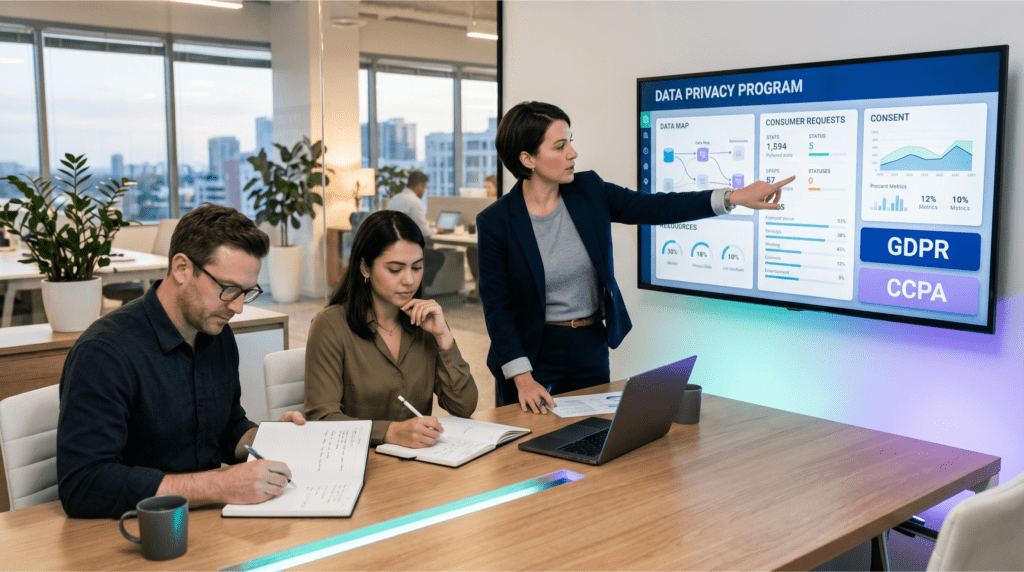
For any company that collects personal information, data privacy consulting has shifted from a nice-to-have to a practical necessity, driven by overlapping regimes like the GDPR in Europe and the CCPA in California. The two laws share a goal, giving people control over their personal data, but they impose different obligations, and most growing businesses end up subject to both at once. Trying to satisfy them without help often produces policies that look compliant but fall apart under a real data subject request or regulator inquiry. This guide explains what data privacy consulting covers, how GDPR and CCPA differ, what a strong partner does, and what it costs, so you can build a privacy and compliance program that holds up in practice. What Data Privacy Consulting Covers Data privacy consulting helps an organization understand what personal data it holds, reduce the risk that data creates, and meet the obligations of the laws that apply to it. The foundation is almost always a data map: knowing what personal information is collected, where it lives, who it is shared with, and why. Everything else builds on that picture. From Notices to Operations A strong engagement goes well beyond drafting a privacy policy. It operationalizes the rights these laws grant, building the processes to handle data subject and consumer requests, conduct privacy risk assessments such as DPIAs, manage vendors and processors, govern cookies and consent, and respond to breaches. Privacy is ultimately an operational capability, not a document, and sustaining it over time is where ongoing compliance support earns its place. GDPR and CCPA Are Not the Same The GDPR governs the personal data of people in the European Union, applies broadly, leans on a lawful basis such as consent, and carries fines that can reach a percentage of global turnover. The CCPA, as amended by the CPRA, governs the personal information of California consumers, emphasizes the right to opt out of the sale or sharing of data, and grants specific consumer rights enforced by a dedicated agency. A program built for one will not automatically satisfy the other, which is why coverage of both is essential for companies that serve customers across regions. What Good Privacy Consulting Looks Like The strongest privacy partners combine legal literacy with operational practicality, and they know both regimes rather than specializing in only one. Look for privacy-certified professionals, such as those holding CIPP credentials, who can translate the requirements of GDPR and CCPA into processes your team can actually run. Just as important is a focus on building a sustainable program rather than a one-time gap assessment, because privacy obligations are continuous and regulations keep evolving. A consultant who hands over templates without operationalizing them leaves the hardest part undone. What Data Privacy Consulting Costs Cost is driven by the complexity of your data, the number of jurisdictions you fall under, and how mature your current program is. A company operating across the EU and several US states with large volumes of consumer data faces more work than one with a single product and a narrow footprint. For startups, the most effective approach is to right-size the program to current risk and scale it as the business grows, rather than building for a scale you have not reached. Ecommerce businesses have a particular focus under the CCPA, where opt-out of data sales and sharing, cookie consent, and the handling of online tracking are common pressure points that need to be set up correctly from the start. Scoping carefully and prioritizing the highest-risk obligations keeps cost proportionate while still closing real exposure. Book a Readiness Call with Elevate’s privacy team to scope a program that fits your data and your budget. Conclusion Data privacy consulting turns overlapping obligations like GDPR and CCPA into a single, workable program built on a clear understanding of the data you hold. Choose a partner who knows both regimes, holds recognized privacy credentials, and focuses on operationalizing rights rather than drafting documents. Size the program to your risk, give ecommerce CCPA obligations the attention they need, and treat privacy as the ongoing capability it is. Book a Readiness Call with Elevate Consult to build a privacy program that stands up to requests and regulators alike. Key Takeaways Data privacy consulting helps a company meet overlapping laws like GDPR and CCPA by turning its data picture into a workable, ongoing program. It starts with a data map – Knowing what personal data you collect, where it lives, who it is shared with, and why is the foundation everything else builds on. Operations beat documents – Strong consulting builds processes for data subject and consumer requests, risk assessments, vendor management, consent, and breach response, not just a privacy policy. GDPR and CCPA differ – GDPR governs EU residents and leans on a lawful basis like consent, while CCPA emphasizes the right to opt out of data sales and sharing, so a program for one will not automatically satisfy the other. Expertise should span both regimes – Look for privacy-certified professionals, such as those holding CIPP credentials, who can operationalize the requirements rather than handing over templates. Cost follows complexity – Data volume, jurisdictions, and maturity drive the price, so startups should right-size to current risk and ecommerce businesses should prioritize CCPA opt-out and consent. The companies that handle privacy well treat it as a living operational program tuned to the laws that apply to them, not a binder that looks compliant until it is tested. FAQs Q1. What does data privacy consulting include? It typically includes mapping the personal data you hold, assessing privacy risk, drafting policies and notices, and operationalizing the rights granted by laws like GDPR and CCPA, including processes for data subject and consumer requests, risk assessments, vendor management, consent, and breach response. Q2. What is the difference between GDPR and CCPA? GDPR governs the personal data of people in the European Union, applies broadly, and relies on a lawful basis such as consent, with significant potential fines. CCPA, as
How Much Does CMMC Level 2 Compliance Cost?
Helping companies become CMMC compliant, we have learned a great deal about the options organizations have and what it actually takes to meet the 110 control requirements (over 300 control objectives) of the standard. One of the first questions every defense contractor asks is also the hardest to answer cleanly: what will this cost? The honest answer is that it depends on how you choose to handle Controlled Unclassified Information (CUI), and the difference between the three main approaches can be substantial. Below, we break down the real cost components and the pitfalls that drive unexpected expense. Common CMMC Level 2 Pitfalls Organizations pursuing CMMC Level 2 certification often hit challenges that derail compliance efforts and create costly delays. The most common ones we see: A poorly defined CUI boundary, with too many assets pulled into scope or, just as damaging, key in-scope assets left out. Scope drives cost, so getting the boundary right is the single highest-leverage decision you make. Beyond scoping, the recurring problem areas include: implementing end-to-end FIPS 140-2 compliant encryption for CUI both at rest within the boundary and in transit across it; assessing all physical locations for secure CUI handling, including paper-based CUI, and enforcing wireless security with FIPS 140-2 compliant encryption; controlling access to printers and other devices that can display or output CUI while maintaining detailed access logs; maintaining robust endpoint security with vulnerability scanning, activity logging, and continuous monitoring for all users and devices accessing CUI; ensuring a CMMC-compliant email security solution; and providing detailed CUI handling guidelines and acceptable use policies with documented end-user acknowledgment. The Three Approaches to CMMC Level 2 Compliance There is no single price tag for CMMC Level 2 because there is no single way to get there. Organizations generally choose among three models, each with a different cost structure: Managing internally, where you build and run the compliant environment yourself. Managing with virtual workspaces on cloud infrastructure, where you stand up a dedicated enclave (often in a government cloud) for CUI. Using a CMMC-compliant Managed Security Services Provider (MSSP), where you outsource much of the operational and security burden. The tables below break down what each component costs under each model. CMMC Level 2 Cost Breakdown by Component Encryption and Email Security Component Manage Internally Virtual Workspaces on Cloud CMMC-Compliant MSSP End-to-end encryption Over $430 per user per year Over $430 per user Offered within their services Microsoft GCC High Not needed if using end-to-end encryption software with messaging Not needed if using end-to-end encryption software with messaging Approx. $1,000 per user per year Monitoring and Infrastructure Component Manage Internally Virtual Workspaces on Cloud CMMC-Compliant MSSP Security Protection Asset (SPA) costs No additional cost if you already have MDR/EDR on all endpoints, a vulnerability scanner, and security monitoring; otherwise these must be added (products do not all have to be FedRAMP authorized — see note below) Cloud operational and monitoring software costs (e.g., CloudTrail, CloudWatch, GuardDuty in AWS) $10,000–$20,000 per month for both operational and security monitoring, regardless of user count Dedicated infrastructure for virtual workspaces May not be needed if end-to-end encryption, hard-drive endpoint encryption, and sufficient endpoint logging/monitoring are in place GovCloud (especially if ITAR/export-controlled): high-compute approx. $145/user/month; light GPU approx. $40/user/month; directory service approx. $400/month/domain; storage approx. $43/month per 1TB $215–$315 per user per month for support, compute, and virtual workspace management, plus added cost to set up site-to-site VPN for printers and CUI assets in the physical boundary Support, Documentation, and Assessment Component Manage Internally Virtual Workspaces on Cloud CMMC-Compliant MSSP Additional IT support May need added resources to maintain the CMMC program May need added resources to maintain the CMMC program Included, but additional fees for changes and special requests GRC software Approx. $6,000 per year per SSP Approx. $6,000 per year per SSP Included, but charged approx. $7,000 per month for maintenance SME CMMC advisor SSP prep (one SSP), policies, and audit support: $50K–$70K (year 1) depending on effort; multiple SSPs negotiated separately; years 2–3 approx. $15K–$20K Same as internal: $50K–$70K (year 1); years 2–3 approx. $15K–$20K Over $250K across 3 years C3PAO auditor Approx. $70K–$80K per audit every 3 years (one SSP) Approx. $70K–$80K per audit every 3 years (one SSP) Approx. $70K–$80K per audit every 3 years (one SSP) A note on the FedRAMP point: the “products don’t all have to be FedRAMP authorized” guidance applies to non-cloud security protection assets, which are assessed against the applicable NIST SP 800-171 practices. It does not apply to cloud services that store, process, or transmit CUI. Any such cloud service must hold a FedRAMP Moderate authorization or demonstrate FedRAMP Moderate equivalency under the DoD’s December 21, 2023 equivalency memo, or the related controls will be marked as not met during your assessment. This distinction is one of the most common sources of unexpected cost, so classify each provider carefully before assuming it is in the clear. Which Approach Is Right for Your Organization? The right model depends on your current state, the type of data you handle (CUI, ITAR, EAR), and your internal capacity to manage the required changes. Managing internally tends to favor organizations that already have mature endpoint security and monitoring in place, since the marginal cost is lowest when you are not buying those capabilities from scratch. The cloud virtual-workspace model fits organizations that need a clean, well-bounded enclave, particularly when export-controlled data makes GovCloud advisable. The MSSP model trades higher recurring fees for reduced internal burden, which can be the right call for smaller teams without the staff to operate a compliant environment year-round. Cost management ultimately comes down to scoping discipline and choosing the model that matches your reality rather than the one with the lowest sticker price on any single line item. How Elevate Can Help At Elevate, we have helped many organizations prepare for and obtain CMMC Level 1 and Level 2 compliance. Our goal is to make sure your CUI boundary is properly defined and your gap analysis and remediation are
How ISO 42001 Overlaps with ISO 27001 and ISO 9001

Organizations pursuing ISO 42001 and ISO 27001 together, often alongside ISO 9001, usually discover the standards share far more than they expected. ISO 42001 (AI management), ISO 27001 (information security), and ISO 9001 (quality management) are all built on the same backbone. Because ISO 42001 and ISO 27001 in particular share nearly identical management-system requirements, you can certify against all three without building three separate management systems. Why the Three Standards Align All three standards follow the Harmonized Structure, sometimes called Annex SL, with their core requirements living in Clauses 4 through 10, the same skeleton used across modern ISO management system standards. In practice, that means every key pillar of the management system, context-setting, leadership, risk, support, operations, measurement, and improvement, sits in the same clause position with the same underlying logic across all three standards. If your organization already holds one of these certifications, the architecture of the others will feel familiar, which is exactly why ISO 42001 and ISO 27001 are so often pursued as a pair. All three also run on the same Plan-Do-Check-Act rhythm, so the cycle of planning controls, operating them, evaluating them, and improving them is common to the AI, security, and quality systems. That shared cadence is what lets one set of audit and review machinery serve several certifications at once. Figure 1: ISO 42001, ISO 9001 and ISO 27001 Venn Diagram The practical payoff is significant. Leadership commitment, policy, and role assignments defined under Clause 5 can be established once and applied across the AI, security, and quality management systems, and risk policies set under Clause 6 align directly across all three. This is why a single internal audit, one management review cycle, and a shared risk register can serve multiple certifications at once. Clause-by-Clause Crosswalk The table below maps the shared Annex SL clauses across the three standards and shows where each one applies the common requirement to its specific domain. Annex SL Clause ISO 9001 (Quality) ISO 27001 (Information Security) ISO 42001 (AI Management) Clause 4: Context Quality-relevant stakeholders and scope Information assets, interested parties, ISMS scope AI stakeholders, regulatory landscape, AIMS scope Clause 5: Leadership Quality policy and roles Security policy and roles AI policy, responsible-AI commitment, roles Clause 6: Planning Quality objectives, risk and opportunity Risk assessment and treatment, SoA AI risk assessment plus AI impact assessment, SoA Clause 7: Support Resources, competence, documented info Resources, awareness, documented info Resources, AI competence, documented info Clause 8: Operation Product and service delivery controls Operational security controls AI system lifecycle: design, development, testing, deployment, monitoring, decommissioning Clause 9: Performance Monitoring, internal audit, management review Monitoring, internal audit, management review Monitoring, internal audit, management review Clause 10: Improvement Nonconformity and continual improvement Nonconformity and continual improvement Nonconformity and continual improvement Clauses 4, 5, 7, 9, and 10 are where most of the shared effort lives. The documentation, processes, and evidence you build for one standard largely satisfy the same clause in the others. The real divergence appears in Clauses 6 and 8, where each standard applies the common structure to its own subject matter. ISO 42001 in Brief ISO/IEC 42001:2023, published in December 2023, is one of the first international, certifiable standards dedicated to AI system governance. Developed jointly by the International Organization for Standardization (ISO) and the International Electrotechnical Commission (IEC), it provides a structured framework for managing AI technologies responsibly throughout their lifecycle, aligned with ethical principles, regulatory requirements, and organizational goals. The standard sets out ten clauses, with the auditable requirements in Clauses 4 through 10, and four annexes. Its normative Annex A provides 38 reference controls grouped under nine control objectives numbered A.2 through A.10, with implementation guidance for each control in Annex B. The key components of ISO 42001 focus on the responsible development, deployment, and operation of AI systems, including: Governance Structure: a framework for an AIMS that integrates with organizational processes so AI practices align with business objectives, strategy, and continuous improvement. ISO 27001 in Brief ISO/IEC 27001:2022 is a leading standard for information security management. It provides a structured framework for organizations to establish, implement, maintain, and continuously improve their information security practices. The standard defines the governance and technical controls necessary to develop a robust information security program. Key components of ISO 27001 include: ISO 9001 in Brief ISO 9001 is a widely recognized standard for quality management systems. It provides a process-driven framework designed to improve efficiency, meet customer expectations, and enhance overall customer satisfaction. Key principles of ISO 9001 include customer focus, prioritizing customer needs to deliver value; leadership, establishing a clear vision and direction; a process approach, managing activities as interrelated processes; evidence-based decision-making, using data to guide strategy; and continuous improvement, driving iterative enhancement. ISO 9001 applies across industries and can serve as a foundation for integrating other standards into the organization. Overlaps and Benefits of Integration ISO 42001 and ISO 27001 The overlap between ISO 42001 and ISO 27001 is the closest of the three, because their management system frameworks are the most tightly aligned. While ISO 27001 protects the confidentiality, integrity, and availability of information assets, ISO 42001 extends these principles to address AI-specific risks. These standards overlap in several ways. Both emphasize proactive identification and mitigation of risk, and the same assessment methodology carries across both environments. Both provide a governance structure that supports internal policy and external regulation: ISO 27001 through an ISMS, ISO 42001 through an AIMS that defines the structures, responsibilities, and processes for ethical and effective AI use. Both mandate controls to protect what sits inside the management system, with ISO 42001 extending familiar security concerns into AI-specific areas such as data quality, system validation, and ongoing monitoring. And both promote continuous improvement, requiring ongoing reassessment as threats and technologies evolve. Table 1: ISO 42001 and ISO 27001 Comparison ISO 42001 and ISO 9001 ISO 42001 shares foundational similarities with ISO 9001 as well, since both are structured around management system frameworks that emphasize risk management and continuous improvement.
2023 HIPAA Compliance

If you are running a healthcare company and providing medical services to patients – you have access to a lot of sensitive information like medical records, test results, and personal details. It is crucial to handle this information responsibly and keep it secure. That’s where HIPAA compliance comes into play. HIPAA, the Health Insurance Portability and Accountability Act, is a set of rules and standards established in 1996 that healthcare companies need to follow in order to demonstrate their commitment to patient privacy and security. So, why is HIPAA compliance important for healthcare companies? There are a few key reasons: First and foremost, it’s about respecting your patients’ privacy. They trust you with their most personal health details, and it’s your responsibility to keep that information confidential. HIPAA compliance helps ensure that patient data is only accessed by authorized individuals who need it for legitimate healthcare purposes. Secondly, being HIPAA compliant helps you avoid legal troubles. Non-compliance with HIPAA regulations can result in hefty fines, legal actions, and damage to your company’s reputation. By following the rules and implementing the necessary safeguards, you reduce the risk of facing these consequences. Thirdly, HIPAA compliance is about data security. It requires you to have measures in place to protect electronic health records (EHRs) from unauthorized access or breaches. This could mean using secure computer systems, encrypting patient data, and implementing access controls to limit who can view or edit the information. Having proper policies and procedures in place will be crucial to this goal. It includes training your staff on privacy and security practices, ensuring they understand their responsibilities, and implementing protocols for handling patient information securely. Regular audits and assessments can help you identify any gaps in compliance and address them promptly. According to the May 2023 report by HIPAA Journal, 2022 was a record year for HIPAA compliance enforcement with 22 settlements and civil monetary penalties (CMPs) imposed to resolve violations of the HIPAA Rules. The Office of Civil Rights (OCR), the body responsible for enforcement of HIPAA compliance, has faced challenges in recent years due to a significant increase in workload. “OCR investigates all data breaches of 500 or more records, and data breaches have been increasing at an alarming rate in recent years. OCR explained in its annual report to Congress that since fiscal year 2017, OCR has received a 100% increase in large breach reports, largely driven by an increase in hacking incidents, especially ransomware attacks.” (HIPAA Journal, 2023). With an ever-growing threat landscape, the need for increased data security in a healthcare environment is more necessary than ever. If you are unsure whether or not your organization is in compliance, check out the free HIPAA Compliance Checklist to determine if you are properly protecting your patient’s data. For a more in-depth assessment of your compliance standing and needs, connect with an Elevate consulting specialist about our HIPAA HITECH services. To read the full May 2023 HIPAA report, visit https://www.hipaajournal.com/state-of-hipaa/ .