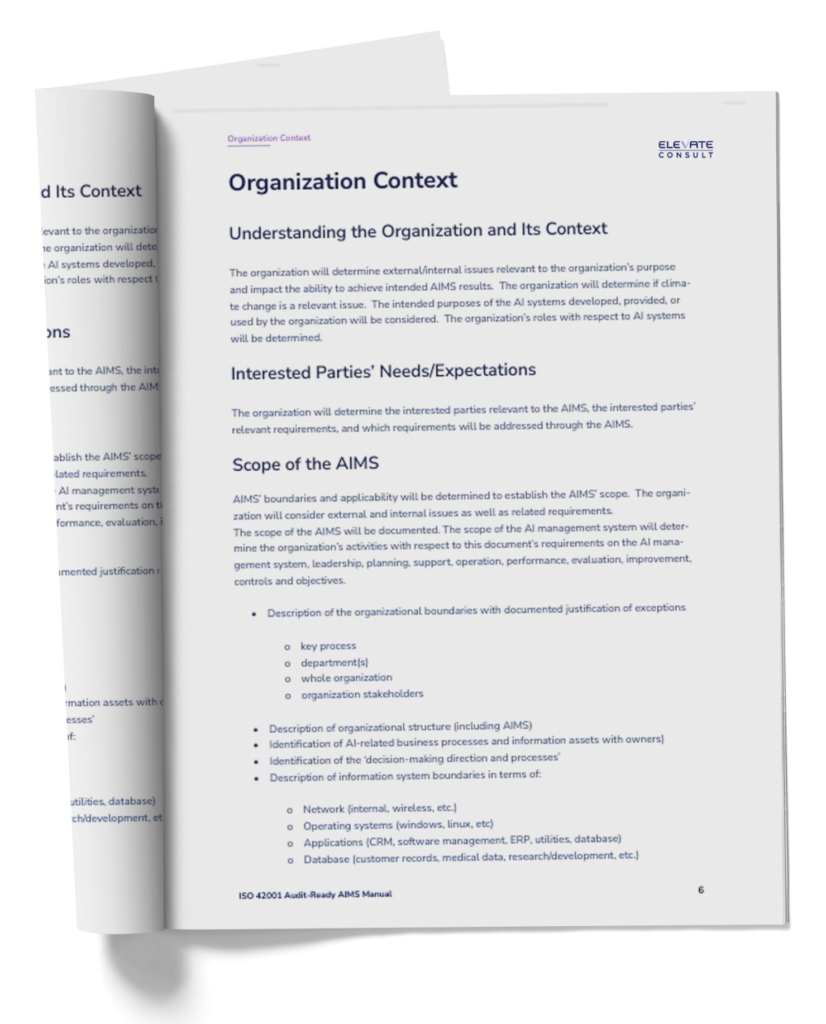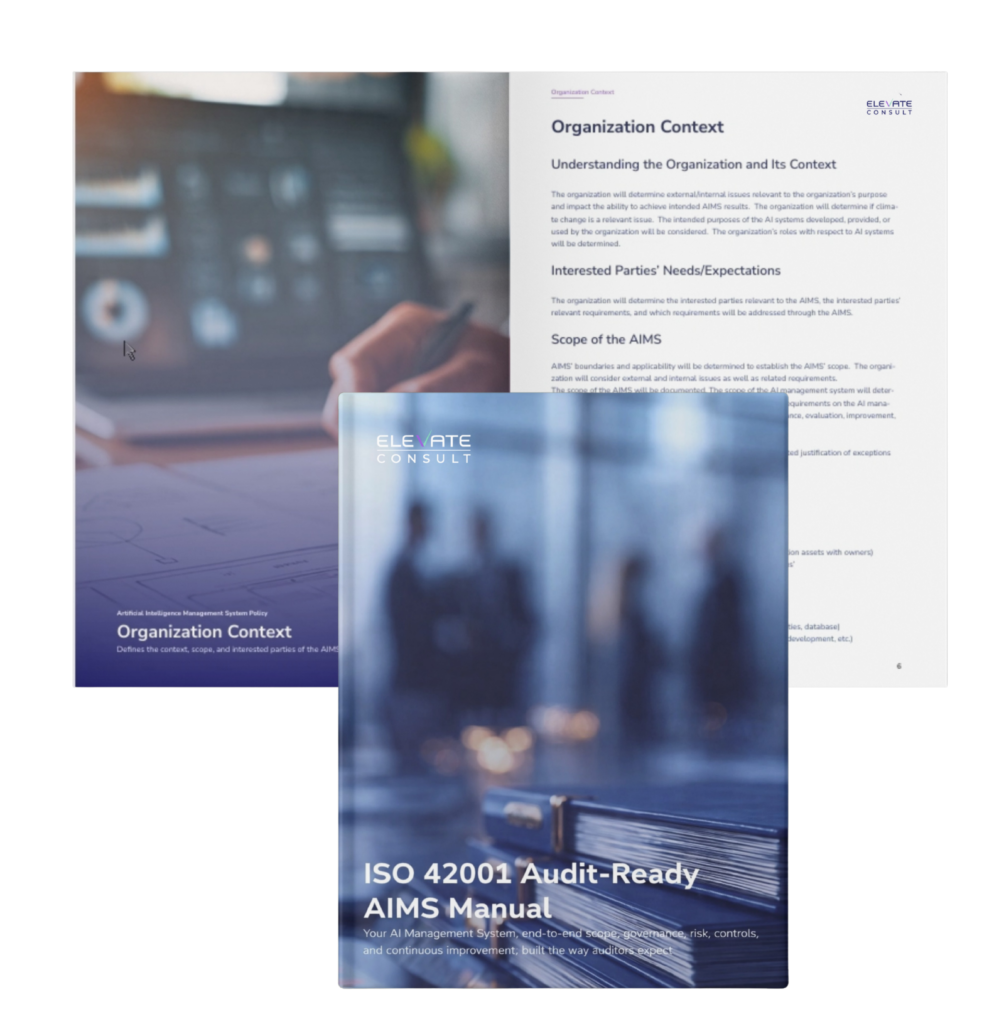
ISO 42001 Audit-Ready AIMS Manual
Your complete AI Management System framework: scope, governance, risk, controls, and continual improvement. Structured the way ISO 42001 auditors expect.
Stop reverse-engineering ISO 42001 clause by clause. Start with a complete AIMS structure aligned to the standard.
Built around real audit expectations: risk assessment, impact analysis, SoA, internal audit, and management review.
Designed to be customized: replace placeholders, define scope, align roles, and operationalize fast.
Covers the full AIMS lifecycle; from AI governance policy to corrective action and continual improvement.
ISO 42001 Readiness Breaks Down at Structure. Not Intent.
Most organizations don’t struggle because they lack AI principles. They struggle because:
![]()
There is no documented AIMS scope tied to actual AI system boundaries.
![]()
AI risk assessments are inconsistent or undocumented.

![]()
Impact assessments exist informally but aren’t integrated into governance.

![]()
Controls are implemented but not mapped to Annex A or captured in a Statement of Applicability.
![]()
Management review and internal audit aren’t structured around ISO 42001 expectations

This manual solves that structural gap: It gives you a complete, clause-aligned AI Management System foundation.
What You’re Getting
A fully structured ISO 42001 Audit-Ready AIMS Manual covering:
- AIMS Purpose, Scope, and Context
- AI Governance Policy framework
- Roles, responsibilities, and executive accountability
- AI Risk Assessment & Treatmentmethodology
- AI System Impact Assessment process
- Statement of Applicability (SoA) structure
- Operational planning and lifecycle controls
- Internal Audit program framework
- Management Review inputs & outputs
- Nonconformity & Corrective Action procedures
- Continual Improvement model
This is not a high-level whitepaper.
It is a structured management system template aligned to ISO 42001 clauses.
What’s Inside
The manual follows ISO 42001’s architecture:
Overview — Purpose, responsible AI commitment
Organization Context — Scope definition, boundaries, interested parties
Leadership — Governance, policy, executive accountability
Planning — Risk assessment, treatment, AI impact assessment, objectives
Support — Competence, communication, document control
Operation — Lifecycle controls and implementation
Performance Evaluation — Monitoring, measurement, internal audit
Management Review — Executive review inputs/outputs
Improvement — Nonconformity and corrective action
Plus:
Annex A control alignment considerations
Statement of Applicability guidance
Documentation retention expectations
Reference alignment (EU AI Act, ISO 27001, ISO 27701, ISO 9001)
Policy Language Built for Audit Reality
Examples of specificity inside:
- AI risk assessmentmethodologyaligned to defined risk criteria
- Impact assessment requirements considering societal and jurisdictional impact
- SoAdevelopment with justification for inclusion/exclusion of controls
- Internal audit program frequency, scope, and objectivity requirements
- Management review inputs including trends in nonconformities and monitoring results
- Corrective action process with documented root cause evaluation
This is why governance teams use it: It translates ISO 42001 from abstract standard to operational system.
How to Use It (Without Boiling the Ocean)
This manual is meant to accelerate implementation, not overwhelm your team.
Implementation principles:
Define scope first — document AI system boundaries and organizational roles.
Establish AI risk criteria before performing risk assessments.
Build your Statement of Applicability alongside your risk treatment plan.
Integrate impact assessments into your existing governance workflows.
Treat internal audit and management review as recurring governance rituals — not one-time events.
Keep it living — update when AI systems, regulations, or risk posture changes.
Built for leaders accountable for responsible AI governance
Who This Is For:
![]()
CISO/ Chief AI Officer/ AI Governance Lead.
![]()
Risk & Compliance Directors
![]()
ISO 42001 Program Owners
![]()
Organizations preparing for ISO 42001 certification

![]()
Companies aligning to EU AI Act + ISO 42001
If you need to move from “AI principles” to a certifiable management system; this is for you.
FAQs
What is ISO 42001?
ISO 42001 is the international standard for Artificial Intelligence Management Systems (AIMS). It defines requirements for establishing, implementing, maintaining, and continually improving governance over AI systems.
What is an AI Management System (AIMS)?
An AIMS is a structured management system that governs AI lifecycle activities, risk assessments, impact analysis, controls, monitoring, internal audits, and continual improvement.
Is this manual certification-ready?
It is structured according to ISO 42001 clauses and designed to support certification readiness, but it must be customized to your organization’s scope, risk posture, and AI system landscape
What is a Statement of Applicability (SoA) under ISO 42001?
The SoA documents which Annex A controls apply to your organization, justification for inclusion/exclusion, and how those controls are implemented.
How often should an AIMS be reviewed?
ISO 42001 requires internal audits at planned intervals and management review at planned intervals. Most organizations conduct at least annual reviews or when significant AI system changes occur.