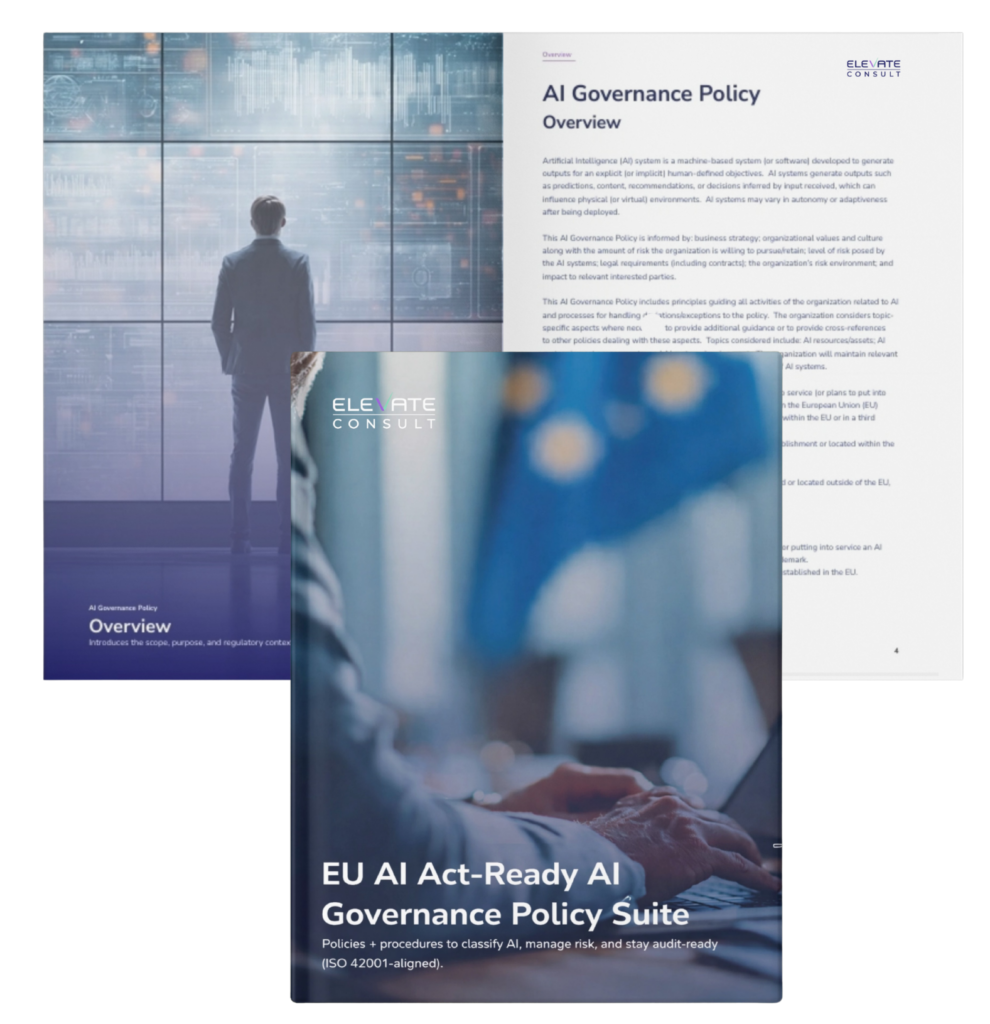
EU AI Act-Ready AI Governance Policy Suite
A complete, structured AI governance policy framework aligned to the EU AI Act and ISO/IEC 42001; built for real compliance, not theoretical maturity models.
Stop improvising AI governance. Start with a structured policy suite aligned to EU AI Act obligations.
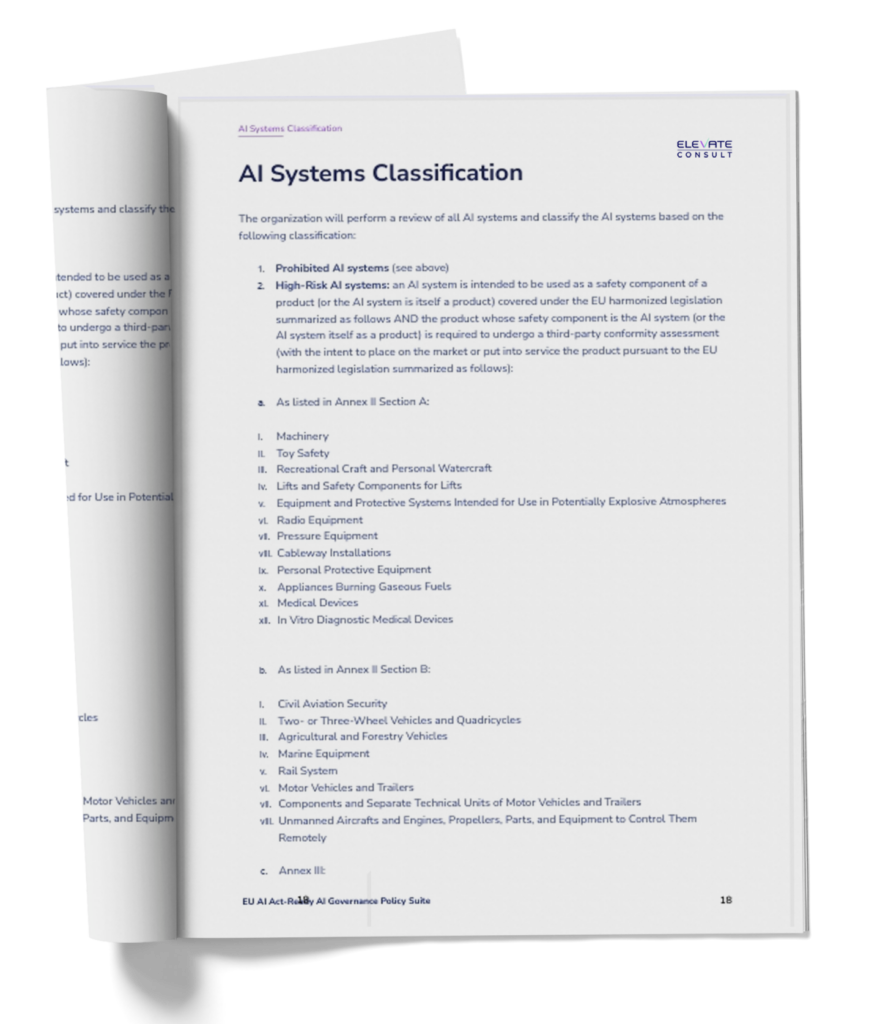
Classify AI systems correctly (prohibited, high-risk, limited-risk, minimal-risk) and document it defensibly.
Built for operationalization: assign ownership, define controls, and embed oversight.
Designed for audit reality: regulators and auditors expect traceability, risk classification, and governance evidence.
AI governance breaks down when policy isn’t structured
Most organizations don’t struggle because they lack AI innovation. They stall because:
![]()
AI systems aren’t formally classified under EU AI Act categories.
![]()
Governance is fragmented between Legal, IT, Data Science, and Compliance
![]()
There’s no centralized policy framework tying risk, oversight, transparency, and accountability together.
This policy suite eliminates that fragmentation: It gives you a centralized AI governance structure aligned to EU regulatory expectations and ISO 42001 management system principles.
A complete EU AI Act-Aligned Governance Framework
This suite consolidates essential AI governance policies into one structured resource so you can:
- Classify AI systems properly.
- Document risk management processes.
- Assign governance roles.
- Establish oversight and monitoring.
- Operationalize accountability.
What it includes
- AI System Classification Policy (Prohibited / High-Risk / Limited-Risk / Minimal-Risk)
- AI Risk Management Policy
- Human Oversight & Accountability Framework
- Data Governance & Quality Controls for AI
- Transparency & Disclosure Requirements
- AI Lifecycle Management
- Monitoring, Logging & Incident Response for AI Systems
- Vendor & Third-Party AI Risk Controls
- Documentation & Recordkeeping Standards
- ISO/IEC 42001-aligned governance structure principles.
Each policy includes structured language, defined responsibilities, and documentation expectations.
Operational Policy Language. Not Theory
Inside, you’ll find structured policy frameworks covering:
AI system inventory and classification workflows
High-risk AI documentation requirements
Governance committee roles and oversight mechanisms
Monitoring obligations and post-deployment review
Risk assessment expectations aligned with regulatory thresholds
Audit-traceable recordkeeping structures
This isn’t high-level AI ethics language.
It’s governance built to withstand regulatory scrutiny.
Governance Language You Can Implement
Examples of the type of specificity included:
- Clear criteria foridentifying“high-risk” AI systems under EU AI Act definitions.
- Defined accountability roles for AI oversight committees.
- Structured documentation expectations for AI system lifecycle controls.
- Monitoring and incident response expectations tied to operational AI systems.
- Vendor AI risk evaluation requirements.
This is why CISOs, AI Officers, and Compliance Leaders download it: It translates regulation into structured governance controls.
Use It as a Governance Backbone. Not a Theory Paper
This suite is meant to be implemented progressively.
Implementation principles:
Start with AI inventory and classification.
Assign governance ownership across Legal, IT, and Risk.
Customize placeholders and align with your internal structure.
Ensure policy is institutionalized; not just written.
Treat it as a living governance framework, update as regulations evolve.
AI governance is not a one-time exercise. It’s a management system.
Built for Leaders Responsible for AI Compliance
This suite is for you if:
![]()
You are a CISO, Chief AI Officer, Head of Compliance, or Risk Leader.
![]()
Your organization develops, deploys, or integrates AI systems.
![]()
You need structured EU AI Act alignment; not abstract AI ethics.
![]()
You are preparing for ISO 42001 readiness.
![]()
You want defensible AI governance documentation before regulators ask for it.
FAQs
What is the EU AI Act?
The EU AI Act is a regulatory framework that classifies AI systems by risk level and imposes obligations on providers and deployers of high-risk AI systems.
What policies are required under the EU AI Act?
Organizations must establish documented processes for AI classification, risk management, human oversight, transparency, monitoring, and recordkeeping; especially for high-risk AI systems.
What is a high-risk AI system?
High-risk AI systems are those used in regulated domains such as employment, critical infrastructure, credit scoring, healthcare, and other areas defined by the EU AI Act.
How does ISO 42001 relate to the EU AI Act?
ISO/IEC 42001 provides a structured AI Management System (AIMS) framework. While the EU AI Act is regulatory, ISO 42001 helps operationalize governance through structured policies and controls.
How often should AI governance policies be reviewed?
At minimum annually, and after significant AI system changes, regulatory updates, or risk events.
Will this alone make us compliant?
Policies are foundational. Regulators and auditors also expect implementation, monitoring, and documented evidence of governance in practice.