
Most organizations today face a critical gap in their AI systems. Recent studies show that 73% lack proper AI governance frameworks, which puts them at risk of regulatory fines and AI control failures. The EU AI Act’s enforcement brings steep penalties – organizations could face fines up to €35 million or 7% of their global revenue. The business world needs trustworthy AI governance more than ever.
This piece offers a practical roadmap to help you get ready for AI governance certification. The numbers tell an interesting story: while only 37% of organizations regularly assess their AI risks, companies with mature governance frameworks see impressive results. These organizations deploy AI systems 3.2x faster and cut compliance risks by 87%. The introduction of ISO 42001, the first global management system standard for AI, gives organizations a clear path to build and improve trustworthy AI systems. The certification process can be challenging because it’s relatively new and has specific requirements. Our step-by-step approach will help you understand and prepare for AI ethics and governance certification, making this complex process more manageable.
What AI Governance Certification Means in 2025
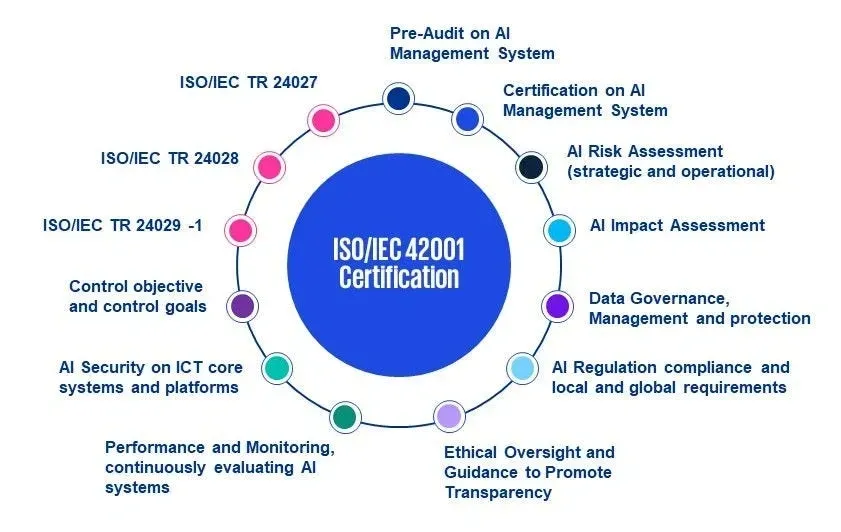
Image Source: Elevate Consult
AI governance certification in 2025 goes beyond a simple compliance checkbox. It shows how well organizations know how to manage AI systems throughout their lifecycle. AI has become deeply woven into critical business processes, and the difference between traditional governance and specialized AI governance keeps growing more important.
Enterprise AI Governance vs. Traditional IT Governance
Enterprise AI governance builds on data governance and IT governance frameworks. Yet it tackles unique challenges that traditional methods can’t handle. The key difference lies in how AI systems work compared to regular IT systems.
Traditional IT governance focuses primarily on:
- System reliability, security protocols, and infrastructure management
- Predetermined functions with predictable outcomes
- Static systems that follow rule-based processes
- Periodic audits for performance monitoring
Enterprise AI governance must handle these extra dimensions:
Dynamic Learning Systems: Regular software performs consistently after deployment. AI applications change as their data and infrastructure evolve, which makes it hard to maintain performance, transparency, and fairness. This means we need ongoing risk checks instead of one-time assessments.
Ethical Considerations and Explainability: Traditional IT governance centers on security and compliance. AI governance must also deal with bias, fairness, and transparency. Many AI systems work like a “black box,” making it hard to understand why they make specific decisions.
Model Governance Complexity: Companies need strategies to move AI models from lab to production safely and effectively. Poor planning can lead to model deterioration—this is a big deal as it means that companies face negative brand impacts, regulatory action, and safety issues.
AI governance also needs special monitoring that goes beyond regular IT metrics. This includes model drift detection, fairness assessments, and explainability requirements. Companies using AI-driven solutions need governance frameworks built specifically for these changing risks and learning models.
How ISO 42001 and NIST AI RMF Complement Each Other
Two frameworks lead the way for AI governance certification in 2025: ISO 42001 and the NIST AI Risk Management Framework (RMF). These frameworks don’t compete—they work together to provide detailed AI governance.
ISO 42001 creates an AI Management System (AIMS) that focuses on ethical AI usage, transparency, and trust. This globally recognized standard helps build credibility with stakeholders worldwide and makes market entry easier. It guides companies through managing AI quality from design to maintenance.
NIST AI RMF provides a more flexible approach to managing AI system risks. It uses four core functions—Govern, Map, Measure, and Manage—to help identify, assess, and reduce AI-specific risks.
These frameworks support each other in several ways:
ISO 42001’s structured management system works well with NIST AI RMF’s risk-based approach. ISO 42001 sets up organizational governance structures, while NIST AI RMF shows how to spot and fix risks.
ISO 42001 creates a detailed management framework that covers organizational governance and legal compliance. NIST AI RMF helps make AI systems more trustworthy and reliable by addressing technical, ethical, and societal risks.
Many organizations use both frameworks together or one after the other. A combined approach uses ISO 42001’s global standardization and quality assurance with NIST AI RMF’s flexibility and ethical focus. Some companies start with NIST AI RMF during early AI adoption and switch to ISO 42001 as their AI systems mature.
AI governance professionals need to understand both frameworks. The AI governance certification market will reach USD 15 billion by 2026, growing faster than most security or ethics-driven sectors. This growth shows the rising need for experts who can understand regulations, arrange AI systems with these frameworks, and check models for bias and explainability.
Assessing Your Current AI Governance Maturity
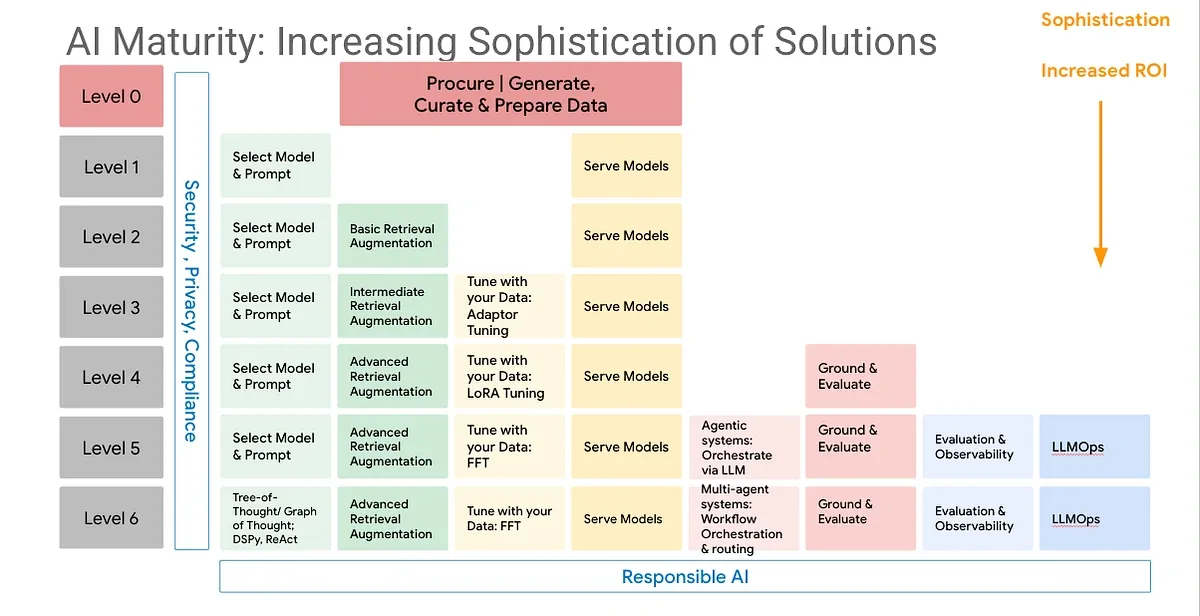
Image Source: Ali Arsanjani – Medium
You need to know your organization’s current maturity level before getting AI governance certification. This step sets a clear baseline and shows exactly where your governance practices need work.
Using a 5-Level Maturity Model for Self-Assessment
Enterprise AI governance frameworks use a five-level system to measure organizational readiness. These maturity models give you a well-laid-out path to review and boost your AI governance capabilities.
The five levels are:
- Initial/Ad-Hoc (Level 1): AI governance doesn’t exist or only reacts to problems at this stage. Individual enthusiasts or isolated teams drive AI adoption using their preferred tools. Risk exposure is very high. “Shadow AI” runs wild without any standard policies.
- Managed/Repeatable (Level 2): Organizations see the need for control, but efforts remain scattered. Each department creates its own guidelines without central coordination. This leads to mixed practices across the enterprise.
- Defined/Standardized (Level 3): Organizations reach a turning point and set up unified governance frameworks. An AI Governance Council forms with members from Legal, IT, Ethics, and Operations. A central AI policy covers data privacy and fairness.
- Managed (Level 4): Organizations track and review activities regularly. They add technical controls like instrumentation and metrics to support evidence-based governance.
- Optimized (Level 5): Governance becomes part of AI systems architecture. The governance layer grows smarter and can understand context and adapt to conditions.
Start your self-assessment by comparing your current practices against these levels. The MITRE AI Maturity Model reviews six key areas: Ethical, Equitable, and Responsible Use; Strategy and Resources; Organization; Technology Enablers; Data; and Performance and Application.
These six questions help measure your current maturity:
- Can you document what your AI is authorized to do?
- Do you know who approved each AI capability?
- How do you measure AI behavior against expectations?
- What happens when AI encounters undefined scenarios?
- Can business leaders update governance without IT involvement?
- Do you review multi-agent interactions?
Book a Readiness Call with AI governance experts if you find these questions hard to answer.
Identifying Shadow AI and Governance Gaps
Shadow AI poses a big risk to organizations seeking certification. Recent studies show that shadow AI emerges when employees use AI tools without IT or security team approval. This often happens when approved tools don’t meet their needs.
Here’s how to spot shadow AI:
Start with a complete audit of existing tool usage. Check what software your employees use and look for tools that already have AI features. Set up technical monitoring through internet gateways, firewalls, and identity providers to catch unapproved tool usage.
Compare your current state with your desired future state. This helps find vulnerabilities, compliance gaps, and readiness levels. You can then build a custom governance roadmap. Look at data quality management, infrastructure optimization, and employee skills.
Common governance gaps include:
- Data leakage risks from employees using unapproved AI tools with private information
- Breaking rules in frameworks like NIST AI RMF or the EU AI Act
- Poor visibility into AI model behavior and decisions
- Teams focused on speed clashing with those focused on caution
Regular AI security audits help reveal these gaps. These audits should check AI models’ security, their data flows, access controls, and how well they follow internal policies and external rules.
Understanding your maturity level and finding governance gaps helps you build a certification-ready AI governance program that fits ISO 42001 and other key frameworks.
Building a Minimum Viable AI Governance Program
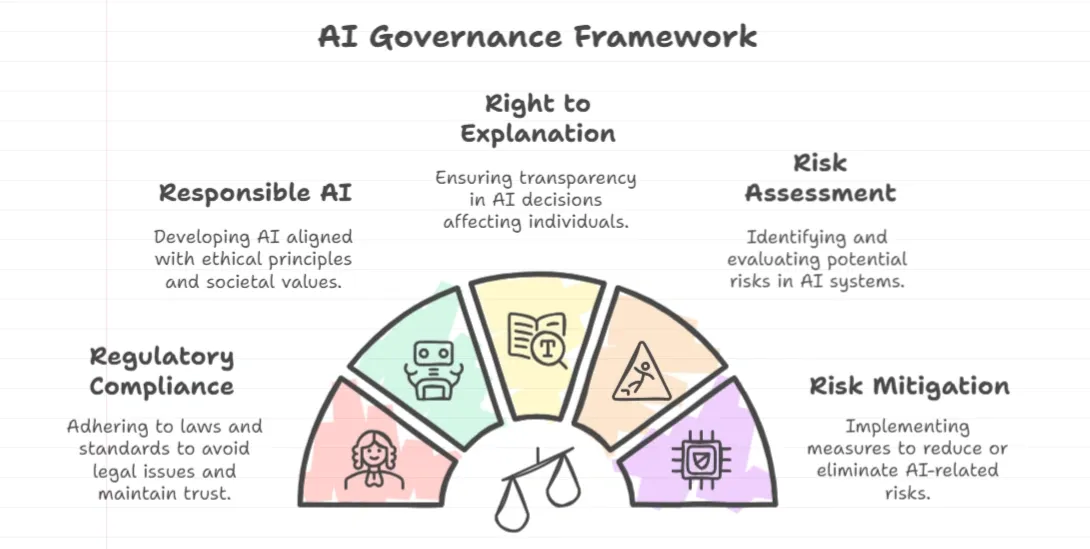
Image Source: Medium
Organizations need a lightweight governance approach to take their first steps toward responsible AI. This approach should balance innovation with risk management. The Minimum Viable AI Governance (MVG) concept gives organizations a starting point that grows with system maturity and real-life usage.
Creating a Lightweight AI Use Register
The life-blood of effective governance lies in an AI use register that shows all AI initiatives in your enterprise. Your original register should capture key information without creating too much paperwork.
A lightweight AI use register should include:
- Basic system information: AI name, description, scope, usage limitations, and system type
- Ownership details: Business owner, model owner, IT owner, legal/compliance stakeholders
- Risk classification: Materiality, complexity, and exposure levels
- Data characteristics: Classification (including PII/PHI status), training datasets, and source systems
- Technical assets: Source code, trained artifacts, and endpoints (for vendor systems)
- Documentation: Design documents, review documentation, and approval records
Your AI register does more than keep inventory – it builds the foundation for risk management by providing detailed visibility. Governance becomes impossible without this transparency. Industry experts often say “You can’t govern what you don’t see”. Yes, it is true whether your AI comes from in-house development, third-party vendors, or existing platforms.
The register works as your organization’s source of truth. It tracks all AI models and documents their origins, training data, and approved use cases. This foundation helps you show compliance with emerging regulations like the EU AI Act, which now requires organizations to maintain documented AI inventories.
Establishing Basic Risk Classification and Ethics Review
Risk classification stands as the second pillar of minimum viable governance. Your organization can enable the right controls without stopping innovation by grouping AI systems based on their potential effects.
Effective risk classification should:
- Line up with regulatory frameworks (such as the EU AI Act’s unacceptable, high, limited, and low-risk categories)
- Think over both technical and ethical dimensions
- Apply appropriate governance intensity based on risk level
- Adapt as systems mature or use cases evolve
Independent review mechanisms serve as flexible governance tools that work in all AI development stages. This approach has guided complex fields like clinical research successfully by putting ethical standards first before projects affect the public. Organizations can review AI projects throughout development from different points of view by creating an independent review committee with expertise in ethics, technical feasibility, and regulatory compliance.
Your risk classification needs to look at both context and technical features. Sometimes organizations might label a system high-risk at first but find minimal actual risk after a full picture. The EU Commission now asks providers to document their assessment before market placement if they think their AI systems are not high-risk.
The NIST AI Risk Management Framework shows that risk management must merge with broader enterprise strategies to work well. Clear accountability mechanisms, roles, and responsibilities need proper definition.
Whatever approach you choose, MVG builds a foundation that grows with your organization’s AI maturity. It focuses first on critical risks while working toward detailed governance that lines up with certification standards.
Developing Policies for AI Governance Certification
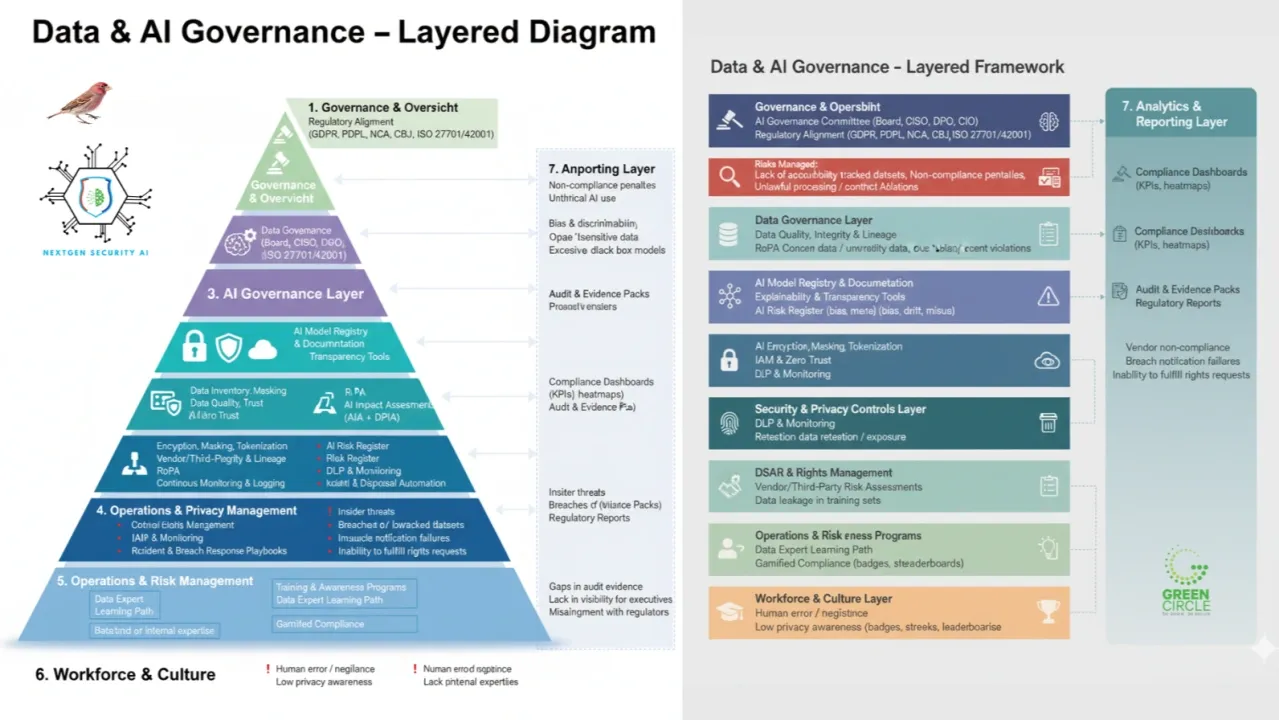
Image Source: LinkedIn
A resilient policy framework serves as the foundation of successful AI governance certification. Clear boundaries and responsibilities that auditors can verify come from well-documented policies rather than informal guidelines.
Acceptable Use, Data Handling, and Model Development Policies
The AI Acceptable Use Policy (AUP) acts as the life-blood document that guides employee interactions with AI systems. This set of rules helps companies tap into the potential of innovation while protecting sensitive data. The rules provide clarity about permitted and prohibited uses of AI technologies.
A good AI AUP should include:
- Scope definition that lists covered employees, departments, and AI technologies
- Data handling protocols that ban input of PII, PHI, intellectual property, source code, and corporate financial data into public AI tools
- Tool authorization process that shows how companies review, approve, and onboard new AI technologies
- Technical vulnerability awareness that recognizes risks from frameworks like OWASP Top 10 for LLMs
- Enforcement mechanisms that spell out consequences of policy violations
Detailed data handling policies must tackle AI-specific concerns beyond acceptable use. These policies should spell out procedures to classify data, set retention limits, and anonymize data used in AI training. Companies seeking certification must protect all customer information through secure channels with proper safeguards.
Model development policies add another layer by setting consistent standards to create AI. Documentation requirements, testing protocols, and validation thresholds become mandatory before models go live. Security experts suggest risk-based approaches work best – with increased oversight as potential risks grow.
Mapping Policies to ISO 42001 and GDPR Requirements
Companies pursuing AI governance certification need policies that line up with key frameworks—mainly ISO 42001 and privacy regulations like GDPR. ISO 42001 sets requirements to manage governance structures, risk processes, and stakeholder involvement.
The Cloud Security Alliance offers an official mapping between the AI Controls Matrix (AICM) and ISO 42001. This mapping gives a control-by-control view to spot governance gaps quickly. Companies can integrate AI-specific policies into existing Information Security Management Systems while saving time with authoritative cross-framework references.
GDPR compliance demands AI governance policies that address several key requirements since data powers AI functionality. Policies should establish valid legal grounds to process AI—usually through consent or legitimate interests. They must also restrict data use to match its original collection purpose.
The policies should emphasize minimal data processing that fits the intended purpose. Companies must take reasonable steps to ensure data accuracy and maintain procedures to fix incorrect information.
Data Protection Impact Assessments (DPIAs) become mandatory before processing when AI activities pose high risks to individual rights and freedoms. These assessments look at the nature, scope, context, and purposes of processing—especially relevant for AI systems making automated decisions.
Policy development should match the Enterprise AI Governance approaches covered earlier. This creates consistency between governance structures and operational policies. It also supports certification readiness through standardized documentation and compliance checks.
Implementing Technical Controls and Guardrails
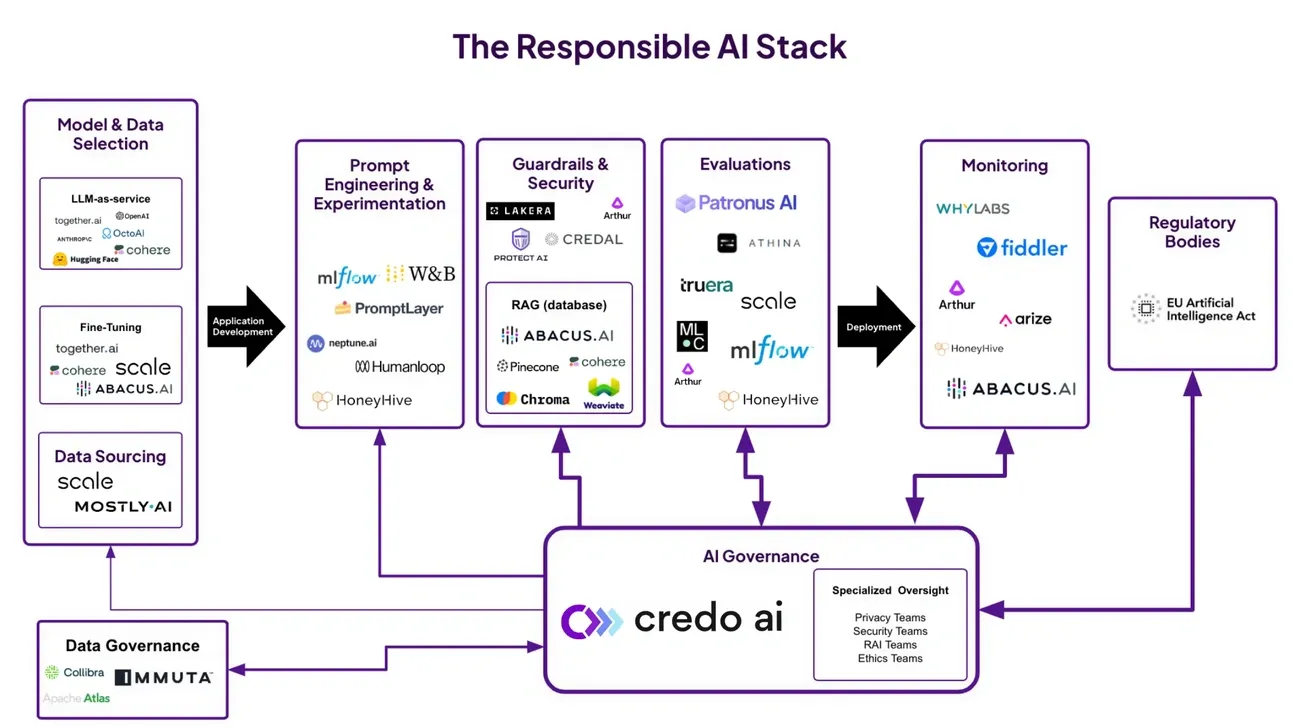
Image Source: Credo AI
Technical controls are the foundations of effective AI governance certification. They turn written policies into enforceable guardrails that protect organizations from AI risks. These technical safeguards embed security principles directly into AI systems and ensure compliance with governance frameworks through automated enforcement rather than manual oversight alone.
Prompt Filtering and Output Validation
Prompt filtering protects against prompt injection attacks that could manipulate AI systems into bypassing safety controls. You can implement these filtering strategies:
- Blocklist filtering checks against predefined restricted terms to prevent sensitive topics, instructions, or malicious patterns from entering AI systems
- Allowlist filtering allows only pre-approved words and phrases to reduce attack surfaces by a lot
- Input preprocessing cleans user prompts before they reach AI models
Output validation works with input filtering to examine AI-generated responses that might violate policies. Many organizations now use a multi-layered approach. A second AI system verifies outputs from the primary system. This method showed better resource efficiency by letting the core team focus on strategic tasks.
Validation frameworks should use “acceptance bands” instead of rigid pass/fail standards as an extra safeguard. This approach acknowledges that AI outputs are inherently unpredictable. These controls need clear threshold definitions and escalation procedures to get certification.
Role-Based Access and Data Loss Prevention
Role-based access control (RBAC) limits AI system access based on user roles. It follows the principle of least privilege to minimize exposure. RBAC helps organizations defend against malicious insiders, negligent employees, and external threat actors. This becomes especially important since insider threats now cause breaches averaging USD 4.92 million—higher than the overall average breach cost of USD 4.44 million.
All the same, standard RBAC doesn’t work well enough to get AI governance certification because AI agents don’t behave like regular software. Organizations need:
- Task-scoped least privilege that adjusts permissions automatically based on the AI’s specific task
- Immediate context evaluation checks every AI action against user identity, stated task alignment, and resource sensitivity
- Instant containment mechanisms let security teams quickly downgrade permissions, revoke tool access, or quarantine problematic AI systems without changing code
Data Loss Prevention (DLP) measures need updates for the generative AI era. Organizations risk exposing sensitive information through accidental exposure or malicious data leakage. Good DLP implementations enforce security controls while providing needed context to content. They connect who, what, how, and where within a unified governance framework.
Audit Logging for AI Interactions
Complete audit logging creates accountability by tracking all AI system interactions. Logs must capture both user interactions and administrative activities to get certification. These logs record which user interacted with AI, the time of interaction, accessed resources, and any detected policy violations.
Audit logs should include these key details:
- References to all accessed resources with their identifiers and file paths
- Sensitivity labels assigned to accessed information
- Actions performed (read, create, modify)
- Policy enforcement details when restrictions applied
A centralized logging system makes it easier to show compliance during certification audits. Organizations can quickly answer vital questions like “Who accessed this model?” or “What data was shared?”. This helps meet requirements for frameworks like GDPR and CCPA.
These technical controls must grow with your AI governance program. Regular testing, updates, and integration with broader enterprise AI governance frameworks help technical safeguards stay effective against new threats. This maintains certification compliance over time.
Training Teams for AI Governance Compliance
Image Source: CFTE
The human element plays a crucial role in successful AI governance. Teams need proper training to understand their duties in upholding ethical AI practices. Written policies become reality through training across organizations seeking certification.
Role-Specific Training for Developers, Users, and Executives
The best AI governance programs make everyone responsible for AI, not just the compliance team. Each organizational role needs customized training:
- General Employee Training: Every staff member needs basic knowledge about AI governance overview, acceptable use policies with real examples, data classification standards, and incident response procedures
- Developer Training: Technical teams require specialized guidance about ethical AI development practices, bias detection methods, and governance guardrails implementation
- Executive Training: Leaders need focused training on risk oversight, strategic AI direction, and governance duties
Today’s directors must grasp data and AI basics to guide company strategy, evaluate risks, and build trust with stakeholders. Leading organizations typically set up an incident response team with specific training to break down and handle AI system failures or ethical issues.
Tracking Training Completion as a Certification KPI
Training completion rates serve as critical metrics for AI governance certification readiness. Organizations pursuing ISO 42001 or similar certifications must show that their staff has the right knowledge level for their roles.
ISACA’s Advanced in AI Audit™ (AAIA™) and Advanced in AI Security Management™ (AAISM™) programs offer structured paths for teams to build specialized expertise. ISACA’s recent AI Pulse Poll shows 85% of digital trust professionals expect they’ll need more artificial intelligence training within two years to keep or advance in their roles.
Beyond tracking completion rates, progressive organizations create transparency reports showing their governance efforts’ effects. These reports showcase their steadfast dedication to responsible AI practices and highlight areas they can improve.
Organizations measure training success through practical tests that check how well people apply knowledge, not just memorize it. Ongoing education remains vital since 73% of organizations lack complete frameworks they need to avoid regulatory fines and control failures.
Preparing for ISO 42001 Certification Audit
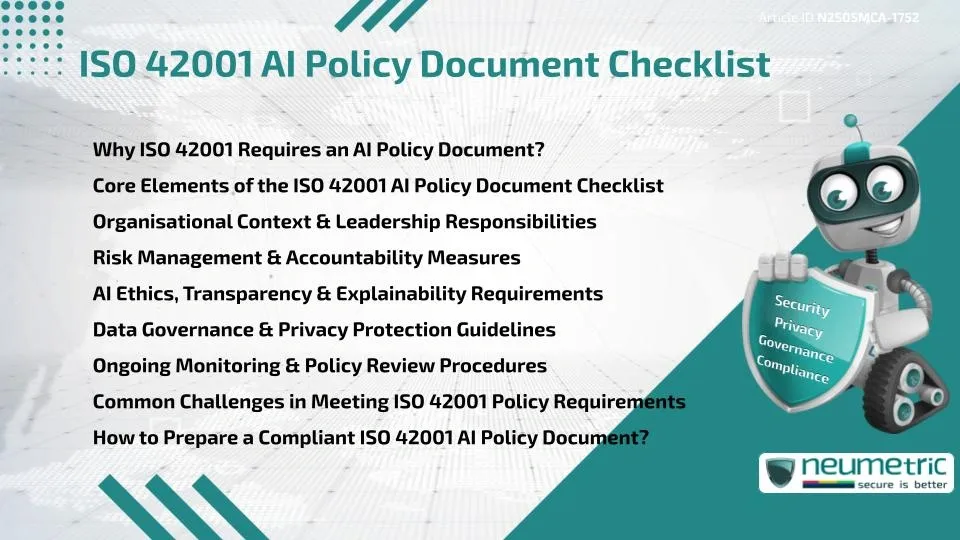
Image Source: Neumetric
Getting ISO 42001 certification needs careful preparation well before auditors show up. A detailed audit readiness plan will show that your organization has the right AI controls and governance systems to meet certification needs.
Gap Analysis and Documentation Readiness
The foundation of ISO 42001 certification success lies in gap analysis. It spots differences between your current AI practices and what the standard requires. This structured review helps you focus on fixing issues and lines up internal processes. The process usually includes:
- Defining certification scope for AI systems and business units
- Mapping existing controls to ISO 42001 requirements
- Getting a full picture of key areas like ethics, security, and transparency
- Creating clear plans to fix any gaps
Your organization should do detailed AI reviews that list all existing tools. This includes system settings, documentation, data sources, and quality controls. The list becomes vital during audits because you must show clear oversight of AI use, even in third-party systems.
Your team must assess if your AI Management System (AIMS) works well and follows ISO 42001 requirements before certification. These reviews prove that governance, risk management, and technical safeguards work as intended. Organizations wanting extra confidence can simulate the formal audit process to test their documentation and controls.
Book a Readiness Call with expert consultants who will give you an unbiased review of your AIMS setup.
Selecting the Best AI Governance Certification Body
You’ll work with your certification body for many years, so choosing one needs careful thought. Right now, only a few bodies can certify ISO 42001. This makes picking an experienced, trusted certification partner vital for a smooth and credible audit process.
While picking certification bodies, look at:
- Their track record with similar standards (ISO 27001, 9001)
- How they approach partnerships and continuous improvement
- Digital tools that help manage risk
- Their specific knowledge of AI governance in your industry
Post-Certification Governance Maintenance
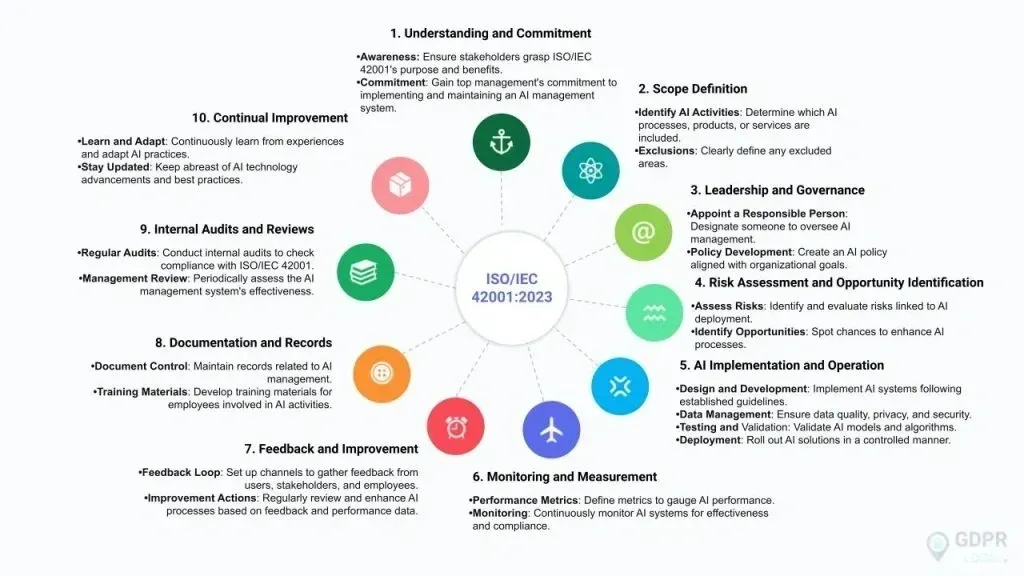
Image Source: Elevate Consult
Getting ISO 42001 certification is just the start of your AI governance trip. Your organization needs to stay compliant through constant alertness and adaptation to keep your AI Management System (AIMS) strong.
Annual Internal Audits and Policy Updates
ISO 42001 requires internal audits at least once a year. These audits should cover most controls and policies your 1-year old certification created. Your audit should give a full picture of how well AI governance works across your company. The audit results should help you improve your AIMS continuously. The digital world changes faster every day, so your audit process should verify that you keep up with new regulations, tech advances, and threats.
Continuous Monitoring and Model Drift Detection
AI systems need constant oversight, unlike traditional software that performs consistently. AI adapts through reinforcement, responds to interactions, and takes in new information. You need to monitor:
- Model drift detection: Spotting when AI models perform worse over time
- Real-time anomaly detection: Using automated tools to find unusual behavior
- Performance baseline tracking: Measuring current metrics against set standards
Modern monitoring works like cybersecurity – it needs to be “always-on” rather than checked occasionally. Finding drift early can save you from expensive system overhauls. Small fixes work better than major repairs when you catch problems early.
Working with AI Governance Professional Certification Standards
Professional credentials verify individual expertise in AI governance among other certifications. Programs like IAPP’s AI Governance Professional (AIGP) certification give teams the tools to review AI systems, pick relevant standards, and follow regulations. These certifications usually cover:
- AI technology basics and development lifecycle
- Risk management frameworks
- Current and future regulatory landscape
Professional development helps maintain expertise in AI governance as technology keeps advancing.
Conclusion
AI governance certification demands strong organizational dedication, technical controls, and proper team arrangement. This certification process helps organizations understand the key differences between traditional IT governance and enterprise AI governance. Traditional approaches target static systems with predictable outcomes, while AI governance deals with dynamic learning systems that change over time.
Notwithstanding that, standards like ISO 42001 and NIST AI RMF offer complementary methods that create a complete AI governance system. Organizations get the best results when they utilize both standards—ISO 42001 gives structured management systems and NIST AI RMF provides risk-based methods.
Organizations should evaluate their current AI governance maturity using the five-level progression model before seeking certification. This evaluation creates a baseline and shows exactly where governance practices need improvement. A minimum viable AI governance program builds a foundation that balances state-of-the-art with proper risk management.
Policies are the foundations of successful AI governance certification. They set clear boundaries for AI usage, data handling, and model development. These policies must work with key frameworks and give practical guidance for implementation.
Technical controls turn written policies into enforceable guardrails that shield organizations from AI risks. Prompt filtering, output validation, role-based access, and full audit logging create accountability in AI systems.
Team training bridges the gap between written policies and actual implementation. Role-specific training helps all stakeholders understand their part in maintaining ethical AI practices. Completion rates give important metrics for certification readiness.
Organizations must keep compliance through ongoing watchfulness after getting certified. Annual internal audits, continuous monitoring, and professional development will give AI governance that works despite rapid technological progress.
The AI governance certification process revolutionizes how organizations handle artificial intelligence—shifting from reactive responses to proactive risk management. This well-laid-out approach satisfies regulatory requirements and builds stakeholder trust through transparent, ethical AI practices. Organizations that adopt complete AI governance will deploy systems faster while substantially reducing compliance risks in this complex regulatory world.
Key Takeaways
Organizations pursuing AI governance certification must navigate a complex landscape where 73% lack comprehensive frameworks, yet those with mature governance deploy AI systems 3.2x faster while reducing compliance risks by 87%.
• Assess your AI governance maturity using a 5-level model to establish baseline capabilities and identify shadow AI risks before pursuing certification • Build minimum viable governance with AI use registers and risk classification to balance innovation with compliance requirements effectively • Implement technical controls including prompt filtering, role-based access, and audit logging to translate policies into enforceable guardrails • Develop role-specific training programs for developers, users, and executives as human expertise bridges written policies and actual implementation • Maintain post-certification compliance through annual audits and continuous monitoring since AI systems evolve dynamically unlike traditional software
The journey toward ISO 42001 certification transforms reactive AI approaches into proactive risk management, building stakeholder trust through transparent, ethical practices while enabling faster deployment in an increasingly regulated environment.
FAQs
Q1. What are the key components of an effective AI governance framework? An effective AI governance framework typically includes four main pillars: transparency, responsibility, oversight, and ethics. These components work together to ensure AI systems are developed and deployed in a responsible and accountable manner.
Q2. Is pursuing AI governance certification beneficial for organizations? Yes, AI governance certification is increasingly valuable. With upcoming regulations like the EU AI Act, certified professionals will be in high demand. Certification demonstrates an organization’s commitment to responsible AI adoption and can provide a competitive advantage in the marketplace.
Q3. What are some of the top AI certifications available? While specific certifications may vary, some popular AI-related certifications include those focused on AI ethics, governance, and risk management. Examples might include ISACA’s Certified in AI Fundamentals or professional certifications from reputable technology companies or academic institutions.
Q4. How can an organization assess its AI readiness? Assessing AI readiness involves evaluating several factors, including data quality, infrastructure capabilities, employee skills, ethical governance frameworks, and change management processes. Organizations often use maturity models or readiness assessments to gage their preparedness for AI implementation and scaling.
Q5. What are the key steps in preparing for an ISO 42001 certification audit? Preparing for an ISO 42001 certification audit involves several key steps: conducting a thorough gap analysis, ensuring comprehensive documentation of AI systems and processes, performing internal audits, addressing any identified shortcomings, and selecting a reputable certification body. It’s also crucial to train staff on AI governance principles and maintain ongoing compliance efforts.