
Companies that don’t assess AI risks properly face huge financial penalties. The EU has collected almost five billion euros in GDPR fines since 2018. AI compliance failures cost businesses 15-25 times more than what they would have spent on original governance investments.
The digital world of artificial intelligence regulation has changed. The EU AI Act now hits violators with fines up to €35 million or 7% of global annual turnover for serious violations. This makes proper risk management crucial for survival. Tech companies should prepare because Gartner expects AI regulatory disputes to rise by 30% by 2028.
Most organizations struggle to create a complete AI risk assessment framework that works for both current and future compliance needs. The numbers tell a concerning story – 95% of organizations faced negative outcomes from their AI projects. Even worse, 77% lost money directly over two years. Risk assessment for generative AI brings its own set of problems as the technology keeps evolving faster with new uses.
This piece compares the costs of taking early action on AI risk assessment versus the potential financial damage from non-compliance. It also shows practical ways your organization can assess AI risks and avoid becoming another warning example.
Understanding the Cost Structure of AI Non-Compliance
AI regulation non-compliance costs go way beyond the reach and influence of basic fines. The real cost breakdown has immediate penalties, hefty legal bills, and long-term fixes. These expenses make proactive AI risk evaluation look like a bargain.
Regulatory penalties under EU AI Act and BIPA
The EU AI Act uses a three-tier penalty system based on how bad the violation is. The worst offenses – those breaking rules about banned AI practices – can cost companies €35,000,000 or 7% of their worldwide yearly revenue, whichever hits harder. Breaking general AI Act rules brings the penalty down to €15,000,000 or 3% of yearly revenue. Even small slip-ups like giving wrong info to authorities can lead to fines of €7,500,000 or 1% of yearly revenue.
BIPA (Illinois Biometric Information Privacy Act) packs quite a punch too. Until just a while back, BIPA violations added up with each biometric scan. Companies had to pay between $1,000 for accidents and $5,000 for intentional violations per scan. This rule created some eye-popping numbers – White Castle faced a possible $17 billion hit just for scanning employee fingerprints repeatedly.
A new change to BIPA now caps it at one violation per person no matter how many scans happen. The financial risk stays pretty big though, especially if you have lots of users.
Litigation and legal defense costs
Companies that fail AI compliance checks face big legal bills on top of those penalties. Attorney fees, court costs, expert witness payments, and settlements often cost more than the original fines.
Legal defense usually needs:
- Lawyers who know AI regulations inside out
- Money for digging up technical documents
- Expert witnesses who can break down AI systems
- Class action defense teams, especially for biometric cases
Companies dealing with rule-breaking in different places end up paying even more as they try to handle various regulations. Just answering regulatory questions can mess up normal business operations.
Remediation expenses for AI system redesign
Most ai risk assessment frameworks miss the huge cleanup costs that come after breaking compliance rules. When regulators catch an AI system breaking rules, companies must:
- Stop using non-compliant AI right away
- Build new systems that follow the rules
- Set up better tracking and documentation
- Get staff up to speed on following rules
These fixes cost serious money through lost work time, tech team distractions, and business disruptions. Tech teams often have to stop working on cool new stuff to fix compliance issues. This hurts their market position and slows down important projects.
Companies also need to build retrieval-augmented generation systems that only use approved, licensed content instead of random internet stuff. This means big system changes, not just quick fixes.
Good AI risk assessment methods help spot these costs early. Companies can then invest smartly in following rules instead of spending money in panic mode. Teams that use structured AI risk assessment questions while building systems usually dodge these snowballing costs by staying on top of things.
Indirect Business Impacts of Ignoring AI Risk Assessment
Poor AI risk assessment leads to more than just regulatory fines and legal expenses. The ripple effects on business often go well beyond initial cost estimates. These secondary effects can put an organization’s survival at risk, whatever its market position.
Revenue loss from paused AI operations
Companies that launch AI projects without proper risk evaluation often need to shut down operations completely. This directly hits their revenue streams. A shocking 95% of enterprise AI pilot programs fail to show any measurable effect on profit and loss statements. This shows how unprepared deployments tend to collapse under pressure.
The challenges show up at every stage. Almost half (48%) of companies that started AI projects ended up having to pause or completely reverse these initiatives. These shutdowns happen because of data privacy issues (48%), weak regulatory frameworks (37%), and customer concerns (35%).
Short-term pauses often turn into complete abandonment. Bad test results tend to raise red flags among executives who aren’t familiar with development processes. Their concerns can shut down entire generative AI programs—not just single applications. This leads to wasted investments and missed revenue opportunities.
Market valuation drops post-incident
Stock markets react quick to signs of AI governance failures. The S&P 500 software and services index fell 4.6% in early 2026. This wiped out about USD 1.00 trillion in market value in just seven trading days. Some companies saw even bigger drops—ServiceNow fell 7.6%, Salesforce lost 4.7%, and Microsoft dropped 5%.
This “software-mageddon” selloff hit companies of all types. Thomson Reuters saw its biggest one-day drop ever after investors worried about Anthropic’s Claude disrupting its legal business. Markets now see AI disruption risk as a threat to the survival of 10-year-old business models.
Financial experts say we might just be seeing the start. Some predict an AI market correction similar to the early 2000s tech crash could wipe out around USD 33.00 trillion of value—more than the entire US economy. Companies without detailed AI risk assessment plans face huge market valuation risks.
Operational inefficiencies from halted deployments
Failed AI projects create inefficiencies that last well beyond the first setbacks. Companies that rush into AI typically skip important governance steps and data preparation. This leads to expensive fixes later. Many AI projects also fail because they’re built on old IT systems without proper integration.
This pattern of starting and stopping creates specific problems:
- Wasted development resources when about 67% of external AI partnerships reach deployment versus only 33% of internal systems
- Missed optimization chances as companies focus on simple uses (like marketing) instead of more valuable operational and back-office functions
- Poor resource allocation as half of generative AI budgets go to sales and marketing while back-office automation offers the highest ROI
Companies that use structured AI risk assessment methodologies see major efficiency gains. A large oil and gas company cut its AI environment setup time from six weeks to less than a day using a centralized validation platform. This approach also made approvals 90% faster because review teams could quickly verify that applications used approved, shared services.
These indirect effects make AI risk assessment more than just a compliance task. It becomes crucial for keeping operations running and maintaining market position.
Modeling Expected Loss: A Risk-Adjusted Investment Framework
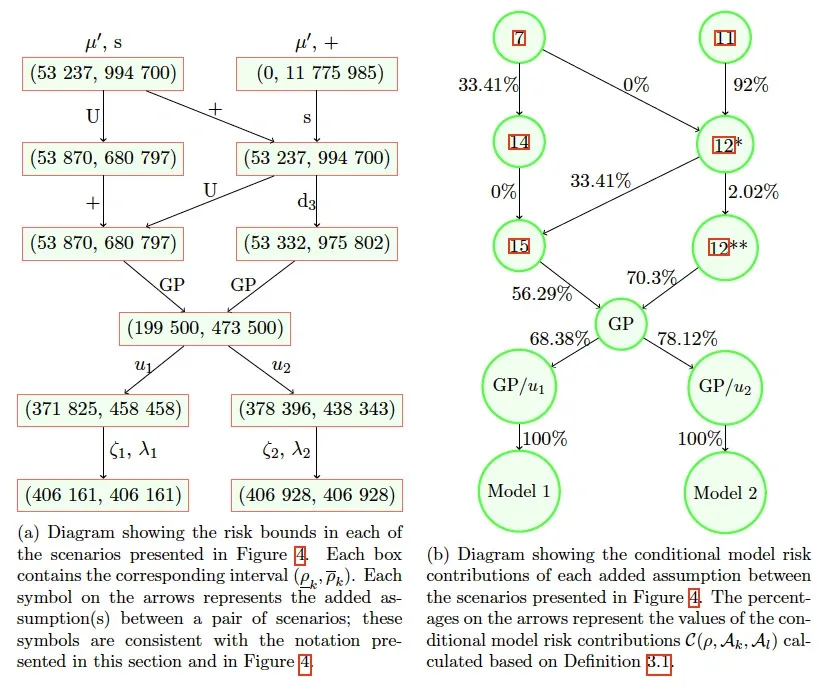
Image Source: Variance Journal
Organizations need a clear framework to measure AI risk and convert abstract threats into financial metrics that decision-makers can use. Decision-makers can compare governance investments against potential failure costs using the expected loss model.
E(Loss) = P(Failure) × Average Cost of Failure
The expected loss formula helps measure potential AI-related losses in a simple way. Risk managers can combine two key variables with this approach: the chance of a compliance incident and how much these failures cost on average. Credit risk analysts created this model first, and now organizations use it to predict average losses in their AI systems.
Let’s look at a real example. An enterprise with a 5% chance of AI compliance failure and an estimated $10 million cost per incident would face an expected yearly loss of $500,000. This number helps companies justify spending on reliable governance systems rather than seeing it as extra cost.
Governance maturity vs. incident probability
Data shows a clear link between how mature governance is and how likely incidents are to happen. Companies with just simple policies face a 25-35% chance of failure. Adding testing to these policies drops this risk to 8-15%. Companies with detailed governance that includes policies, testing, monitoring, and culture see much lower failure rates of just 2-5%.
The Cloud Security Alliance discovered that companies with detailed policies adopt AI early at nearly double the rate (46%) compared to those with partial guidelines (25%) or developing policies (12%). Companies with mature governance also do more security testing – 70% run security experiments compared to 43% of those with partial governance.
Cost comparison: minimal vs. comprehensive governance
Financial analysis shows that investing in AI governance pays off at every level:
- Minimal Investment: Yearly governance costs of $150,000 plus expected losses of $8.75 million (25% × $35 million average failure cost) lead to $9 million in total expected costs
- Moderate Investment: Yearly governance costs of $750,000 plus expected losses of $3.85 million (11% × $35 million) total $4.6 million, saving $4.4 million compared to minimal approach
- Comprehensive Investment: Yearly governance costs of $2 million plus expected losses of $1.23 million (3.5% × $35 million) total $3.23 million, saving $5.78 million compared to minimal investment
This risk-adjusted framework gives companies solid financial reasons to build reliable AI risk assessment methods. Companies now see governance not as red tape but as essential infrastructure that delivers measurable returns by reducing risk.
AI Risk Assessment Frameworks and Methodologies
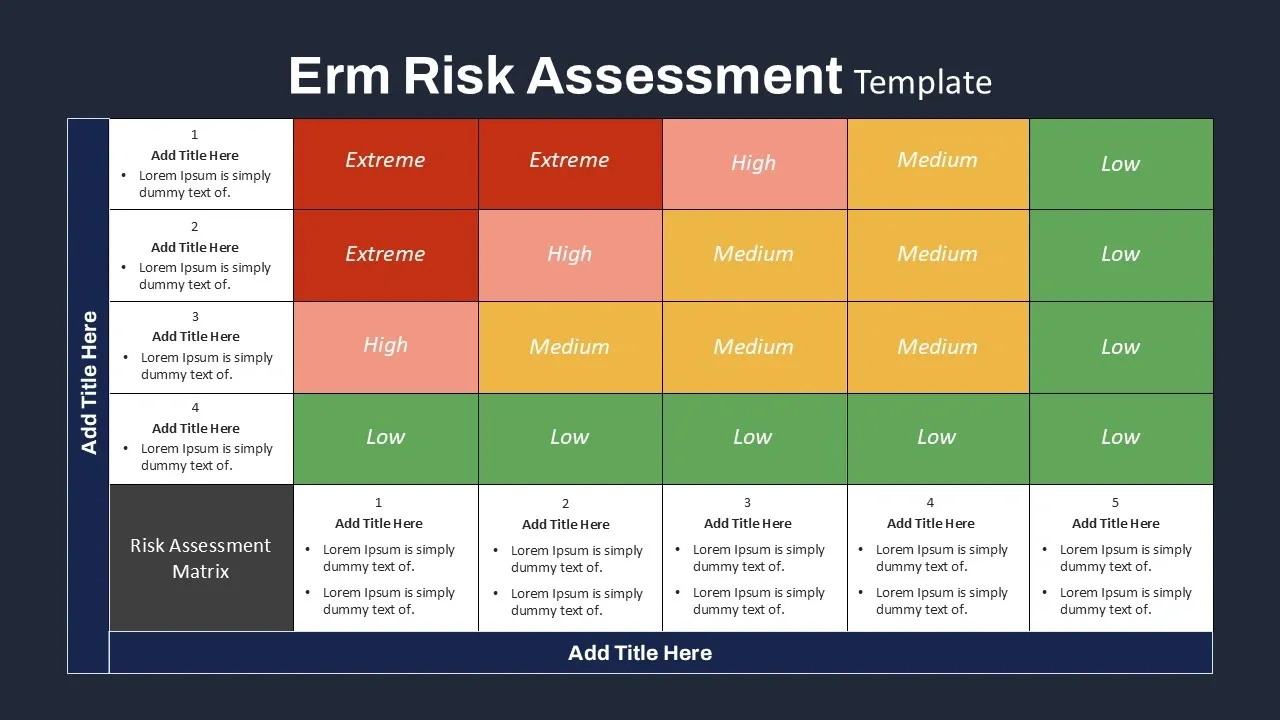
Image Source: SlideKit
AI risk assessment frameworks help organizations spot, analyze, and deal with AI-related risks during development. These frameworks give structure to manage complex risks as AI technologies advance faster.
Overview of ai risk assessment framework for enterprises
Several strong frameworks now guide enterprise ai risk assessment methods. The NIST AI Risk Management Framework (AI RMF) came out in January 2023. It builds on four main functions: Govern, Map, Measure, and Manage. Organizations can use this optional framework to design, develop, and roll out AI systems while tackling risks throughout the AI lifecycle. NIST added more guidance with a Generative AI Profile in July 2024.
ISO/IEC 42001 offers another detailed approach. It lists requirements to implement an AI Management System (AIMS) that adds accountability and transparency to operations. Many organizations choose this standard with the EU Artificial Intelligence Act’s risk-based method. The Act groups AI systems into four risk levels: unacceptable, high, limited, and minimal.
Do you need help picking the right framework for your organization? Book a Readiness Call with our specialists to check your current maturity level.
Generative AI risk assessment: unique challenges
Generative AI brings new risk factors beyond regular AI systems. Companies know about these risks but don’t deal very well with them. While 93% of companies see generative AI risks, only 9% feel ready to handle these threats. The biggest problems with generative AI include:
- Data privacy vulnerabilities (65% of organizations say this tops their concerns)
- Decision-making based on wrong information (60%)
- Employee misuse and ethical issues (55%)
- Copyright and intellectual property risks (34%)
Common ai risk assessment questions to assess
Good assessment starts with the right questions. Key ai risk assessment questions usually cover:
- System inventory: “How many AI/ML models does your company deploy, including third-party models?”
- Impact scope: “How many people or organizations does each model potentially impact?”
- Incident response: “Does your company have response plans to address AI/ML incidents?”
- Monitoring practices: “How are your organization’s models audited for security or privacy vulnerabilities?”
- Bias evaluation: “Have you quantified sociological bias in your company’s AI/ML training data and model predictions?”
These questions help organizations get a full picture of their risk exposure during AI implementation.
Sector-Specific Cost Patterns and Governance Maturity
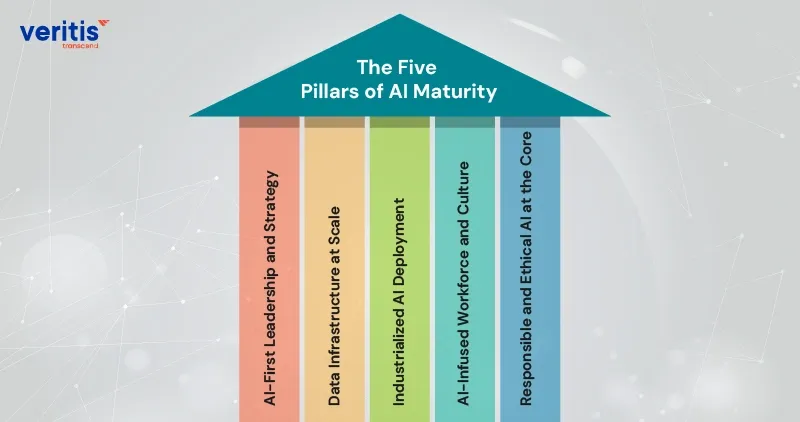
Image Source: Veritis
AI failures can get pricey depending on the industry. Companies with well-developed governance systems tend to handle these failures better than those without proper frameworks.
Financial services: $42M–$65M average failure cost
Banks and financial firms take the biggest hit when AI systems fail. These failures typically cost between $42M to $65M per case. The costs break down into regulatory penalties (40%), legal fees (30%), fixes (20%), and lost revenue (10%). Banks put significant money into AI governance because regulators demand strict compliance for fair lending, Know Your Customer protocols, and anti-money laundering rules.
Healthcare: HIPAA and patient safety risks
Healthcare faces unique challenges because AI failures can harm patients directly. HIPAA violations with AI systems exposed over 275 million records last year, each breach costing about $10.22M. About 71% of healthcare staff use their personal AI tools at work, which creates more compliance risks. Connecting AI with electronic health records costs $7,800-$10,400 per setup. All the same, healthcare AI investments pay off faster than predicted – 81% of organizations report higher revenue.
Retail and tech: brand damage and class-action exposure
Retail companies deal with different risks, mostly from customer-facing AI apps. Failed compliance costs range from $22M to $45M. These costs come from class-action settlements (35%), lost revenue (30%), fixes (20%), and brand damage (15%). A new challenge has emerged – retailers now fight sophisticated AI-generated fake damage claims that threaten their business.
Maturity levels from ad hoc to optimizing
Governance maturity associates with fewer and less severe incidents. Level 1 (Ad Hoc) companies see 2.8 incidents yearly, costing $12-18M while spending under $200,000 on governance. Level 5 (Optimizing) companies face less than 0.05 incidents per year with costs below $200,000, despite investing $3.5-5M in governance systems. Each level up shows positive returns, making it worth investing in better governance rather than just meeting compliance.
Conclusion
Our analysis shows that proactive AI risk assessment isn’t just about checking boxes – it’s a smart business investment with real financial returns. Companies that put solid governance systems in place usually spend 15-25 times less money than those who fix compliance issues after they happen. This holds true in any discipline, but financial services and healthcare companies face the steepest penalties when their governance fails.
New regulations are raising the stakes. The EU AI Act can now impose penalties up to €35 million or 7% of global turnover. The math becomes even more convincing when you look beyond direct penalties. Legal costs, fixing problems, business disruptions, and falling market value can threaten a company’s survival if they’re not prepared.
Companies with mature governance systems see fewer incidents that are also less severe. They’ve turned AI governance from a bureaucratic burden into a strategic asset that reduces risks and gives them an edge over competitors. This approach protects their bottom line and their reputation.
The digital world of AI risk management needs a structured approach to guide you forward. We suggest starting with a detailed look at your current AI governance maturity level. Not sure about your first step? Book a Readiness Call with our specialists. They’ll help assess your situation and create a roadmap that lines up with your goals.
The numbers tell a clear story – good governance costs nowhere near as much as dealing with compliance failures. Companies that see risk assessment as an investment rather than a burden will be better positioned to use AI’s benefits while avoiding its pitfalls. But this takes more than just writing policies. Risk awareness must be part of every stage of AI development, from initial concept through deployment and beyond.
FAQs
Q1. What are the potential financial consequences of non-compliance with AI regulations? Non-compliance can result in severe penalties, including fines of up to €35 million or 7% of global annual turnover under the EU AI Act. Additionally, organizations may face litigation costs, remediation expenses, and significant indirect business impacts such as revenue loss and market valuation drops.
Q2. How does AI governance maturity affect the likelihood of compliance incidents? Organizations with minimal governance face a 25-35% failure probability, while those with comprehensive governance (including policies, testing, monitoring, and culture) experience significantly lower failure rates of just 2-5%. Higher governance maturity directly correlates with reduced incident frequency and severity.
Q3. What unique challenges does generative AI present in terms of risk assessment? Generative AI introduces specific risks related to data privacy vulnerabilities, decision-making based on inaccurate information, employee misuse, ethical considerations, and copyright and intellectual property issues. Despite recognizing these risks, only 9% of companies report readiness to manage them effectively.
Q4. How do AI failure costs vary across different industries? Financial services face the highest average failure costs, ranging from $42M to $65M per incident. Healthcare organizations confront unique challenges related to patient safety and HIPAA compliance, with data breaches costing approximately $10.22M each. Retail businesses experience average compliance failure costs between $22M and $45M, primarily from class-action settlements and revenue loss.
Q5. What is the expected return on investment for comprehensive AI governance? Organizations implementing comprehensive AI governance typically invest around $2 million annually but can expect to save $5.78 million per year compared to minimal investment approaches. This risk-adjusted framework demonstrates that robust governance delivers measurable returns through significant risk reduction.