ISO 42001
ISO 42001 Artificial Intelligence Management System Assessment Services
Purpose of ISO 42001
The primary purpose of ISO 42001 is to help organizations:
Establish a structured AIMS.
Ensure ethical and transparent AI development and deployment.
Mitigate risks associated with AI technology.
Build trust among customers and stakeholders.
Demonstrate commitment to responsible AI practices.
Key Controls Areas
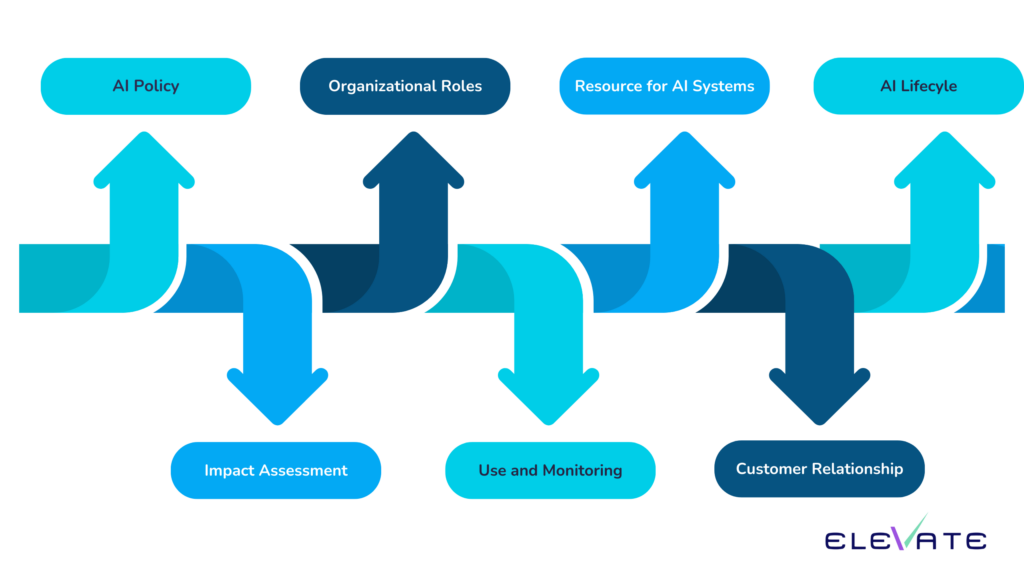
ISO 42001 addresses several critical AI management controls areas:
AI-related policies and procedures
Organizational roles and responsibilities
Resources and data for AI systems
AI system lifecycle management
Impact assessment of AI systems
Use and monitoring of AI systems
Third-party and customer relationships
These areas encompass various aspects such as transparency, accountability, fairness, explainability, data privacy, and reliability of AI systems.
Our Assessment Process
Our expert consultants follow a rigorous process aligned with ISO guidelines to perform annual ISO 42001 assessments:
Initial Review:
- We examine your existing AIMS documentation and processes.
- Initial evidence will be requested if necessary for the assessment.
Control Testing: We test the effectiveness of your AI management controls through various methods, including:
- Document review – We review the evidence requested as part of the controls testing.
- Staff interviews – Interviews are conducted to gain a better understanding of the controls in place.
- Process observations – We conduct walkthroughs to observe and evaluate current processes.
Gap Analysis:
- We identify any discrepancies between your current practices and ISO 42001 requirements.
- Reporting: We provide a comprehensive report detailing:
- Observations of current practices are outlined and described in the report.
- Areas of compliance are noted in the report issued.
- Gaps are identified.
- Recommendations and opportunities of improvement are noted.
- Follow-up: We offer guidance on implementing recommended changes and preparing for certification or recertification audits.
Documentation Support: Our team ensures your documentation meets Federal Reserve requirements, assisting with the creation and organization of essential documents, including self-assessments, policies, and attestation letters.
Ongoing Compliance and Monitoring: FedLine compliance is an ongoing responsibility. We offer continuous support to help your organization stay compliant, adapting to new threats, regulatory updates, and best practices.
Benefits of Our ISO 42001 Assessment Services
Expertise: Our consultants are well-versed in ISO 42001 requirements and best practices.
Risk Mitigation: We help you identify and address potential AI-related risks.
Continuous Improvement: Our recommendations help you enhance your AIMS year after year.
Certification Readiness: Our assessments prepare you for successful certification or recertification audits.

Why Choose Us?
Proven track record of helping organizations achieve and maintain ISO certifications.
Tailored approach to meet your specific industry and organizational needs.
Ongoing support and guidance throughout the AIMS improvement process.
Contact us today to learn how our ISO 42001 assessment services can help your organization enhance its AI management system and demonstrate its commitment to responsible AI practices.
FAQ
What is ISO 42001?
ISO/IEC 42001 is the international management-system standard for Artificial Intelligence Management Systems (AIMS). It specifies requirements to establish, implement, maintain, and continually improve how an organization governs AI across its lifecycle.
What is an Artificial Intelligence Management System (AIMS)?
An AIMS is your organization-wide framework (policies, roles, processes, controls, and records) for governing AI risks, safety, quality, and ethics throughout the AI lifecycle: planning, design, development, deployment, and monitoring. ISO 42001 defines the requirements for this system.
Who is getting certified in ISO 42001?
Organizations that build or use AI (cloud providers, SaaS, fintech/healthcare AI, enterprise ML teams) are pursuing certification to prove trustworthy AI governance to customers and regulators. Major platforms describe ISO 42001 and related offerings publicly (e.g., AWS, Microsoft).
How is ISO 42001 similar to other ISO frameworks?
ISO 42001 follows the same high-level “Annex SL” structure as ISO 27001/9001: context, leadership, planning, support, operation, performance evaluation, and improvement; enabling integrated programs.
What is the overlap between ISO 42001 and ISO 27001?
Both are risk-based management systems that require governance, documented controls, internal audit, and continual improvement. ISO 27001 focuses on information security; ISO 42001 focuses on AI governance, but they interface tightly (e.g., data security, supplier controls, monitoring).
How do you become ISO 42001 certified?
Typical path: define scope → gap & risk assessment → implement AIMS controls/docs → internal audit & management review → accredited certification audit (Stage 1: design/docs; Stage 2: effectiveness) → ongoing surveillance audits (years 2–3)
How to scope the AIMS for an ISO 42001 audit?
Use Clause 4 “Context” to set boundaries: AI systems in scope, locations, processes, people, and suppliers; identify stakeholders and regulatory drivers; define interfaces with existing programs (e.g., ISMS). Document the scope statement and justification.
What are the key documents and policies needed to comply with ISO 42001?
Expect an AI policy, risk and impact assessment procedures, roles & competence, data/ML lifecycle controls (data governance, model development/evaluation/red-team logs, deployment & change control), incident/ethics escalation, supplier management, and continuous monitoring metrics mapped to Annex A controls.
Does ISO 42001 ensure compliance with the EU AI Act or other AI regulation?
No. ISO 42001 helps operationalize governance and overlaps with parts of the EU AI Act/NIST AI RMF, but it is voluntary and does not equal legal compliance. Use it to systematize processes, then gap-map to specific laws.
How to perform/conduct an AI Impact Assessment for ISO 42001?
Define scope & stakeholders → identify potential impacts (privacy, safety, fairness, security, societal) → rate likelihood/severity → plan mitigations and guardrails → record decisions & monitoring criteria. Align your method with ISO 42001 Annex A impact controls and related guidance.
How to perform/conduct an AI Risk Assessment?
Adopt an AI-specific, lifecycle-based process: identify hazards and harms, assess risks, choose controls, verify effectiveness, and iterate. ISO/IEC 23894 provides detailed guidance that complements ISO 42001 and NIST AI RMF.
How to conduct an AIMS Internal Audit to ensure compliance with ISO 42001?
Plan risk-based audits at defined intervals; evaluate conformance to ISO 42001 clauses and Annex A controls; test records (policies, model/eval logs, incidents, supplier due diligence); report nonconformities; verify corrective actions; feed results into management review. Clause 9.2 requires internal audits; certification cycles add annual surveillance.